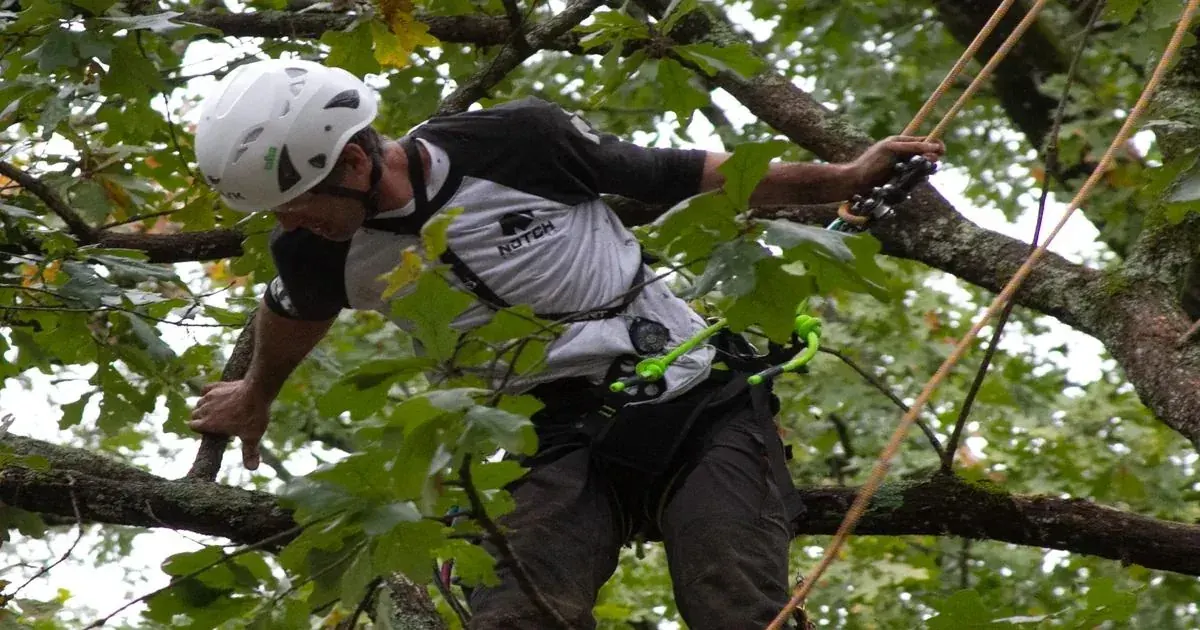
Tree service in Fremont, CA
Tree removal, trimming and stump grinding across Fremont, starting with whether your tree needs a City permit before it is quoted. Most Fremont removals cost between roughly $600 and $2,500. Estimates are free, written, and specific to your tree.
Fremont regulates private trees under Municipal Code Chapter 18.215 and trees in the right of way under Chapter 12.30. A crew that does not know the difference can cost you a mitigation order. Check the ordinance first, every job.
Meet Our Featured Contractor
Our featured contractor is a family-owned tree care company with ISA Certified Arborists on the team, an active California contractor's licence for tree service, and liability and workers' compensation insurance on file with the Contractors State License Board. It is 5-star rated on Google.
It is also on the City of Fremont's list of Approved Tree Contractors. The City requires all street tree work, including work under the 50/50 Street Tree Program, to be done by an approved contractor.
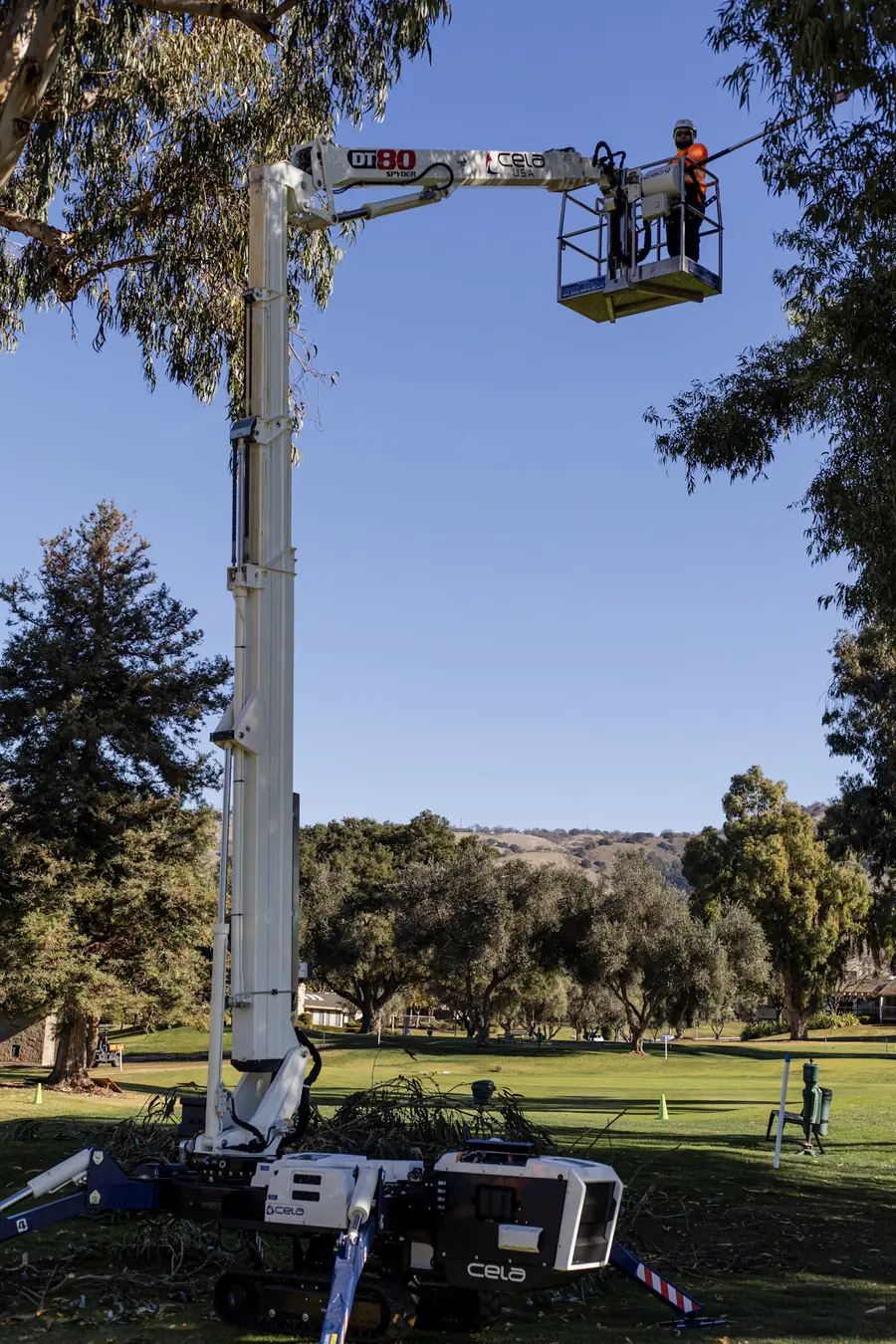
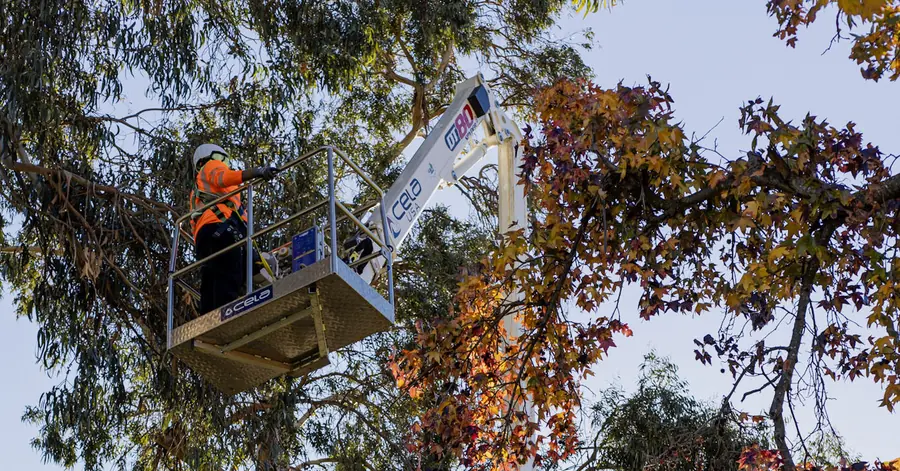
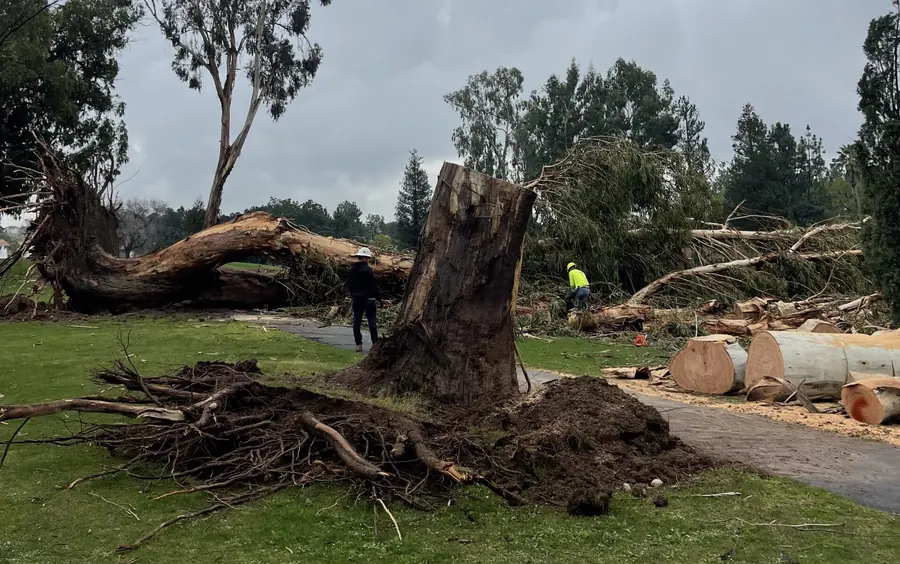
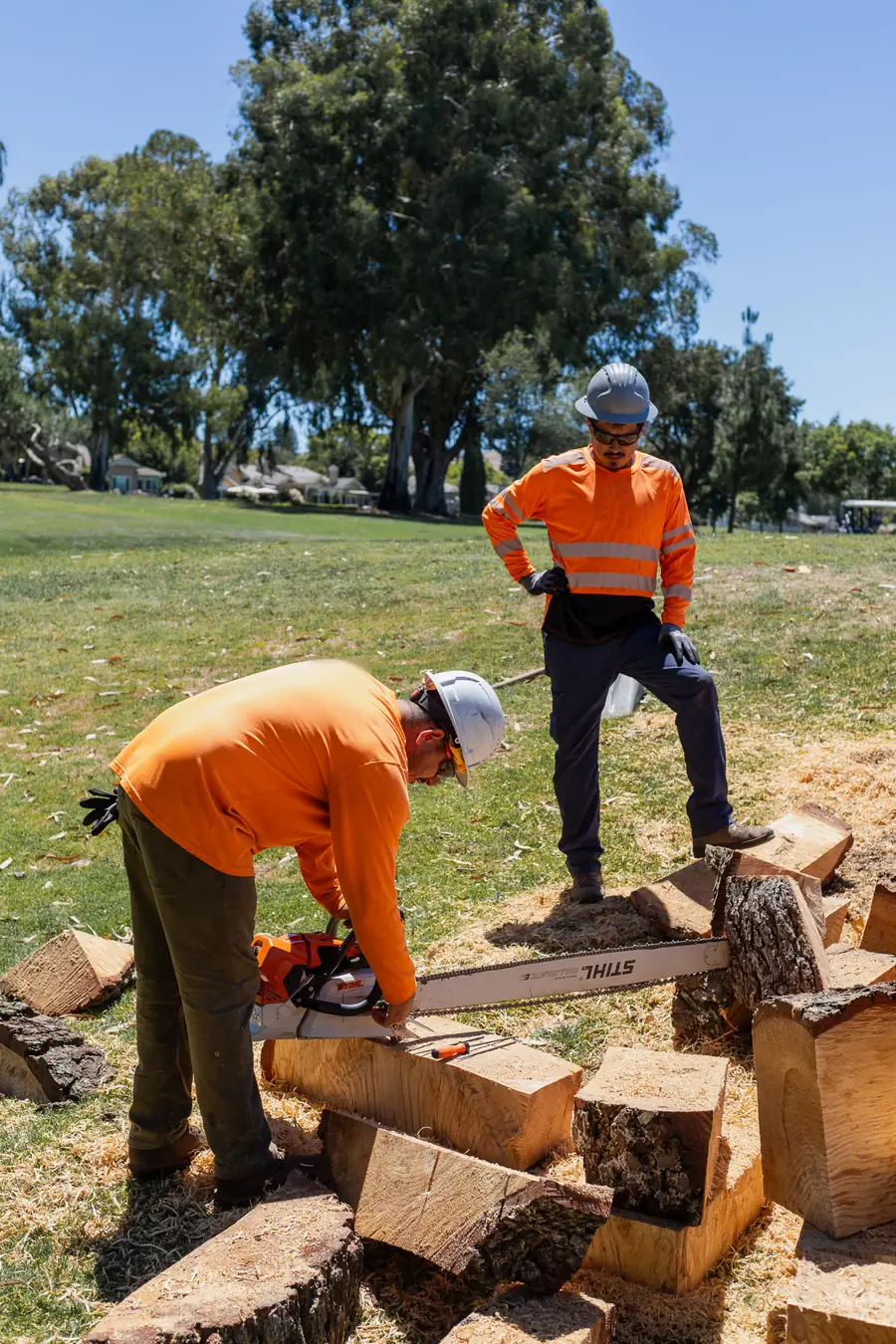
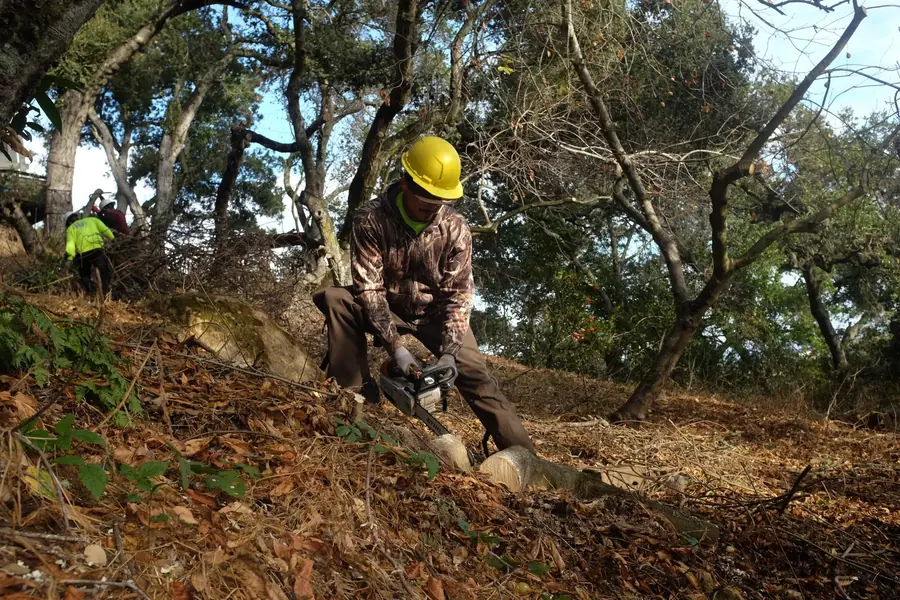
★★★★★“We had [our contractor] and his experienced crew trim our huge tree. … The work was done in a safe and timely manner. When they finished, they completely cleaned the area of all leaves and branches that had fallen on the ground. We were impressed by the professionalism and courteous service.”
★★★★★“[Our contractor] was great to work with. He was very responsive and took the time to make sure the report was clear, accurate, and addressed all of my questions. I appreciated his professionalism and flexibility in making a few revisions so that everything was properly documented. The final report was thorough and easy to understand.”
★★★★★“We had [our contractor] prune our large oak tree … and they did an outstanding job. We highly recommend them!”
★★★★★“I’ve seen several projects done by [our contractor] around the neighborhood and the results always look great. Their team appears professional and efficient, and they leave the areas very clean after tree trimming or tree removal.”
Tree services in Fremont
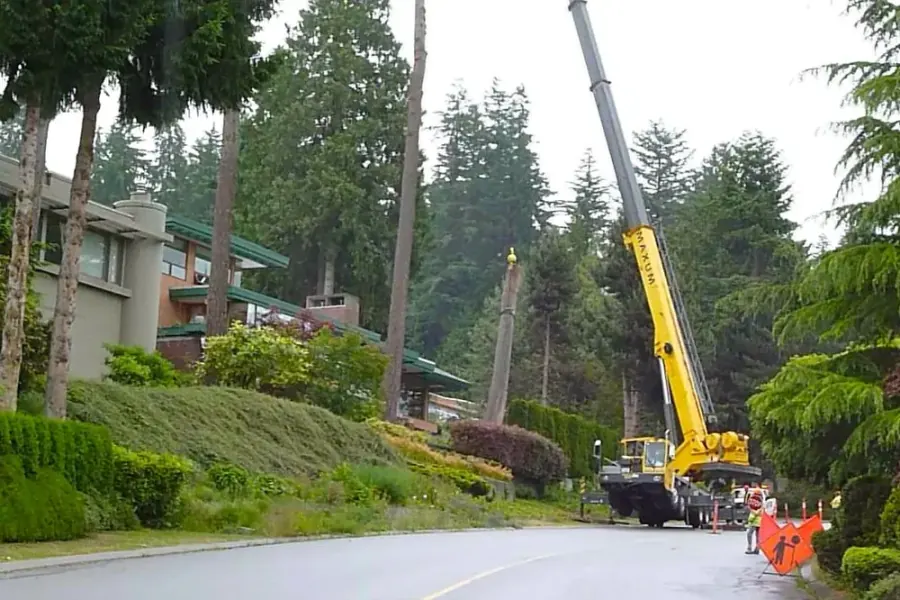
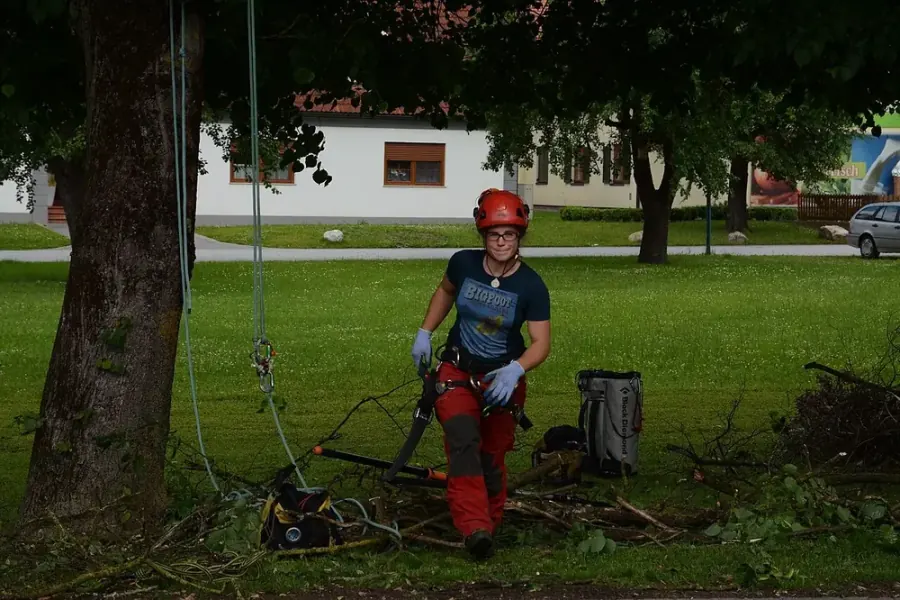
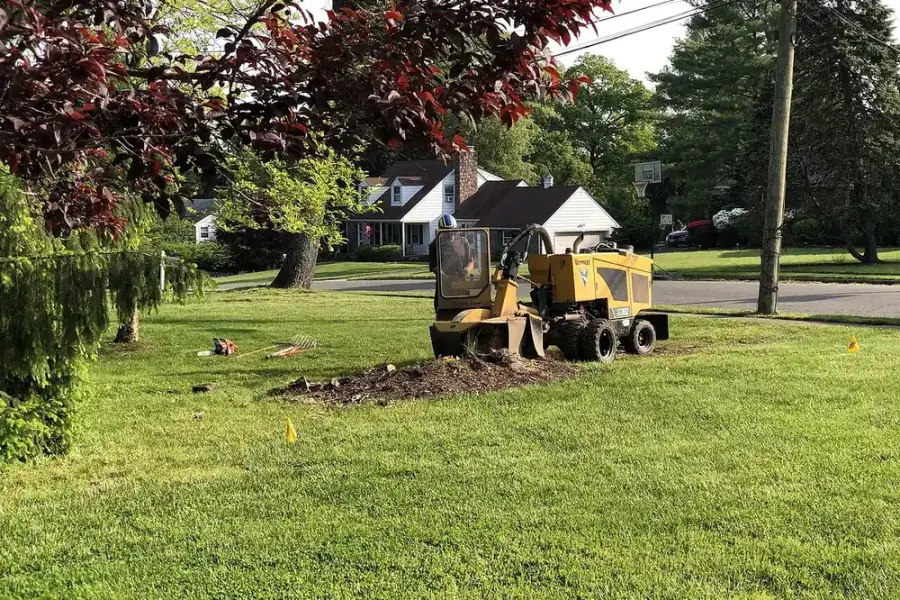
Nine services, each with its own page explaining how the job actually runs in Fremont, what moves the price, and what the City requires. Pick the one that matches your tree.
See more services
Whether you need a Fremont tree permit comes down to a tape measure
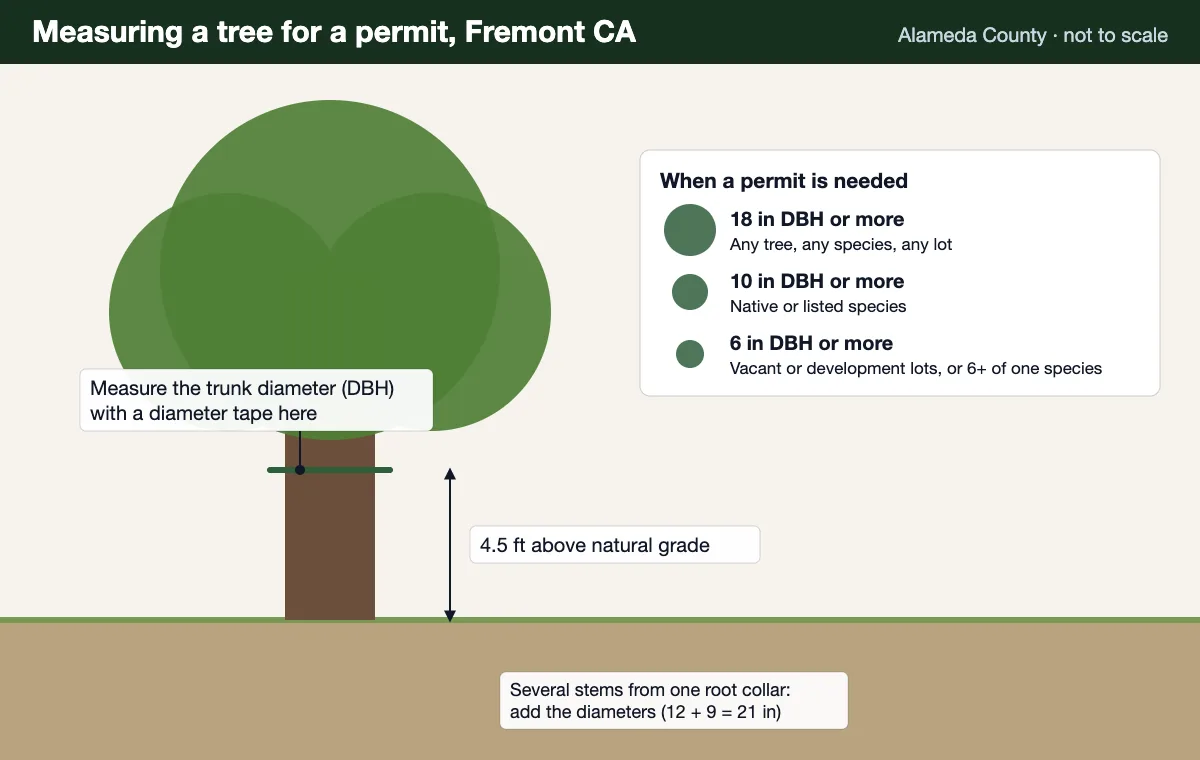
In Fremont, a private tree needs a removal permit once it hits 18 inches in diameter at breast height for any species, or 10 inches DBH if it is a native tree or a tree of exceptional adaptability. Those two numbers decide most Fremont jobs. Diameter at breast height is defined in FMC 18.215.030 as trunk diameter measured four and a half feet above the tree's natural grade, and for a multi-trunked tree it is the DBH of all trunks added together. That last clause catches a lot of people out, because a three-stemmed tree with 7 inch trunks is a 21 inch tree in the eyes of the ordinance.
The full list in FMC 18.215.050(a) has seven triggers. A permit is required for a tree of 6 inches DBH or more on a vacant or underdeveloped lot, a tree of 6 inches or more on a developed lot that is the subject of a contemplated or pending development project application, a native tree or tree of exceptional adaptability at 10 inches or more, any tree at 18 inches or more, a tree the City required to be planted or retained as mitigation, a tree planted or retained as a condition of a development approval, and one of six or more trees of the same species on the same lot that each measure 6 inches or more.
“Native tree” means any of the following trees native to the San Francisco Bay area: oak, redwood, buckeye, madrone, sycamore, big-leaf maple, red-bud, and bay.
Trees of exceptional adaptability to the Fremont area are listed as Fremont cottonwood, California pepper, European olive, black walnut and Deodar cedar, with a fuller list held by the City's engineering division.
The exemption most Fremont homeowners qualify for is FMC 18.215.050(c)(1): a tree on a developed lot of not more than 10,000 square feet, zoned R-1 or single-family detached planned district, where the tree sits behind the forward-most face of the front of the principal building. In plain terms, a backyard tree on a standard Fremont R-1 lot is usually exempt. Move that same tree to the front yard and it is not. The exemption never applies to a landmark tree or to a tree planted or retained under a City requirement.
Two other exemptions matter in practice. Fruit and nut trees of species grown for commercial food production are exempt, but black walnut and olive are carved out and stay protected. And emergency removal is exempt under 18.215.050(c)(4), but only where a City official has determined that immediate removal is necessary to protect people from imminent injury or property from imminent and substantial damage. A storm-damaged tree is not automatically exempt just because a storm damaged it.
One detail almost nobody mentions: FMC 18.215.040(a) requires the issued permit to be posted on the lot, prominently visible from the street, the entire time anyone is removing or damaging the tree. If your contractor cannot produce the permit to post, the job should not start. The process is covered end to end on the Fremont tree removal permit page and the definitions in detail on the protected trees page.
If the trunk is in the right of way, it is not your tree
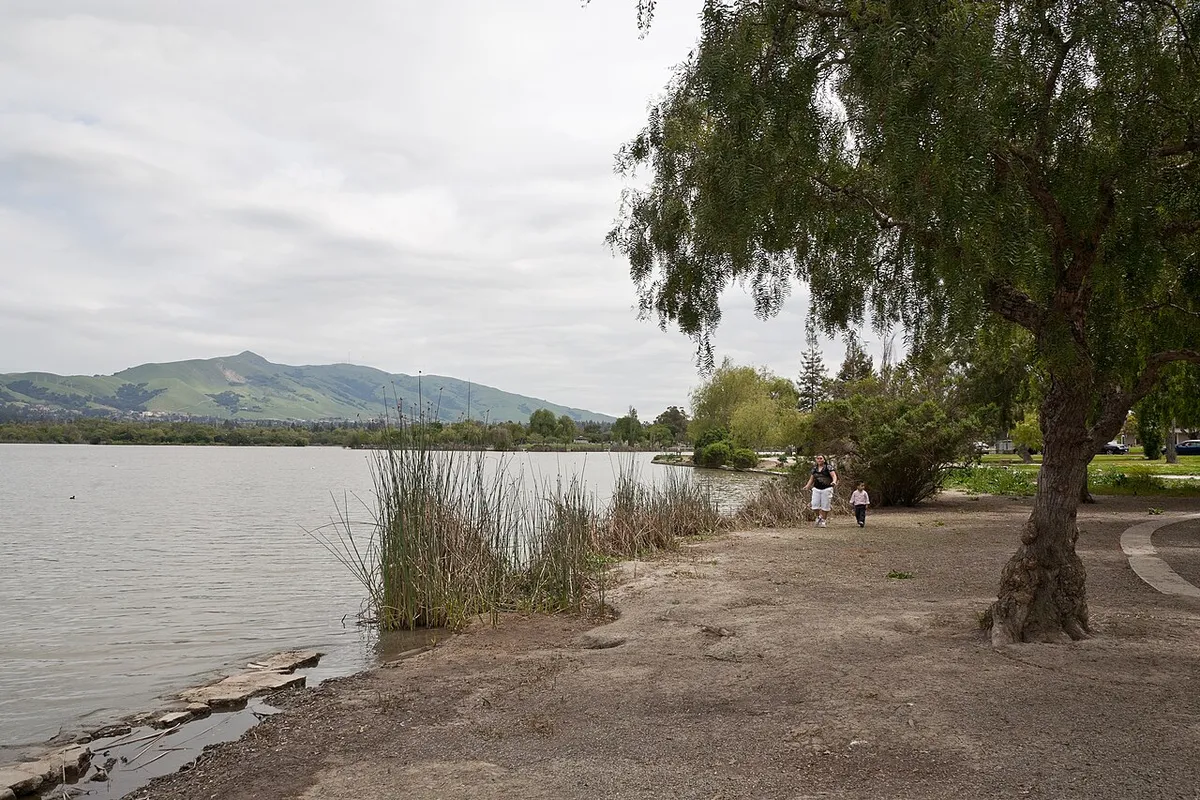
A tree whose base sits wholly or partly inside the public right of way is a street tree, and the City of Fremont controls what happens to it regardless of who mows around it. FMC 12.30.010 defines a public street as the full width of the right of way, and explicitly includes any park strip, sidewalk and dedicated planting easement between the adjacent property and the street line. That is why the tree in your park strip, the one you have watered for fifteen years, is legally the City's.
The practical consequences are sharper than most homeowners expect. Under FMC 12.30.050 a street tree may only be pruned by a certified arborist, or by someone working under a certified arborist's supervision, and only after a street tree permit has been issued. The two narrow exceptions are incidental pruning of a tree under 15 feet tall after planting, and clearing low-hanging branches under two inches in diameter to maintain required clearance over the right of way. Everything else needs the permit.
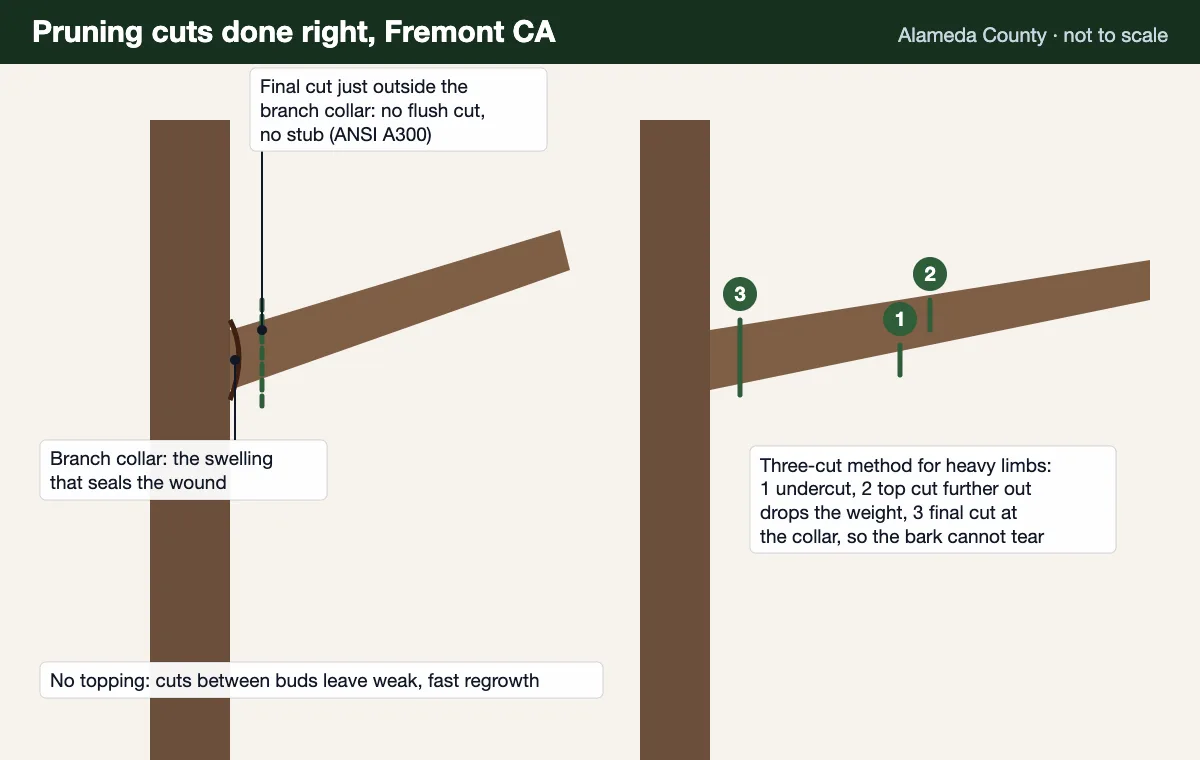
Topping is prohibited outright. FMC 12.30.060(b) bans topping of street trees unless the city manager specifically authorises it in writing on clear evidence of extraordinary circumstances, and the pruning that is allowed must follow the current ISA Tree Pruning Guidelines. Any crew that offers to top your street tree for a good price is offering to commit a municipal code violation on your behalf.
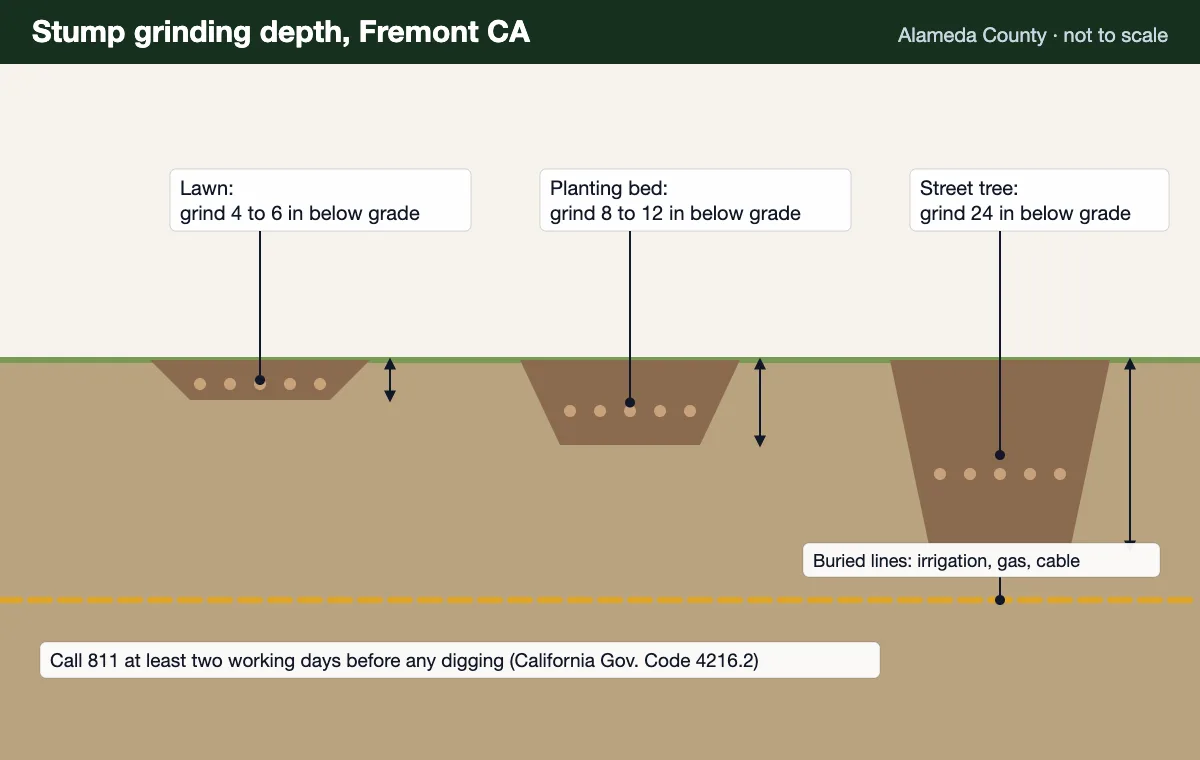
Removal is tighter still. FMC 12.30.070 allows removal only under a street tree permit, an approved development plan, or an emergency authorisation from the city manager, and FMC 12.30.080 lists the seven grounds on which a nonemergency permit may be issued: substantial hazard that cannot be feasibly restored, a dead or dying tree, serious disease, overcrowding where removal helps more desirable neighbours, extensive utility damage, extensive concrete damage after deep watering and root trimming has been tried, and damage beyond feasible restoration. After removal, the stump must be ground to 24 inches below grade or taken out entirely, right of way damage has to be repaired, and an encroachment permit under Chapter 12.05 is required before those repairs. The adjoining property owner is then obliged to replace the tree.
FMC 12.30.090 lets urban forestry staff authorise immediate pruning or removal when there is an imminent threat of substantial injury or property damage, with no prior written application. The catch is subsection (e): within two business days of finishing, the adjoining property owner must give the maintenance department a written description of the work and the exact location. Miss that and work that exceeded the imminent threat can be treated as damage to a street tree.
Getting this wrong is expensive in a way most people do not expect. California Code of Civil Procedure section 733 makes anyone who cuts or injures a tree on another person's land, or on the street in front of any person's house, without lawful authority liable for treble the amount of damages, and Civil Code section 3346 sets the same treble measure for wrongful injury to trees. See California neighbour tree law.
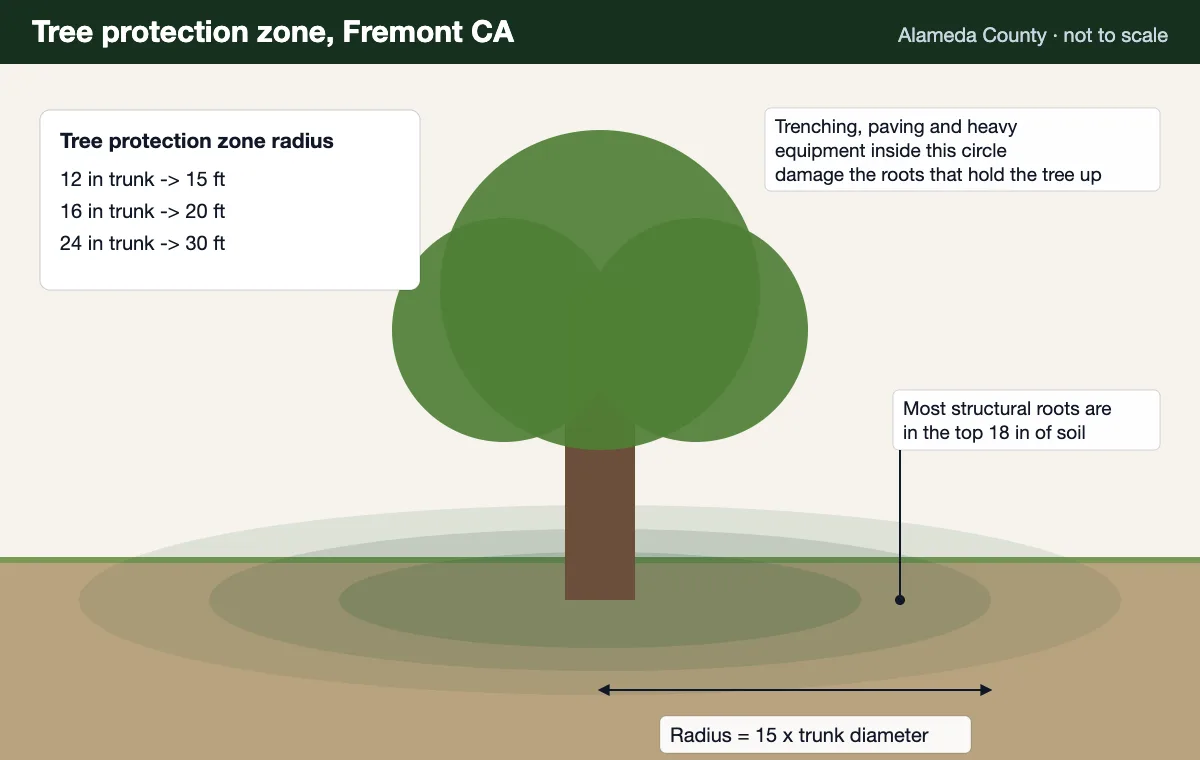
Full detail, including how the ordinance handles paving within four feet of a trunk and the rule against attaching anything to a street tree, is on the Fremont street trees page.
Four rainless months, then 82 percent of the year's rain in five
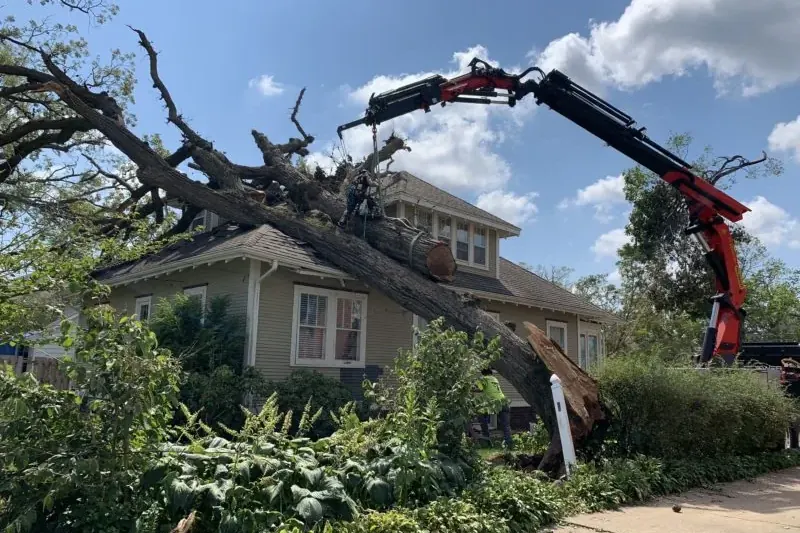
Fremont trees mostly do not fail in the summer heat. They fail in February, because the soil that held them up for eight dry months turns to soup in five wet ones. The nearest long-record NOAA station, Hayward Air Terminal, shows a 1991 to 2020 normal of about 16.00 inches of precipitation a year. June through September together contribute 0.33 inches. November through March deliver 13.08 inches, roughly 82 percent of the annual total.
That pattern is what an arborist reads when looking at a Fremont root plate. Through the dry season the soil shrinks and cracks and fine roots die back. Then the winter rain saturates a shallow, compacted urban soil profile, the friction holding the root plate drops, and the first real wind event of the season pushes over trees that looked perfectly sound in August. Windthrow here is a soil failure far more often than a wood failure.
It also explains the seasonal shape of the work. Search demand for tree work across California peaks in May and June, when homeowners look at their canopy and decide to act, with a second spike through the December to February storm window when they have no choice. If you are choosing when to have a hazardous tree dealt with, the cheap, unhurried time to do it is the dry season. The expensive time is at two in the morning with a limb through the roof.
| November through March | 13.08 in | 82% of the year |
|---|---|---|
| June through September | 0.33 in | Effectively zero |
| Annual total | 16.00 in | Mediterranean pattern |
| Average daily high | 68.5 F | Mild year round |
| Average daily low | 50.8 F | Frost is rare |
What tree service costs in Fremont
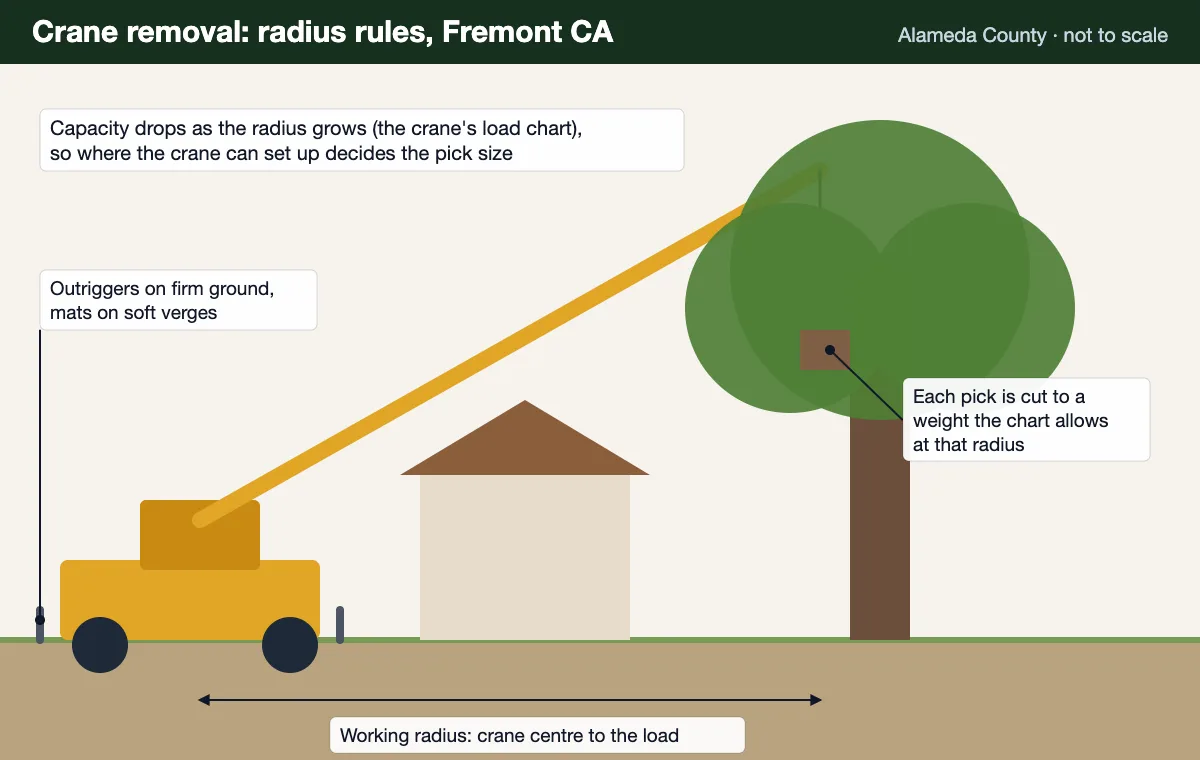
Most Fremont residential removals land between roughly $600 and $2,500, with large or technical removals running well past that, and Bay Area pricing runs above every published national figure. Trunk diameter and height, species, how close the tree sits to a structure or power line, and whether a crane or a climber has to do the work are what move a given tree within that range.
The published baselines, cited so you can check them. For removal, LawnStarter puts the national average at $630 across a $385 to $1,070 range, and Fixr puts it at $435 across a $400 to $1,100 range. By species, Fixr records oak at $900 to $2,000 and eucalyptus at $700 to $2,200, both common in Fremont. For trimming, Fixr gives a $450 average across $175 to $750, and LawnStarter gives $430 to $640 per tree.
No publisher produces a Fremont specific table. LawnStarter's own California city figure puts San Diego trimming at $478 to $710 against a national $430 to $640, roughly eleven percent above national, and Bay Area labour and insurance run above San Diego. So this site treats national ranges as a floor and never prints a national average as if it were a Fremont number.
Detailed breakdowns with the drivers named: tree removal cost, tree trimming cost and stump grinding cost.
How a Fremont tree job actually runs, in six steps
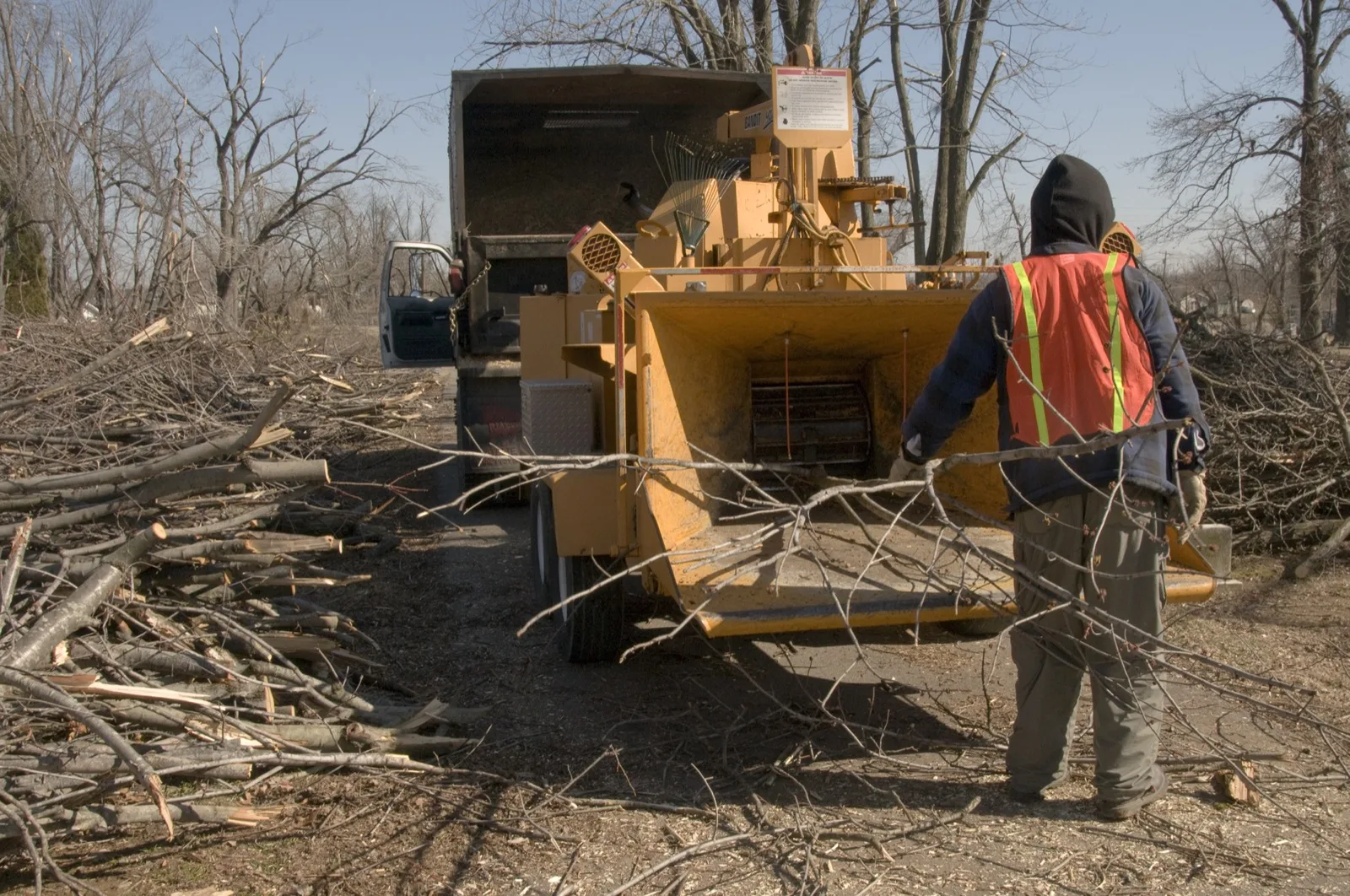
Every job follows the same six steps, and the ordinance check happens before the price, not after. That order matters. A quote given without knowing whether the tree is protected is a quote that can change, and a changed quote is the most common complaint homeowners have about this trade.
- 1
Send the address and what the tree is doing
Send the property address and a short description through the estimate form. A photo from two angles helps more than anything else you can write. Include roughly how tall the tree is, how close it sits to a structure or a power line, and whether anything has already failed.
- 2
The tree is checked against Fremont's ordinance before the quote
Before a number goes on paper, the diameter at breast height is measured, the species identified, and the lot checked against Fremont Municipal Code 18.215.050. That tells you whether your tree is exempt or whether a permit from the city landscape architect has to come first. It also shows whether the tree is a street tree under FMC 12.30, which is a different process entirely.
- 3
You get a written estimate with the scope spelled out
The estimate names the tree, the work, what happens to the debris, and whether stump grinding is included or priced separately. Verbal numbers are how disputes start, so insist on writing. If the job needs a permit, the estimate says so and says who is applying.
- 4
Site setup and drop zone control
On the day, the crew tarps or boards what needs protecting, sets the drop zone, and confirms rigging points. On a tight Fremont lot with a fence line eight feet from the trunk, this is most of the job. Nothing comes down until the landing area is clear and controlled.
- 5
Rigging, sectioning, and removal
Most Fremont removals are not felled in one piece. A climber or a lift takes the tree down in sections, each one roped to a friction device so it lands where it is supposed to. Large limbs over a roof get lowered, never dropped.
- 6
Stump, cleanup, and sign off
Brush is chipped, rounds are hauled or stacked as agreed, and the stump is ground to the depth quoted. The work area should be raked and blown before the crew leaves, with a final walk of the site with you. If the job was a street tree, the stump is ground to 24 inches below grade because FMC 12.30.070 requires it.
The trees that matter most in Fremont
Species drives almost everything: whether a permit applies, how the tree has to be rigged, what the debris weighs, and what is likely to be wrong with it. These six make up most of the tree work at Fremont addresses.
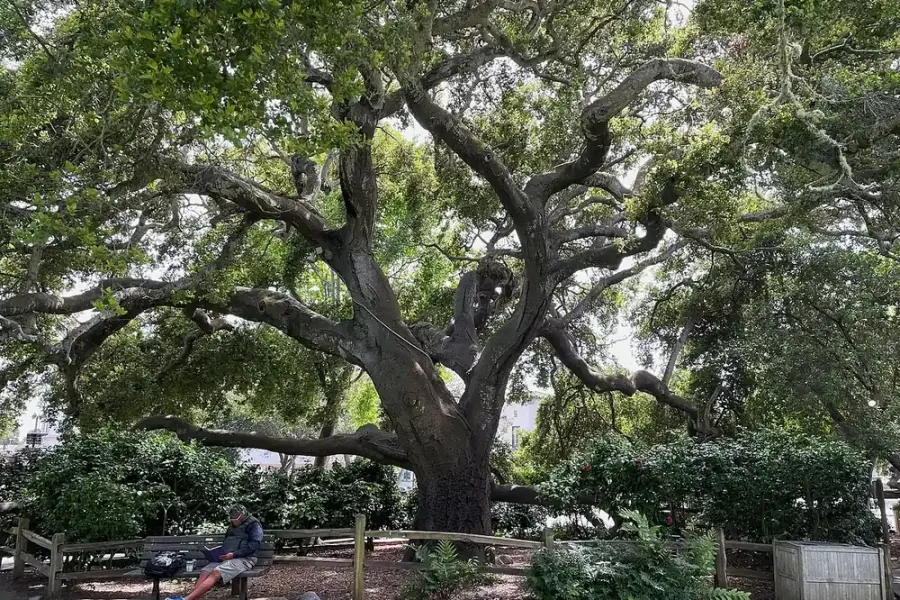
Fremont's signature native. Protected at 10 inches DBH under FMC 18.215.050(a)(3). Prune in dormancy, watch for bleeding cankers, and keep summer irrigation away from the root crown.
Fast, tall, and notorious for shedding large limbs without warning in still weather. Heavy, brittle wood makes these technical rigging jobs rather than simple fells.
Gets far taller than owners expect and holds a heavy skirt of dead fronds. Removal is a climbing or lift job with no branch structure to rig from.
Planted widely mid century and now reaching the end of its service life across the flatlands. Bark beetle pressure after dry summers turns whole crowns red fast.
The reservoir host for Phytophthora ramorum. It sporulates heavily and infects nearby oaks without dying itself, so its proximity is the key risk factor for an oak.
Fremont's workhorse street tree. Sycamore is on the native list, so a private one is protected at 10 inches DBH, and one in the right of way is a street tree under FMC 12.30.
Sudden Oak Death is in Alameda County and it changes what can be done
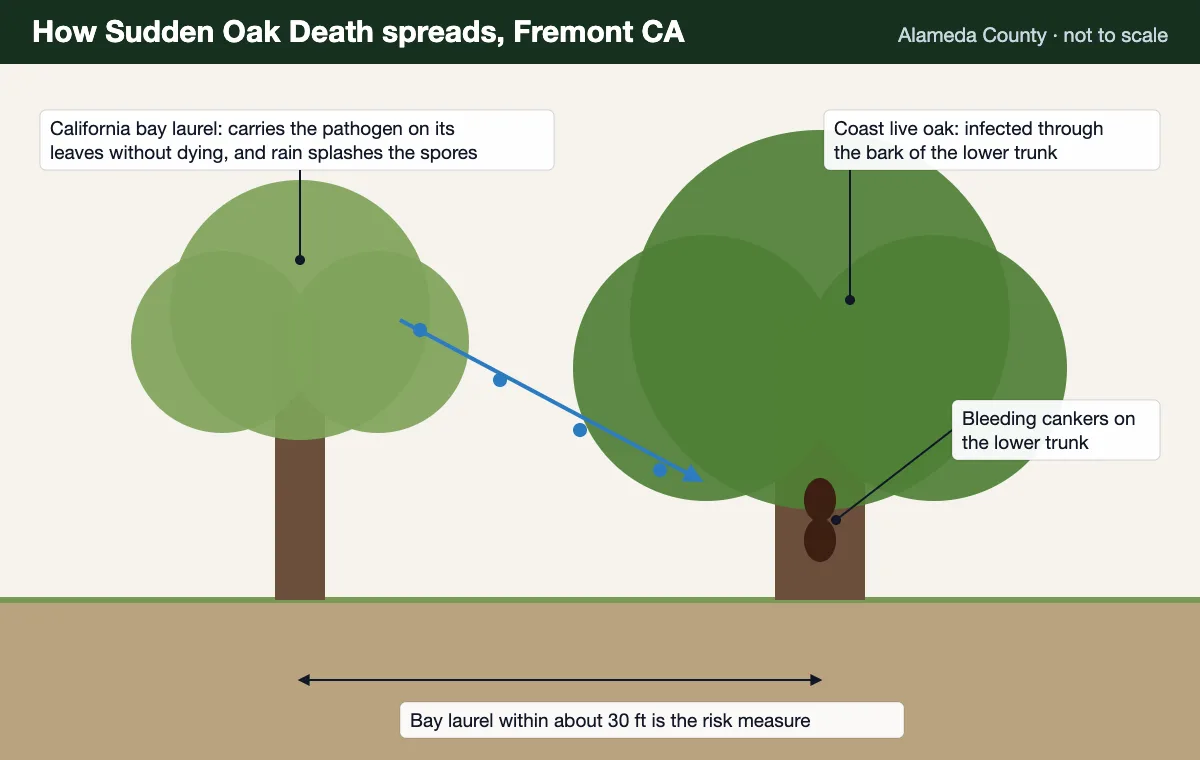
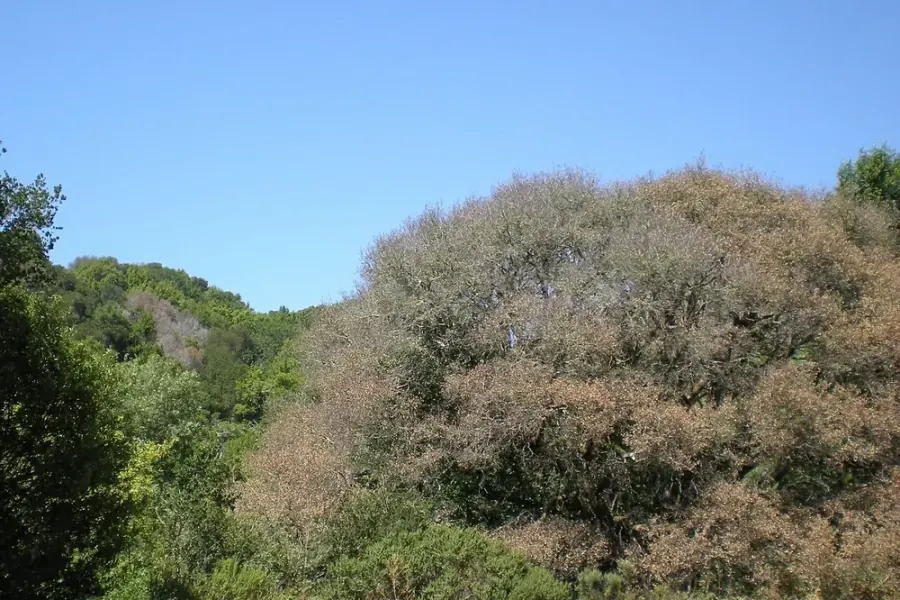
Sudden Oak Death is caused by Phytophthora ramorum, an oomycete or funguslike organism, and it is confirmed in Alameda County. There is no cure once a tree is infected. Calling it a fungus is the giveaway that whoever wrote the page has not looked closely. It is a water mould, which is why it spreads in wet conditions and travels in infected leaves, wood and soil rather than simply blowing around as spores on a dry day.
The Alameda County Department of Agriculture records known infested sites at Redwood Regional Park, on East Bay Municipal Utility District property, and on one hillside in Castro Valley. Statewide the pathogen is confirmed in natural settings across fifteen central and northern coastal counties and has killed hundreds of thousands of trees. The hosts it kills are coast live oak, black oak, tanoak and Shreve oak, which is to say most of the oaks a Fremont homeowner is likely to have.
The mechanism worth understanding is the reservoir host. California bay laurel gets infected, sporulates heavily on its leaves, and passes the pathogen to nearby oaks without dying itself. A bay laurel growing within throwing distance of your oak is the single strongest risk factor you can actually see from the ground. Where a high value oak has bay laurel nearby, selective bay removal is a genuine preventive measure.
On treatment, beware of overselling. Phosphonate is a preventive applied to uninfected high value trees to reduce the chance of infection. It is not a rescue for a tree already showing bleeding cankers, and anyone telling you otherwise is selling. Symptoms start with dark seeping cankers on the trunk, not with leaf drop, and the sudden brown crown that gives the disease its name usually appears years after infection began.
It also constrains debris. Because spread happens through movement of infected material, plant material and soil should not be moved out of the coastal zone, which affects where a removed oak's wood can legally and responsibly go. The full picture, including what to look for and when phosphonate timing makes sense, is on the Sudden Oak Death page.
Fremont adopted a new Fire Hazard Severity Zone map in July 2025
Fremont Municipal Code Chapter 15.65, adopted by Ordinance 10-2025 on 15 July 2025, adopts the map titled City of Fremont, Local Responsibility Area, Fire Hazard Severity Zones, dated 26 June 2025. It replaces the designation made by Ordinance 33-2007 back in December 2007. If you last checked whether your parcel was in a fire hazard zone more than a year ago, you checked against a map that no longer governs.
The mapped band follows Fremont's eastern hills, running from Mission Peak south toward the Sunol border and taking in the Niles Canyon corridor. That puts a meaningful slice of Mission San Jose and Niles inside or adjacent to it. Because the designation is parcel specific, the only reliable answer for your address is the City's address lookup viewer, not a neighbour's guess.
Being inside a mapped zone brings defensible space obligations into play. California Public Resources Code section 4291 is the statutory source of the 100 foot defensible space standard in State Responsibility Areas, and FMC 15.65.020 cross references the state scheme. The specific clearance requirements were revised in the 2025 state rulemaking cycle, so rather than quote distances that may already be stale, this site points you at the current CAL FIRE and Office of the State Fire Marshal guidance. The work should follow whatever the current standard is.
In practice, defensible space work on a Fremont hillside lot means ladder fuel removal, limbing up, thinning crown-to-crown continuity, and clearing dead material, and it often overlaps with the protected tree rules, because the oaks on those lots are exactly the ones FMC 18.215 protects at 10 inches. Doing it properly means doing both at once. See the Fire Hazard Severity Zone guide and the defensible space clearing page.
What to check before you let anyone put a saw in your tree
Ask for a CSLB licence number in a tree classification (C-49, or C-61/D-49 on many active licences) and a current certificate of insurance that includes workers compensation, and verify both before work starts. C-49 is Tree and Palm Contractor, defined in California Code of Regulations Title 16 section 832.49 and approved by the Office of Administrative Law on March 30, 2022, and it is the classification California uses for tree work. The Contractors State License Board lets you check any number online for free in under a minute.
A C-27 landscaping contractor is a different scope. Plenty of good C-27 firms do competent ornamental pruning, but a landscaping licence does not make someone qualified to section a 40 foot eucalyptus over a neighbour's roof. When the job is structural removal, the licence you want to see is C-49. Applying pesticides for hire is a separate licence again, issued through the California Department of Pesticide Regulation, which a C-49 does not by itself authorise.
Work within ten feet of energised conductors is line clearance work and is restricted to qualified line clearance tree trimmers. It is not a job for a general tree service, and it is not a job for you. If your tree is touching or close to primary lines, the correct first call is the utility, not a contractor. Any tree service willing to take that work on without the qualification is telling you something about how they handle risk generally.
Two more checks are worth the two minutes. Ask whether the person pruning is an ISA certified arborist, because FMC 18.215.030 defines an arborist as someone with at least three years of arboricultural practice who is certified by and in good standing with the International Society of Arboriculture, and because FMC 12.30.050 requires exactly that for street tree pruning. And ask for the estimate in writing with the debris and stump treatment named. Almost every dispute in this trade traces back to one of those two gaps. The hiring guide walks through the whole check.
Prices and local guides
Bay Area tree work prices above national averages, and national calculators consistently quote Fremont low. These pages give real local ranges with the drivers named, plus the regulatory background rival sites leave out.
Areas covered
This site covers all of Fremont plus Newark and Union City, and each district shapes the job before anyone arrives. Fremont was incorporated in 1956 out of five towns, and residents still navigate by those names rather than by zip code.
Mission San Jose is the oldest district, sitting at the base of Mission Peak, with the most mature oak canopy in the city and the largest overlap with the mapped fire hazard band. Hillside lots there produce the technical jobs: steep access, no crane position, everything rigged down by rope. Niles sits at the canyon mouth and gets funnelled wind that the flatlands do not, on top of historic district considerations. Warm Springs is the newer, BART-adjacent growth side with a younger planted canopy and dense street tree plantings, which means many Warm Springs jobs turn out to be street tree questions rather than private tree work. Centerville and Irvington are established mid-century residential, where the mid-century street trees and yard trees are now reaching the end of their service life all at once.
Newark and Union City are covered too, and the surrounding Alameda County addresses in Sunol, Milpitas, Hayward and Pleasanton are worth asking about. The service area page lists every district and neighbouring city with its own page.
Fremont tree service questions, answered
Can I cut down a tree on my own property in California?
Not always, and in Fremont the answer depends on the tree and the lot. California has no statewide ban on removing your own tree, but cities regulate it, and Fremont's tree preservation ordinance (FMC Chapter 18.215) prohibits removing or damaging a protected private tree without a permit from the city landscape architect. Section 18.215.040 also requires that the issued permit be posted on the lot, prominently visible from the street, while the work is happening.
Who is responsible for trees on property lines in California?
A tree whose trunk straddles a boundary line is jointly owned by both neighbours under California Civil Code section 834, and neither owner may remove or seriously damage it without the other's agreement. You may trim branches and roots that cross onto your side, but only back to the property line, and you are liable if that trimming kills or destabilises the tree. That liability is why boundary trees are worth getting an arborist opinion on before anyone starts cutting.
Who pays for tree removal between neighbours in California?
Whoever owns the tree pays, and ownership is decided by where the trunk sits, not where the branches fall. If a neighbour's tree drops a limb on your property in a storm, cleanup on your side is generally yours to handle unless you can show the owner knew the tree was hazardous and did nothing. Documented written notice of a visible defect is what changes that answer, which is why a written arborist assessment is worth having before a storm rather than after.
Does homeowners insurance cover tree removal?
Usually only when the tree has already damaged a covered structure. Most California homeowner policies pay to remove a tree that has fallen on the house, garage or a fence, often with a per tree cap, and will not pay to remove a standing tree just because it looks dangerous. Preventive removal is almost always an out of pocket expense, which is the single most common surprise Fremont homeowners hit.
How do I know if a tree is dangerous?
The signals that matter most are mushrooms or conks at the base, a fresh lean with cracked or heaved soil on the uphill side, bleeding cankers on the trunk, a hollow that sounds drummy when struck, and dead wood in the upper canopy. In Fremont the highest risk window is December through March, when the ground is saturated after months of dry weather and the root plate loses its grip. A tree that stood through ten dry summers can go over in one wet February storm.
What is the best time of year to trim trees in California?
Late summer through early winter is the safest window for most Fremont trees, and for oaks specifically the dormant window from roughly November through February is strongly preferred. Pruning oaks in spring while they are actively growing opens wounds when beetles and pathogens are most active. Structural pruning on young trees can be done almost any time, but major cuts on a mature coast live oak should wait for dormancy.
How much does it cost to grind a stump?
Stump grinding in the Fremont area generally runs from about $100 to $150 for a small stump up to $400 or more for a large, wide-flared stump, and it is normally priced separately from the removal. Diameter measured across the widest point of the flare is the main driver, then access, then grinding depth. A street tree stump must be ground to 24 inches below grade under FMC 12.30.070, which is deeper than a typical yard grind.
Who is the cheapest tree service?
The cheapest bid is usually the uninsured one, and in tree work that is a risk you personally carry. If an uninsured crew member is hurt on your property, or an unrigged limb goes through your neighbour's roof, the exposure lands on your homeowner policy. Ask every bidder for their CSLB number and a certificate of insurance before you compare prices, then compare only the bids that clear that bar.
Can seniors get free tree cutting service in Fremont?
There is no City of Fremont program that removes healthy private trees for free for seniors. The City maintains street trees in the public right of way, and some nonprofit and utility programs cover specific situations such as line clearance or defensible space in high fire risk areas. For a private hazard tree, expect to pay, and ask about staging the work over two visits if cost is the obstacle.
Get a free estimate on your tree
Send the address and what the tree is doing. A good estimate checks whether the tree needs a permit and puts a number on it in writing.
- Free written estimate, no obligation
- Check whether your tree is protected before work starts
- Ask any crew for its CSLB license and certificate of insurance
- Mark storm damage as urgent in your request