Tree removal in Fremont, CA
First question: is your tree protected?
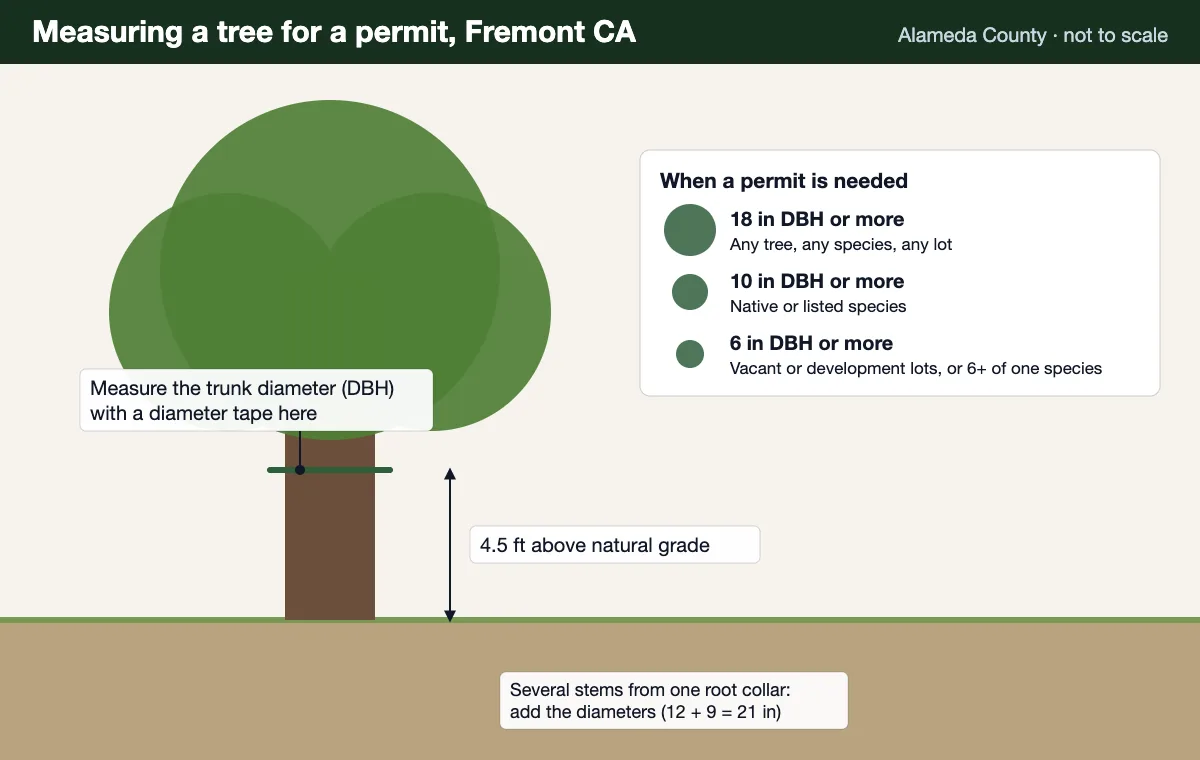
A private Fremont tree needs a removal permit once it reaches 18 inches DBH for any species, or 10 inches DBH if it is a native tree or a tree of exceptional adaptability. DBH means trunk diameter measured four and a half feet above natural grade, and for a multi-trunk tree Fremont adds every trunk together. Three 7 inch stems is a 21 inch tree under FMC 18.215.030, which is over the line.
FMC 18.215.050(a) lists seven triggers in total. Beyond the two size thresholds, a permit is required for any tree of 6 inches DBH or more on a vacant or underdeveloped lot, any tree of 6 inches or more on a developed lot with a contemplated or pending development project application, any tree the City required to be planted or retained as mitigation, any tree planted or retained as a condition of a development approval, and any tree that is one of six or more of the same species on the same lot each at 6 inches or more.
Oak, redwood, buckeye, madrone, sycamore, big-leaf maple, red-bud and bay. These are protected from 10 inches DBH. The separate exceptional-adaptability list names Fremont cottonwood, California pepper, European olive, black walnut and Deodar cedar.
The exemption that covers most Fremont back gardens is FMC 18.215.050(c)(1): a tree on a developed lot of 10,000 square feet or less, zoned R-1 or single-family detached planned district, sitting behind the forward-most face of the front of the house. A front-yard tree on the same lot is not exempt. Neither is a landmark tree, nor any tree the City required you to keep.
Where a permit applies, FMC 18.215.040(a) requires the permit to be posted on the lot and prominently visible from the street the whole time the work is happening. Full detail on the process is on the permit page, and the definitions are unpacked on the protected trees page.
What tree removal actually costs in Fremont
Budget roughly $600 to $1,200 for a small to mid-size Fremont tree, $1,200 to $2,500 for a large tree with clear access, and above $2,500 once a crane, a permit, or a tight rigging situation enters the picture. Bay Area labour, insurance and green-waste disposal all sit above national averages, so national cost calculators routinely quote Fremont low by a third or more.
The drivers that actually move a number, roughly in order of impact: trunk diameter and total height, because they set the tonnage; proximity to a structure or a power line, because that is the difference between felling a tree and lowering it in fifty pieces; species, because eucalyptus and oak are dense and heavy where a fruit tree is not; access, because a backyard reachable only through a three foot side gate means every round is carried by hand; debris handling, because haul-away costs more than leaving rounds stacked; and stump grinding, which is priced separately.
Two Fremont-specific add-ons are worth planning for. If the tree is protected, the permit process adds time and the City may impose replacement planting as mitigation under FMC 18.215.080, which is a real cost to budget. And if the work is emergency or after hours, expect a premium, which is one more argument for dealing with a known hazard tree in the dry season. Full breakdown on the tree removal cost page.
Why most Fremont removals are rigged, not felled
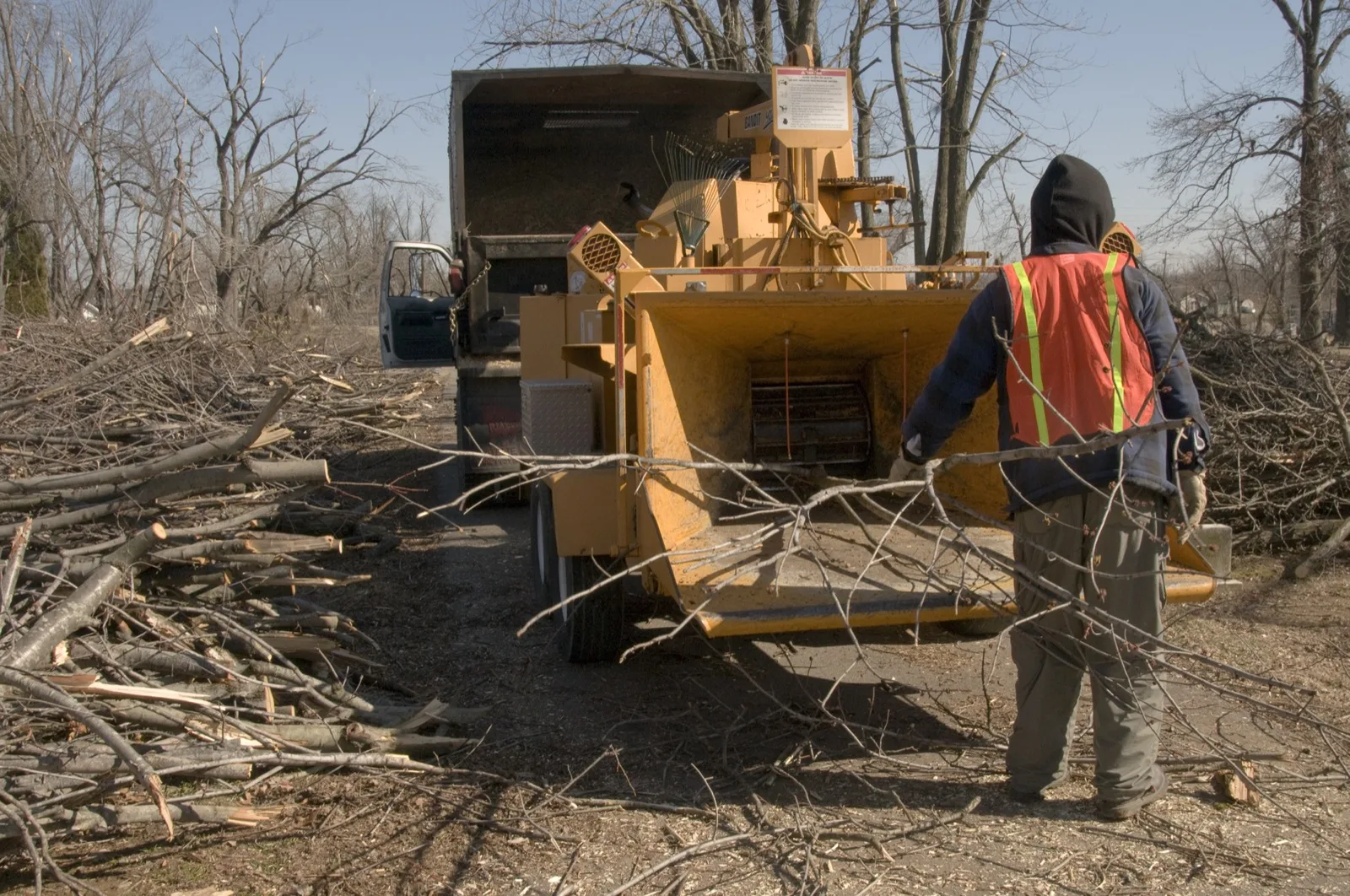
Very few Fremont properties have room to drop a tree in one piece, so most removals are sectional: a climber or a lift takes the tree apart from the top down, with every significant piece rigged to a rope. A straight fell needs a clear landing zone at least as long as the tree is tall, plus escape routes. On a typical quarter-acre lot with a fence eight feet from the trunk and a neighbour's conservatory behind it, that landing zone does not exist.
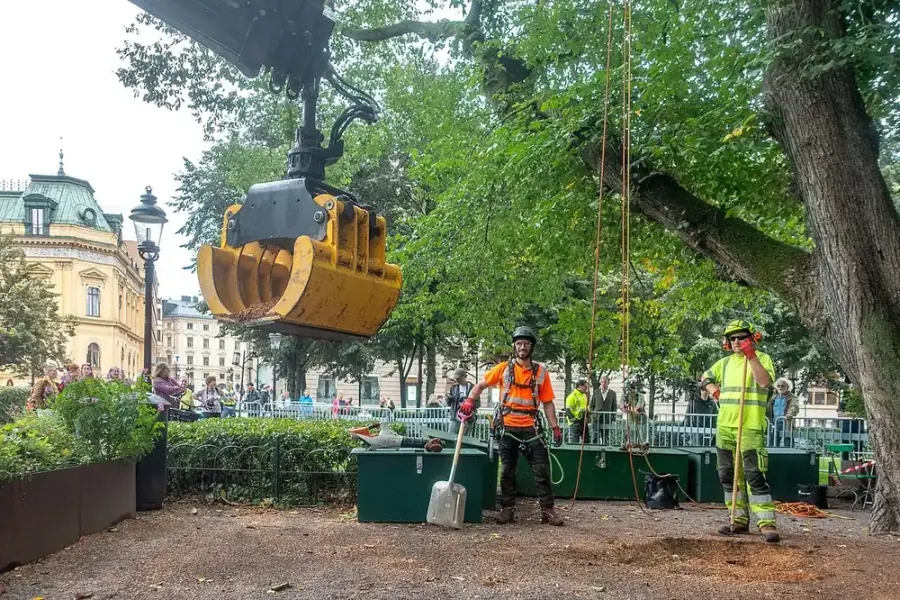
Sectional removal means the climber sets a rigging point above the piece being cut, the ground crew runs the line through a friction device at the base, the piece is cut and then lowered under control rather than dropped. It is slower and it is why removal over a roof costs what it does. It is also the only way to take a large limb off a tree that overhangs a structure without risking the structure.
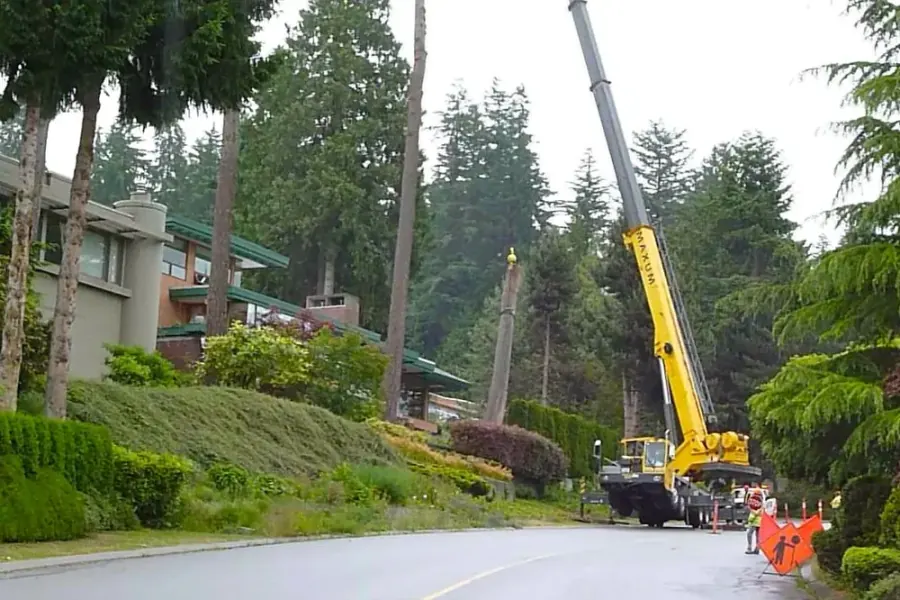
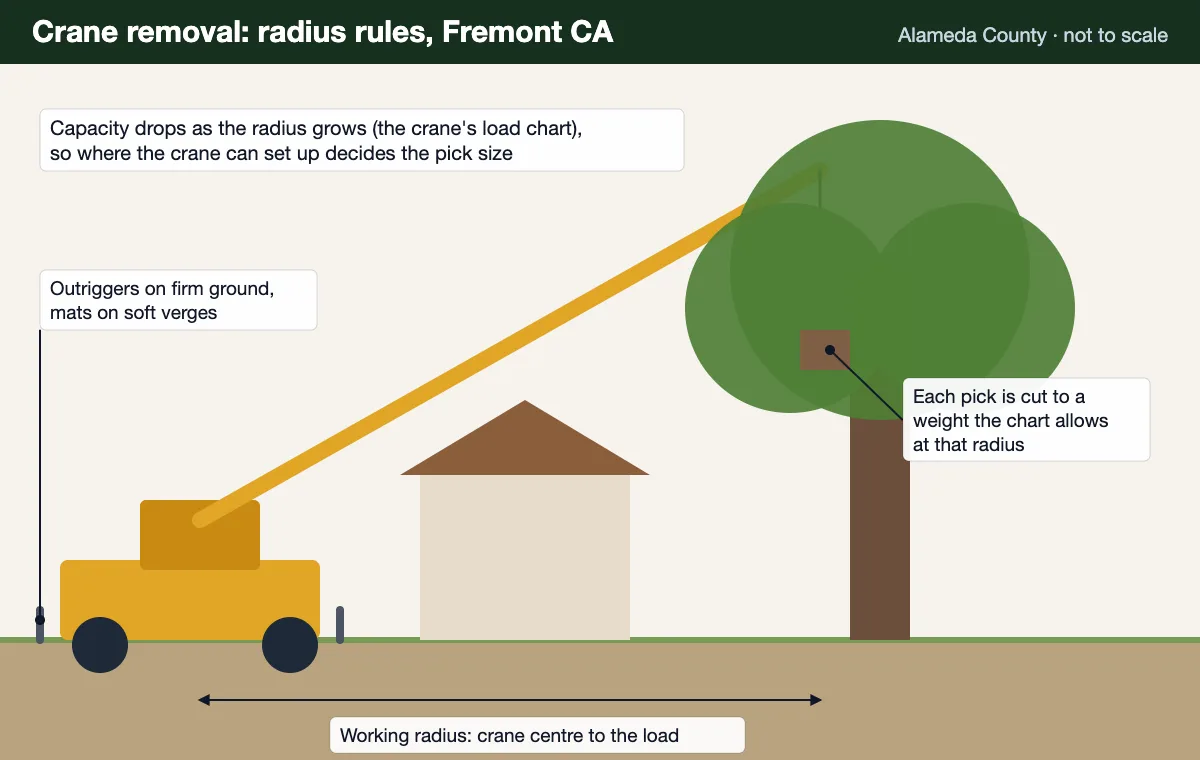
Where there is no safe rigging point, because the tree is dead, hollow or storm damaged, the answer is usually a crane. A crane lets the operator pick the piece before it is cut and swing it clear into the street, which removes the shock load from the tree entirely. On big technical jobs a crane is often cheaper than a full day of climbing, not more expensive. See crane tree removal.
No general tree crew should work within ten feet of energised conductors. That is line clearance work, restricted to qualified line clearance tree trimmers, and the correct first call is the utility. Trees should not be topped either, on private property or in the right of way, where FMC 12.30.060(b) prohibits it outright.
When a Fremont tree actually needs to come out
Removal is the right call when the tree is dead, structurally compromised beyond what pruning can fix, or when its failure would land on something that matters. A tree that is simply inconvenient, or dropping leaves you would rather not rake, is usually a pruning job or a mulching problem, and a contractor who reaches for removal first is selling rather than assessing.
The defects that genuinely warrant removal are fruiting bodies or conks at the root collar, which indicate root or butt rot; a fresh lean paired with cracked or heaved soil on the opposite side, which means the root plate is already moving; a large cavity or a trunk that sounds drummy when struck; extensive bleeding cankers on an oak, which may indicate Phytophthora; and a crown that is more than about a third dead. Any one of these on a tree within striking distance of the house is worth an assessment.
In Fremont the failure season is winter, and the reason is soil rather than wind strength. The nearest long-record NOAA station shows about 16 inches of annual rain, of which roughly 82 percent arrives November through March, after a June to September stretch that delivers 0.33 inches total. Eight dry months shrink and crack the soil and kill back fine roots, then five wet months saturate it. The root plate loses friction, and an ordinary storm pushes over a tree that looked fine in August.
That is also the argument for getting it done now rather than in January. Dry-season removal is a scheduled job at a scheduled price. Wet-season removal is often an emergency callout with a premium attached, plus whatever the tree landed on.
What happens to the wood, the brush and the stump
Brush is chipped on site, trunk wood is either hauled away or left stacked as rounds at your choice, and the stump is a separately priced grind unless the estimate says otherwise. Getting this stated in writing before the crew arrives prevents the most common post-job argument in this trade.
Leaving rounds on site saves money if you burn wood or have somewhere to stack them, and costs nothing to decide later if you say so up front. Haul-away costs more because green waste tipping fees in Alameda County are real money and a mature oak is several tons of it.
There is one local constraint worth knowing. Because Phytophthora ramorum spreads through movement of infected leaves, wood and soil, material from an oak in a coastal California county should not be moved out of the coastal zone. If your removed tree is an oak with suspicious symptoms, that limits where the wood can responsibly go, and it is a question worth asking any contractor who offers to take the wood. More on the Sudden Oak Death page.
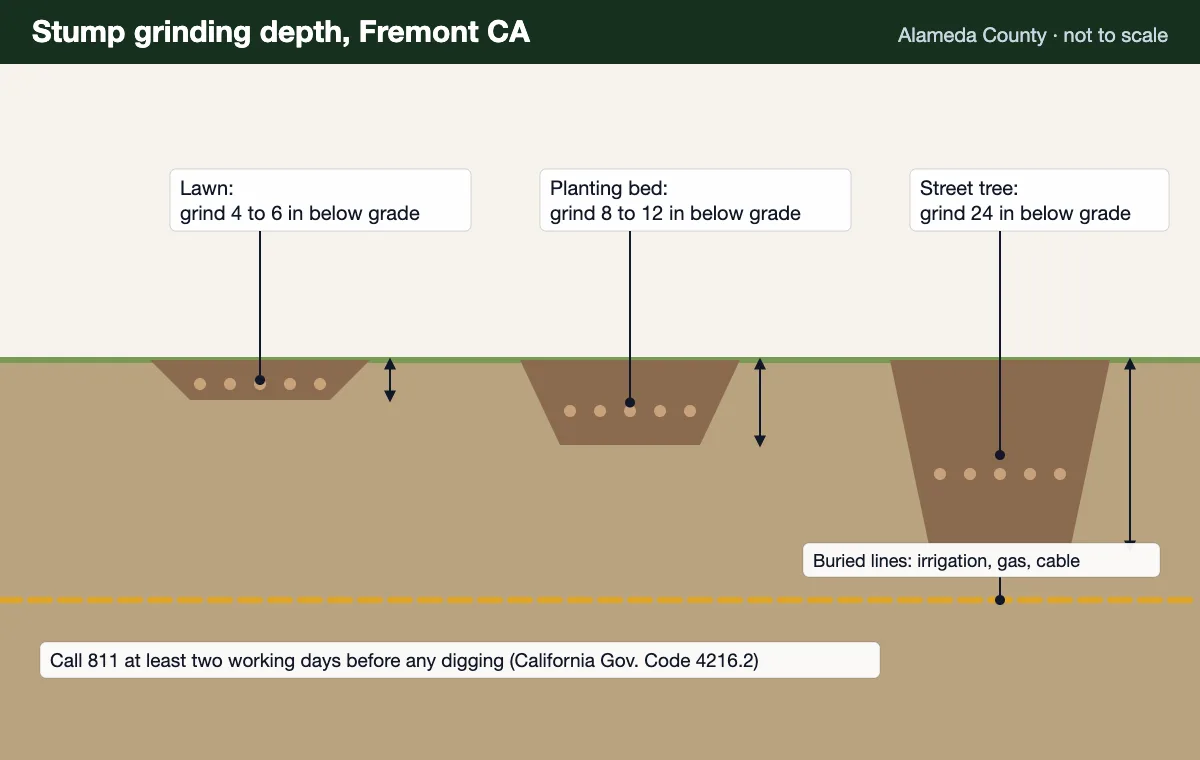
On the stump: a standard yard grind takes the stump 4 to 8 inches below grade, enough to turf or plant over. A replant in the same spot needs deeper, because you have to get below the root flare. And a street tree stump must be ground to 24 inches below grade under FMC 12.30.070, with right of way damage repaired and an encroachment permit taken out under Chapter 12.05 first. See stump grinding.
How the removal runs, start to finish
Six steps, in this order, with the ordinance check before the price rather than after it. A quote issued without knowing whether the tree is protected is a quote that can change.
- 1
Send the address and two photos
Use the estimate form. Two photos from different angles, one showing the base of the trunk and one showing the whole tree against the house, say more than any written description.
- 2
Site visit, measurement and ordinance check
DBH is measured at four and a half feet, the species identified, note the lot zoning and size, and check the tree against FMC 18.215.050 and the street tree definition in FMC 12.30.010.
- 3
Written estimate with scope named
You get the tree identified, the work described, the debris and stump treatment stated, and the permit position spelled out including who applies for it.
- 4
Permit, if one is required
Where FMC 18.215 applies, the application goes to the city landscape architect and the issued permit is posted on the lot, prominently visible from the street, for the duration of the work.
- 5
Setup, rigging and sectional removal
Drop zone is cleared and protected, rigging points are set, and the tree comes down in controlled sections. Anything over a structure is lowered on a line, never dropped.
- 6
Chip, haul, grind and walk the site
Brush is chipped, wood is handled the way the estimate says, the stump is ground to the quoted depth, and the work area is raked and blown before a final walk of the site with you.
Fremont tree removal questions
How much does tree removal cost in Fremont CA?
Most Fremont residential removals fall between roughly $600 and $2,500, with technical or crane-assisted jobs running higher. Bay Area labour and disposal costs sit above national averages, so national calculators tend to underquote Fremont. Trunk diameter, height, proximity to structures, species density and access are what actually move the number.
Do I need a permit to remove a tree in Fremont CA?
You need a permit if the tree meets any trigger in FMC 18.215.050(a), most commonly 18 inches DBH for any species or 10 inches DBH for a native tree such as an oak. A tree behind the front face of the house on a developed R-1 lot of 10,000 square feet or less is normally exempt. Check this before quoting so there is no surprise mid-job.
Can I cut down a tree on my own property in California?
Only if local rules allow it, and Fremont's do not in every case. There is no statewide ban, but FMC 18.215.040 prohibits removing or damaging a protected private tree without a permit from the city landscape architect. Removing a protected tree without authorisation exposes you to mitigation requirements under FMC 18.215.090, which can mean replacement planting or a cash payment based on appraised tree value.
How long does a tree removal take?
A straightforward small tree with good access is often done in two to four hours, and a large rigged removal over a structure can take a full day or two days with a cleanup return. Crane jobs are usually faster on site but need street staging and sometimes a traffic plan. The estimate should state the expected number of days.
Does homeowners insurance cover tree removal?
Generally only after the tree has damaged a covered structure. Most California policies pay to remove a tree that has fallen on the house, garage or fence, often subject to a per-tree limit, and do not pay to remove a standing tree that is merely hazardous. Preventive removal is almost always out of pocket.
What is the best time of year to remove a tree in Fremont?
The dry season, roughly May through October, is the cheaper and safer window. Ground conditions are firm enough for equipment, scheduling is not compressed by storm callouts, and you are removing the hazard before the saturated-soil failure window from December through March. Removing a hazard tree in January usually means paying an emergency premium.
Can a tree service remove a tree that is touching a power line?
No, and neither should anyone else without the right qualification. Work within ten feet of energised conductors is line clearance work restricted to qualified line clearance tree trimmers, so the correct first call is the utility. Once the utility has made the line safe or cleared its side, a tree crew can handle the rest of the tree.
Is stump removal part of the price?
Stump grinding is quoted separately unless the estimate explicitly bundles it. Grinding is a different machine and a different access problem, and stump size does not track tree size reliably because the flare can be much wider than the trunk. Ask for it to be itemised so you can decide.
What happens if a protected tree is removed without a permit in Fremont?
The City can impose mitigation for unauthorised removal under FMC 18.215.090, which generally means replacement trees providing beneficial attributes at least equivalent to the tree removed. Where value must be established, FMC 18.215.090(d) has the city landscape architect calculate it using the current Guide for Plant Appraisal from the Council of Tree and Landscape Appraisers. That is a materially worse outcome than applying first.
Can a tree in a backyard with no gate access be removed?
Yes, but it changes the method and the price. With no equipment access every piece is carried out by hand through the house side or over a fence, or a crane picks it over the roofline from the street. Describe access when you request the estimate, because it is the single most common reason a quoted price would otherwise need revising.
Related Pages
Get a free estimate on your tree
Send the address and what the tree is doing. A good estimate checks whether the tree needs a permit and puts a number on it in writing.
- Free written estimate, no obligation
- Check whether your tree is protected before work starts
- Ask any crew for its CSLB license and certificate of insurance
- Mark storm damage as urgent in your request