Oak tree care in Fremont, CA
Stop watering it: the summer irrigation problem
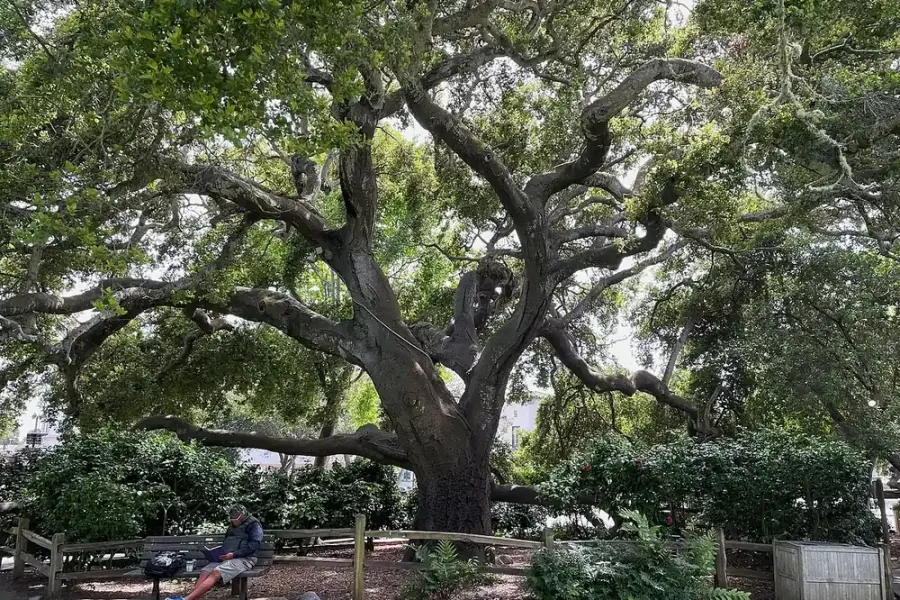
A mature native oak in Fremont should not be receiving summer irrigation anywhere near its root collar, and removing that water is the single highest value thing most homeowners can do for their oak. This is counterintuitive, which is exactly why it keeps happening.
The NOAA 1991 to 2020 normals for the station nearest Fremont record 0.33 inches of rain across June, July, August and September combined, with a July normal of zero. Coast live oak did not merely tolerate that, it evolved into it. Its dormancy, its root architecture and its resistance to soil pathogens are all calibrated to a dry summer.
Put a lawn under it, or run a drip line for shrubs inside the root zone, and the soil around the root crown stays damp for four months that should be dry. Warm damp soil against the collar of a tree adapted to the opposite is the condition root and crown pathogens want. The decline takes years, so by the time the crown thins the sprinkler is never the suspect.
Move irrigation out of the root zone rather than reducing its frequency, because a lawn dies at the water level an oak tolerates. Under the canopy, use coarse organic mulch two to four inches deep kept well clear of the trunk, or dry tolerant planting outside the inner root zone. A newly planted young oak is a different case and does need establishment water for its first few years.
The root zone is the tree, and it is bigger than you think
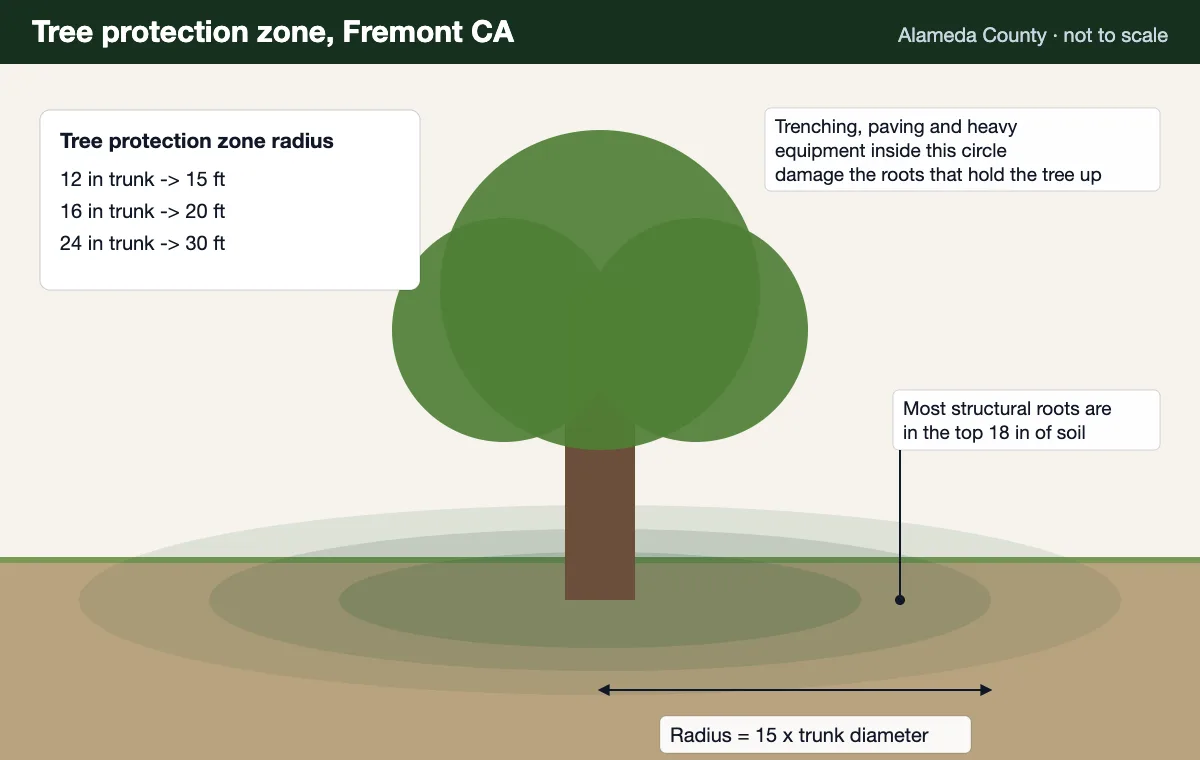
An oak's absorbing roots sit in the top eighteen inches of soil and extend well beyond the edge of the canopy, so the area you need to protect is considerably larger than the shade the tree casts. Most serious oak decline in Fremont is root zone damage that happened years before the crown said anything about it.
The things that do the damage, roughly in order of how often they show up:
- Summer irrigation at the collar. Covered above, and it is number one by some distance.
- Trenching.A utility, irrigation or drainage run cut straight through the root plate. One trench can sever a large fraction of a tree's absorbing capacity in an afternoon.
- Grade change. Adding soil over the root zone suffocates shallow roots. Cutting the grade down removes them outright.
- Compaction. Repeated vehicle or equipment traffic over the root zone during a construction project. Invisible, permanent without intervention.
- Paving. Impermeable surface over the root zone cuts both gas exchange and the winter water the tree actually relies on.
If a project is planned anywhere near a large oak, the protection fence goes up before the first machine arrives, not after. And if the oak is protected under FMC Chapter 18.215, work inside its protected zone is a regulatory question as well as an arboricultural one.
How much to prune an oak, and when
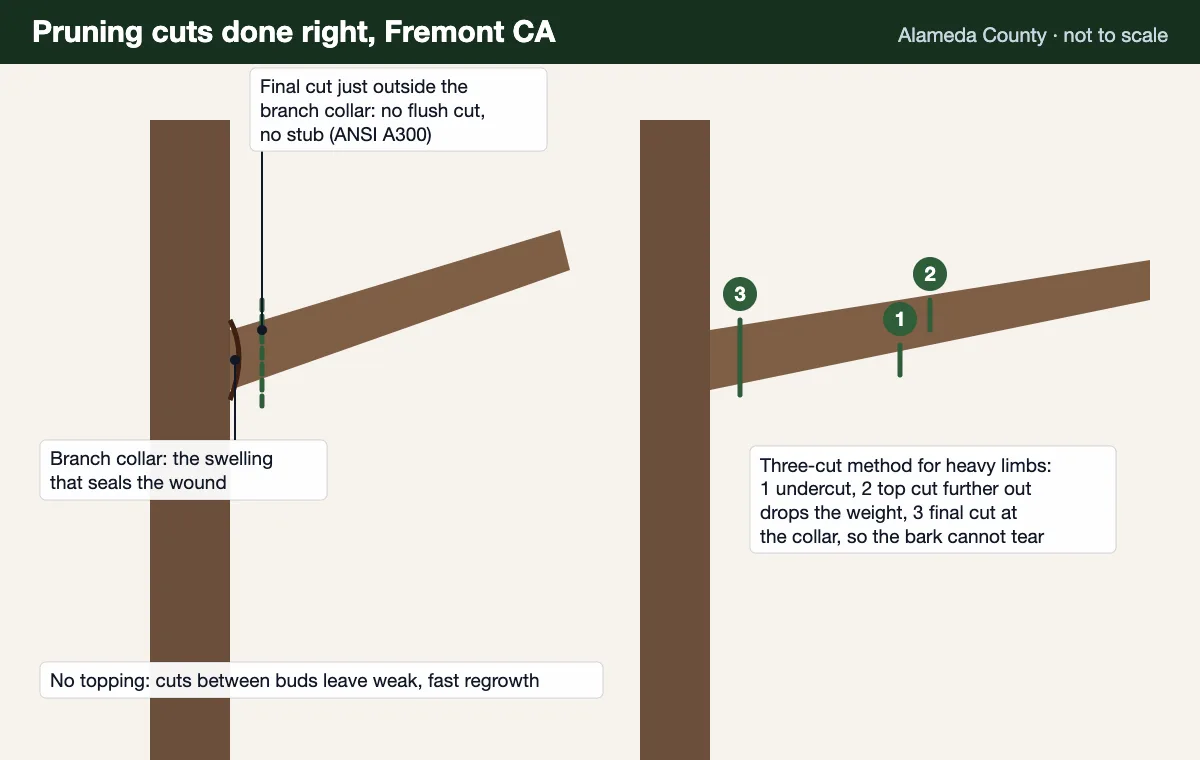
Oaks want less pruning than most trees and they want it in dry weather. Deadwood removal and clearance are the mainstay, live crown removal stays modest, and the Fremont window is roughly June through September when rainfall is effectively zero. Pathogens travel in water, so a fresh wound in wet conditions is an open door.
What conservative actually means on a mature oak:
- Deadwood first. Crown cleaning removes dead, dying, diseased and broken limbs. Nothing living comes off, so it is the lowest risk work there is and it addresses most genuine safety concerns.
- Clearance second. Limbs off the roof, off the driveway, away from the walls. On a hillside lot this doubles as fire clearance work.
- Live crown reduction sparingly. Well under a quarter of the living canopy in a season on an established tree, and less on a stressed one. Leaves are how the tree feeds itself.
- Never topping. FMC 18.215.030 defines damage to a protected tree to include topping, so on a protected oak this is a legal standard as well as a professional one. See why topping makes a tree more dangerous.
Every pruning visit to an oak is also an inspection visit. The climber is the only person who ever sees the upper structure closely, and old wounds, poorly attached unions and decay pockets are found from up there, not from the lawn.
Sudden Oak Death: what to look for on a Fremont oak
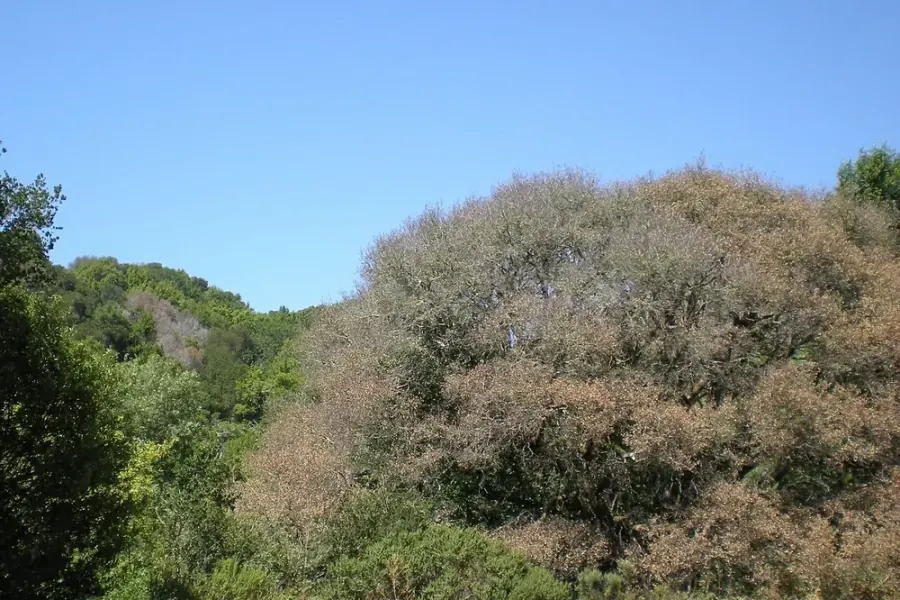
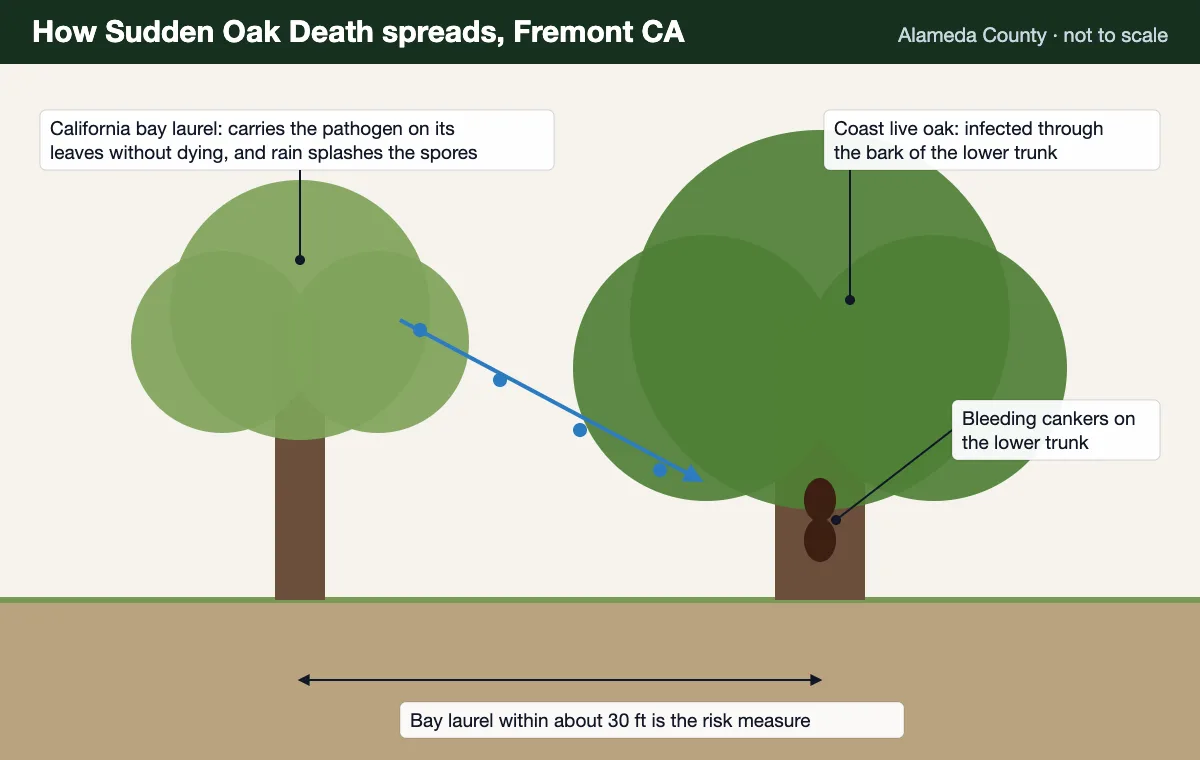
Look at the lower trunk, not the leaves. Sudden Oak Death produces dark seeping bleeding cankers on the bark long before the crown shows anything, and by the time the leaves brown the tree has usually been infected for a long time. The pathogen is Phytophthora ramorum, a funguslike organism called an oomycete rather than a true fungus.
The verified position for this area: infestations are confirmed in natural settings in fifteen central and northern coastal California counties, including Alameda County, with known county sites at Redwood Regional Park, East Bay Municipal Utility District property, and one hillside in Castro Valley. Hosts killed include coast live oak, black oak, tanoak and Shreve oak. That is a county level statement, not a claim about Fremont city limits specifically.
California bay laurel is the key reservoir host. It sporulates heavily, infects neighbouring oaks, and does not die itself. Bay proximity is the single strongest risk factor an oak can have, and managing the bays around a high value oak is one of the few genuinely preventive actions available. Spread is by movement of infected leaves, wood and soil, which is why plant material should not be moved out of affected coastal areas.
There is no cure. Phosphonate treatment is protective, applied to uninfected high value trees, and it is not a rescue for a symptomatic one. Anyone selling it as a cure is misrepresenting it. The full picture, including symptoms, debris handling and what a dead oak means structurally, is on the Sudden Oak Death page, and treatment options generally are covered under tree disease treatment.
What the Fremont ordinance means for a large oak
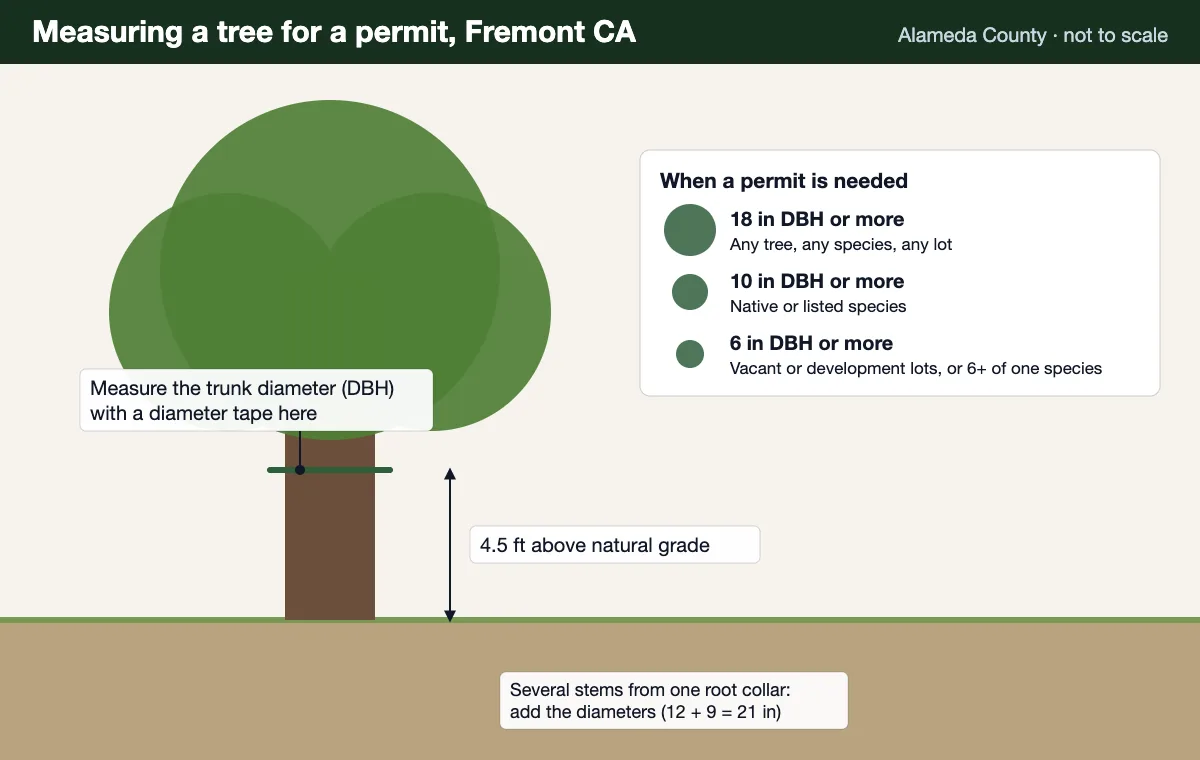
Under FMC Chapter 18.215 a protected tree cannot simply be removed, and it also cannot be damaged, with FMC 18.215.030 defining damage to include topping and defining cutting to include pruning and trimming. That second half is what catches people out: a protected oak can be unlawfully damaged while still standing.
Native oaks are precisely the category tree preservation ordinances exist to cover, so on any large oak the sequence is: confirm whether the tree is protected, then scope the work, then quote it. Not the other way around. The practical checks are on the protected trees page, and the permit pathway, including replacement planting obligations, is on the tree removal permit page.
Two further situations that change the answer entirely. If the oak is in the public right of way it is a City street tree under FMC Chapter 12.30 and none of it is your call, which is covered on is it my tree or the City's. And if the trunk straddles a property boundary, California Civil Code section 834 makes it owned in common with your neighbour, which is on the neighbour tree law page.
How to assess a Fremont oak
Six steps, and note that four of them happen before any cutting is proposed. On oaks the diagnosis is worth more than the saw work.
- 1
Establish what the tree actually is
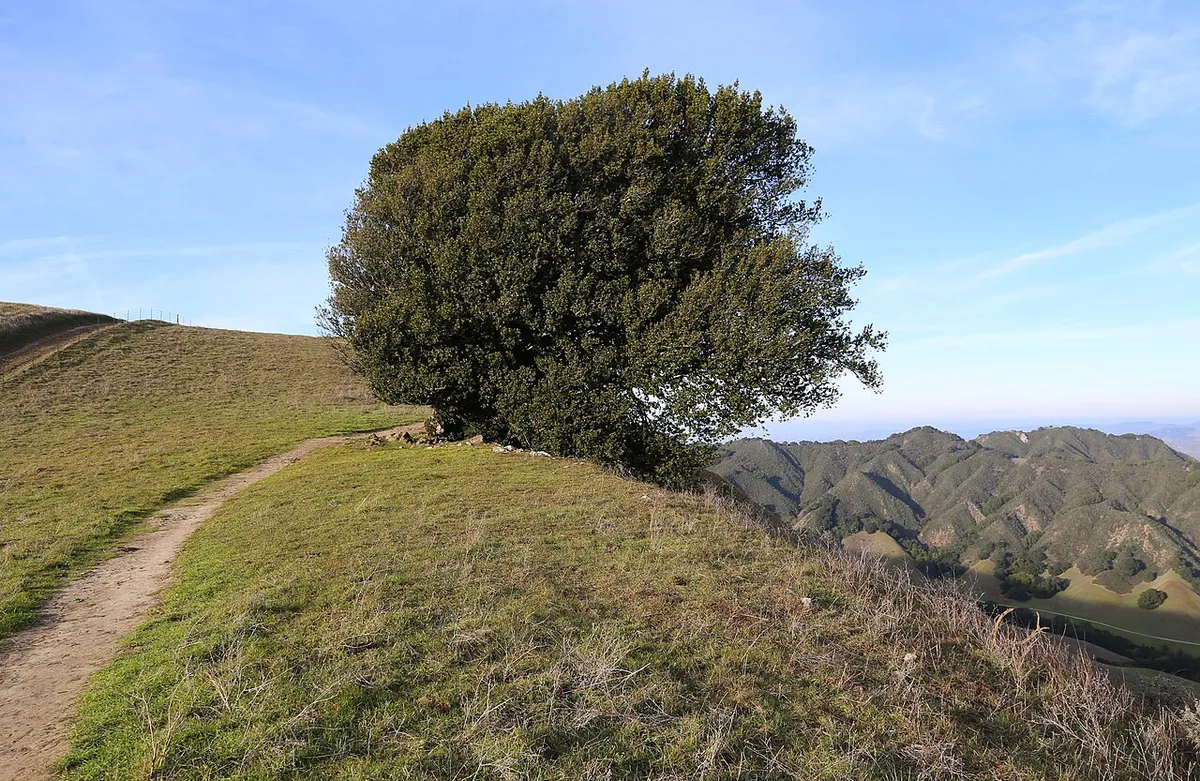
Coast live oak, valley oak, black oak and a planted non native oak want different things, and Fremont has all of them. Coast live oak holds its leaves year round with small cupped hollylike foliage, while valley oak is deciduous with deeply lobed leaves. Species also determines whether Sudden Oak Death is even a relevant question, because the pathogen kills some oaks and ignores others.
- 2
Map the root zone before anything else
An oak's absorbing roots are shallow and spread well past the canopy edge, mostly within the top eighteen inches of soil. Mark the area out to and beyond the dripline and treat it as no go for trenching, grade change, compaction and paving. Most oak decline in Fremont traces back to something done to this zone years before symptoms showed.
- 3
Audit the irrigation, and usually turn it off
The single most common way a Fremont homeowner kills a mature native oak is running lawn or bed irrigation near its root collar through summer. A coast live oak evolved for four rainless months a year and dies faster when the collar stays wet through August. Check for spray heads, drip lines and lawn edges inside the root zone and move them out rather than adjusting the schedule.
- 4
Inspect the lower trunk and the bay laurels
The lower trunk gets examined for the dark seeping bleeding cankers associated with Sudden Oak Death, which appear on the bark long before the crown shows anything. Also look at what is growing near the oak, because California bay laurel is the key reservoir host for the pathogen and its proximity is the single strongest risk factor an oak can have.
- 5
Prune conservatively, in dry conditions, to ISA standard
Oaks get less pruning than most people expect. Deadwood removal and clearance work are the mainstay, live crown removal stays modest, and cuts are made just outside the branch collar with no topping and no flush cuts. Timing matters because pathogens move in water, so the work happens in dry weather, which in Fremont means the June to September window.
- 6
Check the ordinance before scoping anything major
Fremont's tree preservation ordinance treats certain trees as protected, and FMC 18.215.030 defines damage to include topping and defines cutting to include pruning and trimming. That means a protected oak can be unlawfully damaged while still standing. Anything beyond routine deadwood on a large oak gets checked against the ordinance before it is quoted.
Oak tree questions
Should I water my oak tree in summer in Fremont?
No, not near the root collar, and this is the most common way homeowners kill a mature native oak. Coast live oak evolved in a climate that delivers effectively no rain from June through September, and keeping the collar and root crown wet through the dry months creates exactly the conditions that root and crown pathogens need. A newly planted young oak needs establishment water, and a mature native oak in native soil does not.
Can I put a lawn under my oak tree?
It is one of the worst things you can do to a mature native oak, because a lawn needs summer irrigation and the oak needs summer dryness. The conflict is not solvable by adjusting the schedule, because the lawn dies at the watering level the oak tolerates. The right treatment for the area under an oak is coarse mulch kept back from the trunk, or dry tolerant planting kept outside the inner root zone.
When should coast live oak be pruned in Fremont?
Prune coast live oak in dry conditions, which in Fremont means roughly June through September when the NOAA normals show effectively zero rainfall. Pathogens move in water, so a fresh wound in wet weather is an open door. The other half of the answer is how much: oaks want conservative pruning, mostly deadwood and clearance, with live crown removal kept modest.
What is a protected tree in Fremont?
Fremont's tree preservation ordinance, FMC Chapter 18.215, designates certain trees as protected, and once a tree is protected both removing it and damaging it are regulated. FMC 18.215.030 defines damage to include topping and defines cutting to include pruning and trimming, which is the part most people miss. Native oaks are exactly the category the ordinance exists for, so check before you scope work on a large one.
Is Sudden Oak Death in Fremont?
Sudden Oak Death is confirmed in natural settings in Alameda County, with known infested sites at Redwood Regional Park, East Bay Municipal Utility District property, and one hillside in Castro Valley. The verified statement is county level rather than Fremont city limits specifically. Because coast live oak is a host and the county is affected, a Fremont oak with bleeding cankers on the lower trunk is worth having looked at.
Why does a bay laurel near my oak matter?
California bay laurel is the key reservoir host for Phytophthora ramorum, the funguslike organism that causes Sudden Oak Death. Bay laurel sporulates heavily, infects neighbouring oaks, and does not die itself, which makes bay proximity the single strongest risk factor for an oak. Managing the bays near a high value oak is one of the few genuinely preventive actions available.
Can Sudden Oak Death be cured?
No. There is no cure. Management is prevention, using phosphonate treatment applied to uninfected high value trees as a protective measure, plus selective removal of infected material. Phosphonate is preventive on an uninfected tree and is not a rescue for a tree that is already symptomatic, and any contractor selling it as a cure is misrepresenting it.
Why are my oak's leaves turning brown all at once?
Rapid whole crown browning on a coast live oak while the leaves stay attached is a classic late stage Sudden Oak Death presentation, and by the time it happens the tree has usually been infected for a long time. It can also follow root damage, a severed major root from trenching, or sustained summer irrigation at the collar. In every one of those cases the diagnosis starts at the lower trunk and the root zone, not at the leaves.
Can I pave or build near my oak tree?
Not within the root zone without expecting consequences, because an oak's absorbing roots sit in the top eighteen inches of soil and extend well past the canopy edge. Paving, compaction from equipment, trenching for utilities and any change to the soil grade all damage that layer, and oaks decline slowly enough that the cause is usually forgotten by the time the symptoms arrive. If the oak is protected under FMC 18.215, work inside its protected zone is also a regulatory question.
My oak dropped a huge limb with no warning. Why?
Summer limb drop on a calm day is a recognised phenomenon in large oaks and it is not fully explained, but the practical causes in Fremont are usually decay at an old wound, a poorly attached union, or end weight on an over extended lateral. The honest response is an inspection of the remaining structure rather than assuming the tree has discharged its one bad limb. See our emergency tree service page if a limb is currently down or hung up.
How much does oak tree work cost in Fremont?
Oak sits at the expensive end of every published table because it is dense, heavy and usually large. Fixr puts oak removal at $900 to $2,000 nationally and oak trimming at $175 to $1,500, while LawnStarter puts oak removal at an average of $775 and oak trimming at $230 to $1,480, and Bay Area pricing runs above those national figures. Add the permit question if the tree is protected, which costs time rather than money.
Should I remove a dead oak or leave it?
A dead oak near a structure, a driveway, a path or anywhere people go should come out, because a dead coast live oak loses limbs unpredictably and the failure point is usually invisible from the ground. A dead oak in the back of a large lot with nothing under it is a habitat asset and can often stay. Where the oak died of Sudden Oak Death there is a further consideration, because infected wood and soil should not be moved out of the affected coastal area, which constrains how the debris is handled.
Related Pages
Send a photo of the lower trunk
For any oak you are worried about, photograph the trunk from the ground up to about head height on all sides, plus one wide shot of the whole tree and what is growing near it. That says more than a description of the leaves.
- Free written estimate, no obligation
- Check whether your tree is protected before work starts
- Ask any crew for its CSLB license and certificate of insurance
- Mark storm damage as urgent in your request