Sudden Oak Death in Fremont, CA
What the pathogen actually is
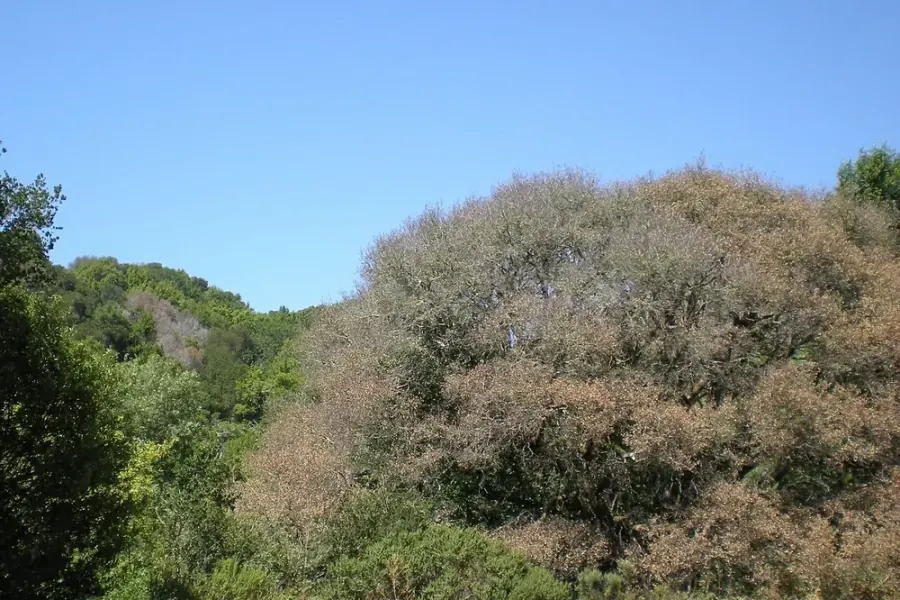
Phytophthora ramorum is an oomycete, a funguslike water mould, not a true fungus. That is not pedantry. Oomycetes are more closely related to algae than to fungi, they move through free water rather than through dry air, and they do not respond to the chemistry that controls fungal leaf diseases. Anyone selling you a fungicide for Sudden Oak Death is selling you the wrong product category.
Because it needs free water to move and reproduce, the disease follows the wet season. Fremont takes roughly 13 of its 16 annual inches of rain between November and March, and that five month window is when spores are produced and splashed. The four effectively rainless months from June to September, which together deliver about a third of an inch, are a quiet period for the pathogen and a stressful one for the tree.
Infestations are confirmed in natural settings in fifteen central and northern coastal California counties, Alameda County among them. The known infested sites in Alameda County are Redwood Regional Park, East Bay Municipal Utility District property, and one hillside in Castro Valley. That is a countywide confirmation with named sites, not a claim that Fremont city limits are infested.
What it looks like on a Fremont oak
The first visible symptom is bleeding: dark red brown to black seeping spots on the lower trunk, often well before anything is visibly wrong with the canopy. People expect a dying tree to announce itself through its leaves. This one does not, and by the time the crown browns the tree has usually been infected for a long while.
The progression on a coast live oak, roughly in order:
- Bleeding cankers on the bole. Dark seeping patches, sometimes several feet above ground, sometimes with a dried crust.
- Beetle activity. Fine boring dust in bark crevices from ambrosia and bark beetles moving in on a weakened tree.
- Fungal fruiting bodies on the bark, typically small and cream to tan, as secondary decay organisms colonise.
- Crown collapse. Foliage browns, often rapidly and across the whole canopy, which is what gives the disease its name.
Other problems cause oak bleeding too, including other Phytophthora root diseases, bacterial wetwood and old mechanical wounds. That is exactly why laboratory confirmation matters rather than diagnosis by photograph. The Alameda County Department of Agriculture and Weights and Measures runs a Sudden Oak Death programme and is the right first call.
Bay laurel is the reason one oak dies and the next one does not
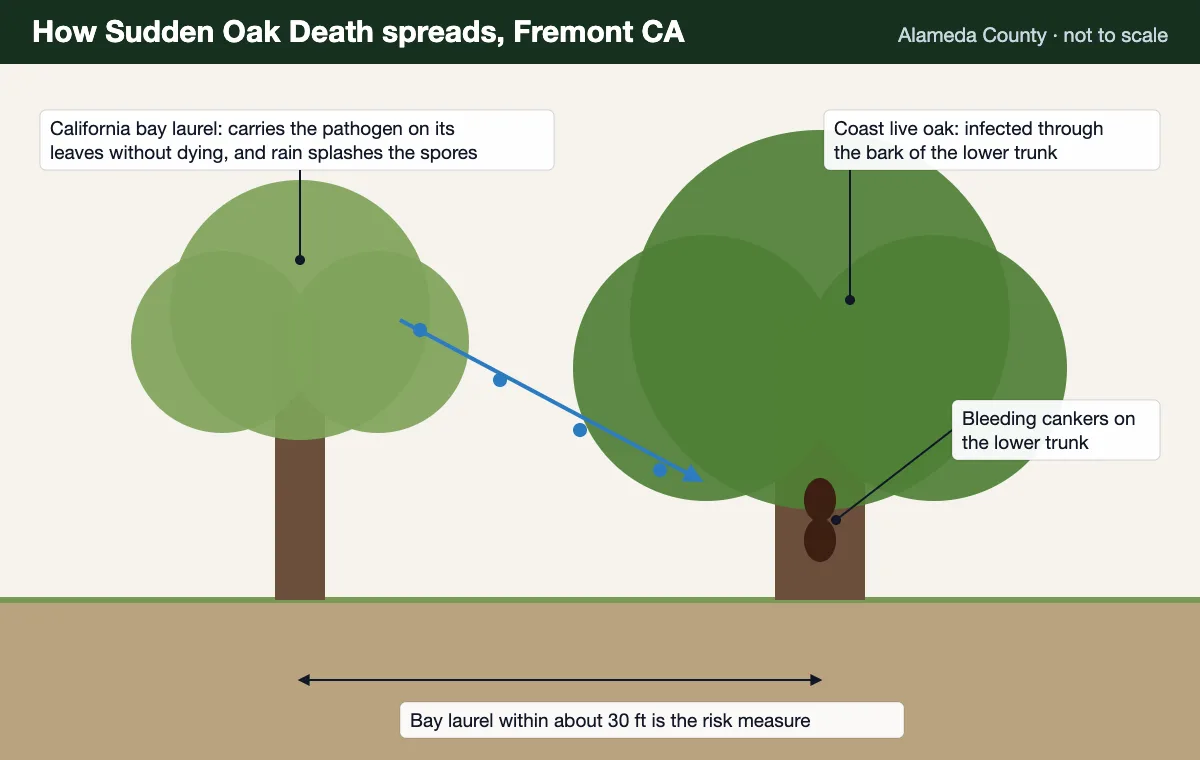
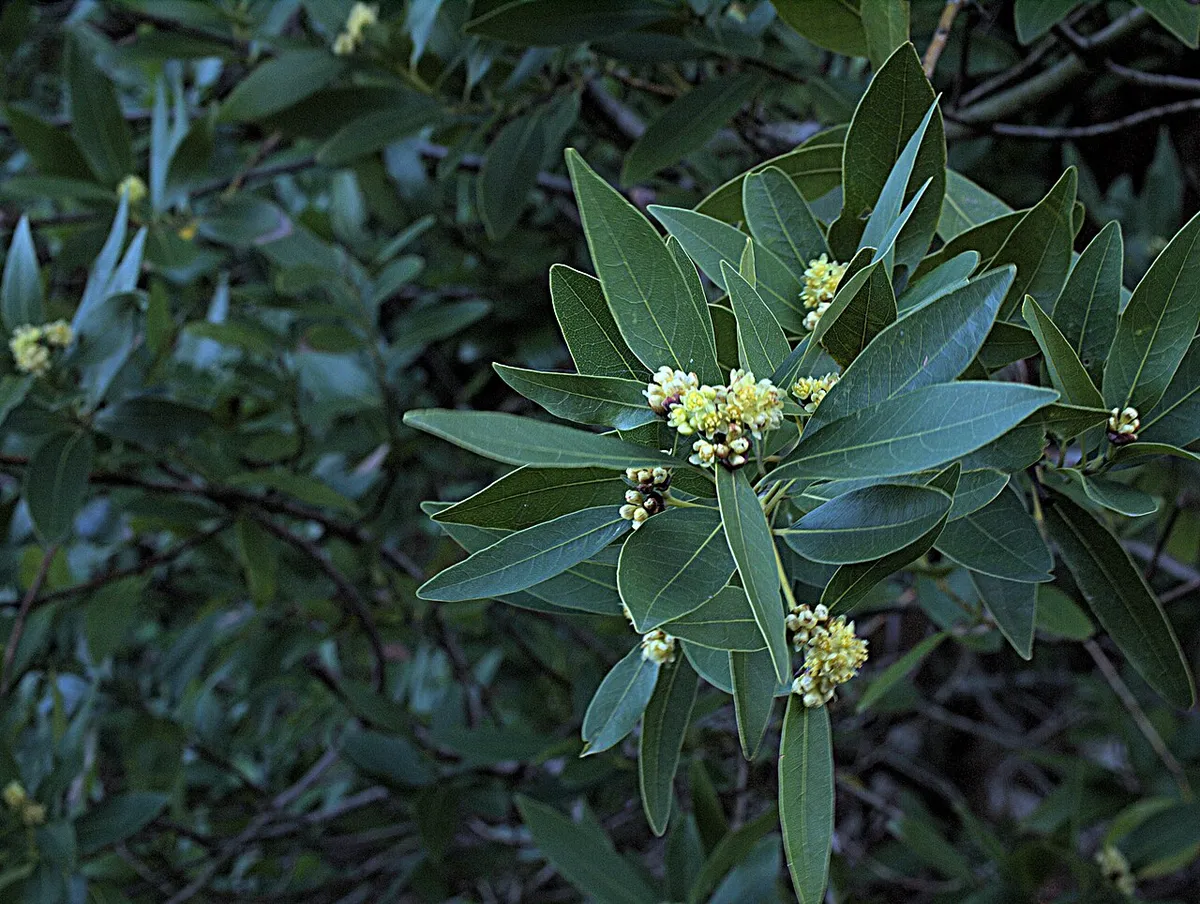
California bay laurel is the key reservoir host: it produces the pathogen's spores in enormous quantity on its foliage, passes them to nearby oaks, and rarely dies itself. If you want one practical predictor of whether a particular Fremont oak is at risk, it is how much bay is growing within about 30 feet of it.
This creates the defining management decision in Sudden Oak Death, and it is genuinely uncomfortable. Bay laurel is a handsome native tree. It is also the delivery mechanism that kills the oak you actually care about. Removing bays around a high value oak reduces the spore load reaching that oak, and that is a recognised action rather than an aggressive one.
Bay is on Fremont's native tree list in FMC 18.215.030, alongside oak. That means a bay laurel 10 inches DBH or larger is a protected tree in its own right, and removing it to protect an oak goes through the City permit process. See protected trees in Fremont for the thresholds, and the permit walkthrough for the application.
On a hillside lot in Mission San Jose with a mature oak canopy and bay in the understory, this is not a hypothetical. It is the actual choice in front of the owner, and it is better made deliberately than by default.
What phosphonate can and cannot do
Phosphonate treatment is preventive only. It is applied to uninfected trees to reduce the chance and severity of infection, and it will not rescue an oak that is already showing cankers. There is no cure for an infected tree. Anyone telling you otherwise is either misinformed or selling.
Where phosphonate makes sense is narrow and specific: a structurally sound, high value oak, near a known bay reservoir, with no current symptoms. Treatment is repeated on a schedule set by the applicator rather than applied once. On a low value, structurally poor or already symptomatic tree, the money is better spent on assessment and, where needed, removal.
Beyond chemistry, the management tools are cultural and they all reduce stress on the tree. Do not irrigate near an oak's root collar in summer. Do not cut grade or trench inside the root zone. Do not pile mulch against the trunk. A coast live oak evolved for four rainless months a year and dies faster when a lawn irrigation system keeps its collar wet through August.
Our tree disease page covers the other pathogens found on Fremont properties, and oak tree care covers the cultural side in detail.
Why a diseased oak changes how the debris is handled
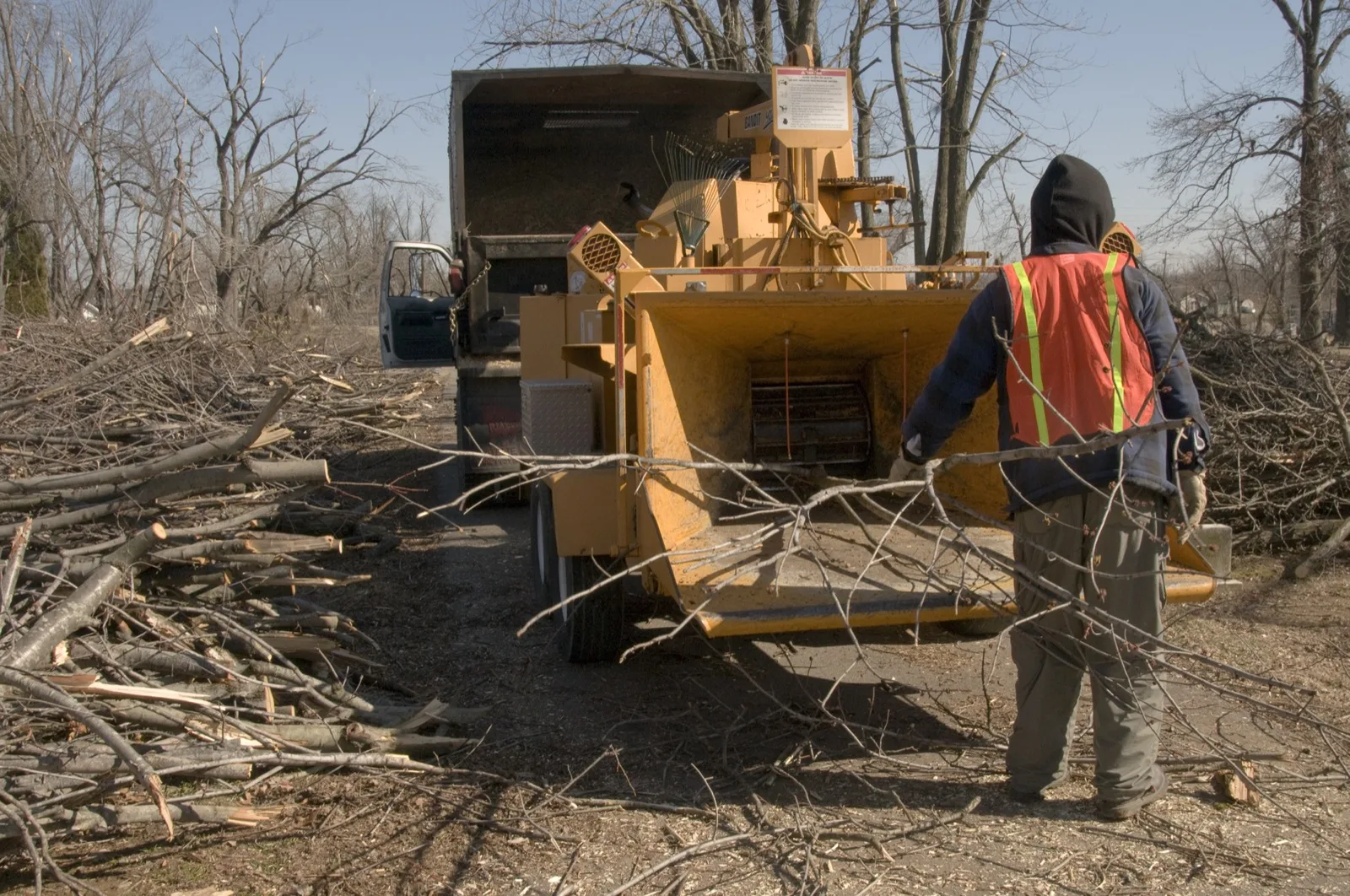
Phytophthora ramorum spreads through movement of infected leaves, wood and soil, and plant material and soil should not be moved out of coastal areas. That is a real constraint on a removal job and it is worth raising with any contractor before the chipper starts.
The practical questions to ask: where is this material going, is it leaving the coastal zone, and is equipment being cleaned of soil between sites. A crew that moves chips and rounds from an infested hillside lot to an uninfested one has just extended the outbreak, and neither party intended it.
It is also why the nursery trade is regulated for this pathogen. Rhododendron, camellia and viburnum are among the many ornamental hosts that show leaf and twig symptoms without dying, and they were the vector that moved the pathogen long distances in the first place.
A dead oak is a structural problem, not just a sad one
A dead coast live oak loses wood strength quickly and tends to fail at major unions rather than shedding small branches first, so a dead oak within reach of a building, drive or path needs assessment promptly rather than at your leisure.
The timing is predictable. Fremont's soil is bone dry from June to September and then takes 82 percent of its annual rainfall between November and March. A saturated root plate under a standing dead tree, combined with a winter wind event, is the exact mechanism behind most emergency oak removals. A dead oak that stood happily through a dry summer has told you nothing about how it will behave in February.
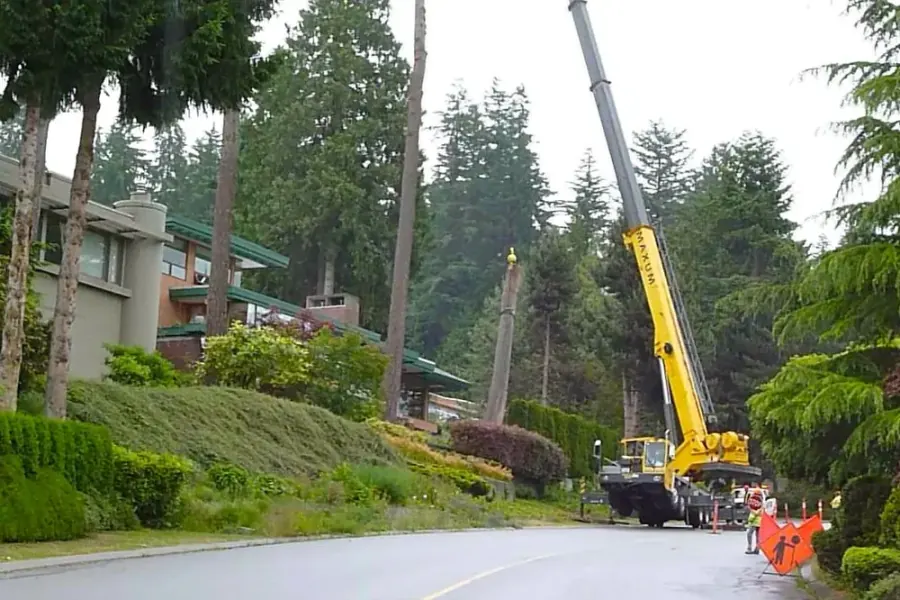
Removals of large dead oaks are frequently rigged or crane assisted rather than felled, because dead wood cannot be trusted to take rigging loads the way live wood can. That changes the method and the price. See tree removal in Fremont and crane assisted removal for what that involves.
How to assess a Fremont oak for Sudden Oak Death
Six steps you can start yourself this afternoon. The first four are diagnosis, the last two are what to do with the answer.
- 1
Look at the trunk before you look at the leaves
Walk the lower trunk and look for dark red brown to black seeping spots, often described as bleeding cankers. On a coast live oak these appear on the bole, sometimes several feet up. Bleeding is usually the first visible sign, and it can precede canopy symptoms by a long time.
- 2
Check for the secondary beetle and fungus signs
Look for fine boring dust in bark crevices from ambrosia and bark beetles, and for small cream or tan fungal fruiting bodies on the bark. These secondary organisms colonise a tree already weakened by the pathogen, and their presence on an oak with bleeding cankers is a strong indicator.
- 3
Inventory the California bay laurel within about 30 feet
Bay laurel is the main reservoir host. It sporulates heavily on its leaf tips and infects neighbouring oaks without dying itself. Count the bays near each oak you care about, because bay proximity is the single strongest risk factor for an oak on a Fremont property.
- 4
Get a confirmed diagnosis rather than assuming
Several other problems produce bleeding on oaks, including Phytophthora root diseases, wetwood and mechanical injury. Laboratory confirmation of Phytophthora ramorum matters because the management response differs. Contact the Alameda County Department of Agriculture and Weights and Measures about their Sudden Oak Death programme.
- 5
Protect uninfected high value oaks with phosphonate
Phosphonate treatment is preventive. It is applied to uninfected trees to reduce the chance of infection, not to rescue a tree that is already symptomatic. Treatment is repeated on a schedule set by the applicator, and it works best on trees near a known bay reservoir but not yet showing cankers.
- 6
Reassess the tree structurally once it is dead
A dead coast live oak loses strength quickly and the failure mode is brittle, often at the main unions rather than at small branches. If a dead oak stands within striking distance of a structure, a drive or a footpath, get it assessed for removal rather than leaving it standing as habitat.
Sudden Oak Death questions
What is Sudden Oak Death and is it in Fremont?
Sudden Oak Death is a tree disease caused by Phytophthora ramorum, a funguslike organism called an oomycete, and it is confirmed in Alameda County. Infestations have been confirmed in natural settings in fifteen central and northern coastal California counties. Within Alameda County, known infested sites include Redwood Regional Park, East Bay Municipal Utility District property, and a hillside in Castro Valley.
Is Phytophthora ramorum a fungus?
No. It is an oomycete, a funguslike water mould, which is biologically distinct from true fungi. The distinction matters practically because oomycetes respond to different management chemistry than fungi do, and a product labelled for fungal leaf disease is not a Sudden Oak Death treatment.
Which trees does Sudden Oak Death kill?
The trees killed by Phytophthora ramorum are coast live oak, black oak, tanoak and Shreve oak. Hundreds of thousands of trees have been killed in northern California. Coast live oak is the species most Fremont homeowners have, which is why the disease is locally relevant rather than academic.
Why does California bay laurel matter so much?
California bay laurel is the key reservoir host, meaning it supports heavy production of the pathogen's spores on its foliage while rarely being killed itself, and it infects neighbouring oaks. Proximity to bay laurel is the single strongest predictor of risk for an oak, which is why an inventory of the bays around a valued oak is the first practical step in managing the risk.
What are the first symptoms of Sudden Oak Death on an oak?
The first visible symptom on an oak is usually bleeding, dark red brown to black seeping spots on the lower trunk, rather than anything in the canopy. Leaf symptoms often come late, and when the crown finally browns it can happen across the whole tree in a matter of weeks, which is where the name comes from. If you are waiting for leaf symptoms to tell you something is wrong, you are looking in the wrong place.
Can Sudden Oak Death be cured?
There is no cure for an infected tree. Management consists of prevention on uninfected high value trees using phosphonate, plus selective removal of infected material and of reservoir hosts where appropriate. Any product or contractor promising to cure an infected oak is misrepresenting what is known about the disease.
Does phosphonate treatment work?
Phosphonate is protective, applied to uninfected trees to reduce the likelihood and severity of infection, and it is not a rescue treatment for a tree already showing cankers. It is most worth doing on a structurally sound, high value oak that sits near a known bay laurel reservoir and has no symptoms yet. Treatment is repeated on a schedule, not applied once.
Can I move the wood from a diseased oak?
No. The pathogen spreads through movement of infected leaves, wood and soil, and plant material and soil should not be moved out of coastal areas. That constrains how debris from a Sudden Oak Death removal is handled, and it is a question worth asking any contractor before they take your oak away.
Should I remove the bay laurels near my oak?
Removing bay laurel within roughly 30 feet of a valued oak reduces the spore load reaching that oak, and it is a recognised management action. Bay is on Fremont's native tree list under FMC 18.215.030, so a bay 10 inches DBH or larger is a protected tree and its removal goes through the City permit process rather than around it.
Is a dead oak dangerous?
A dead coast live oak loses wood strength quickly and tends to fail at major unions rather than shedding small branches first, so a dead oak within reach of a house, drive or path should be assessed promptly. Fremont's winter saturation and wind cycle is what actually brings these trees down, which means a dead oak standing through summer is not evidence that it is stable.
How do I know if a tree is dangerous?
Look for bleeding or cracked bark on the lower trunk, mushrooms or conks at the base, a lean that has changed, soil heaving on one side of the root plate, and dead limbs in the upper crown. Any one of those on a large tree within striking distance of a target warrants a professional assessment, and soil heaving on one side is the most urgent of them.
Does Sudden Oak Death affect other plants in my garden?
Phytophthora ramorum infects a wide host range beyond oaks, with many hosts developing leaf and twig symptoms rather than dying. Rhododendron, camellia and viburnum are among the ornamental hosts that have driven nursery quarantine rules, which is why the pathogen is regulated at the agricultural level and not only as a forestry problem.
Related Pages
Worried about an oak on your property?
Send the address and photos of the lower trunk for a free estimate. Some findings need laboratory confirmation before anyone can say whether the tree is a structural concern yet.
- Free written estimate, no obligation
- Check whether your tree is protected before work starts
- Ask any crew for its CSLB license and certificate of insurance
- Mark storm damage as urgent in your request