Neighbor tree law in California
The trunk decides everything
California Civil Code 833 provides that trees whose trunks stand wholly upon the land of one owner belong exclusively to that owner, although their roots grow into the land of another. Civil Code 834 completes the picture: trees whose trunks stand partly on the land of two or more coterminous owners belong to them in common.
That is the entire ownership rule, and it is refreshingly blunt. Roots under your lawn do not give you a share. Branches over your roof do not give you a share. A tree that drops forty years of leaves into your gutters and none into its owner's is still entirely its owner's tree.
A true boundary tree under Civil Code 834 is one whose trunk physically straddles the line. Not its roots, not its canopy. Because trunks grow outward over time, a tree planted three feet inside a line can become a boundary tree decades later, and a tree planted on the line is a boundary tree from the start.
When a tree is owned in common, neither owner may unilaterally remove it or substantially destroy it. Co ownership is a genuine constraint on both parties, which is why a boundary tree dispute is usually resolved by negotiation and a written agreement rather than by one side establishing that they were right.
What you may do about branches and roots over your line
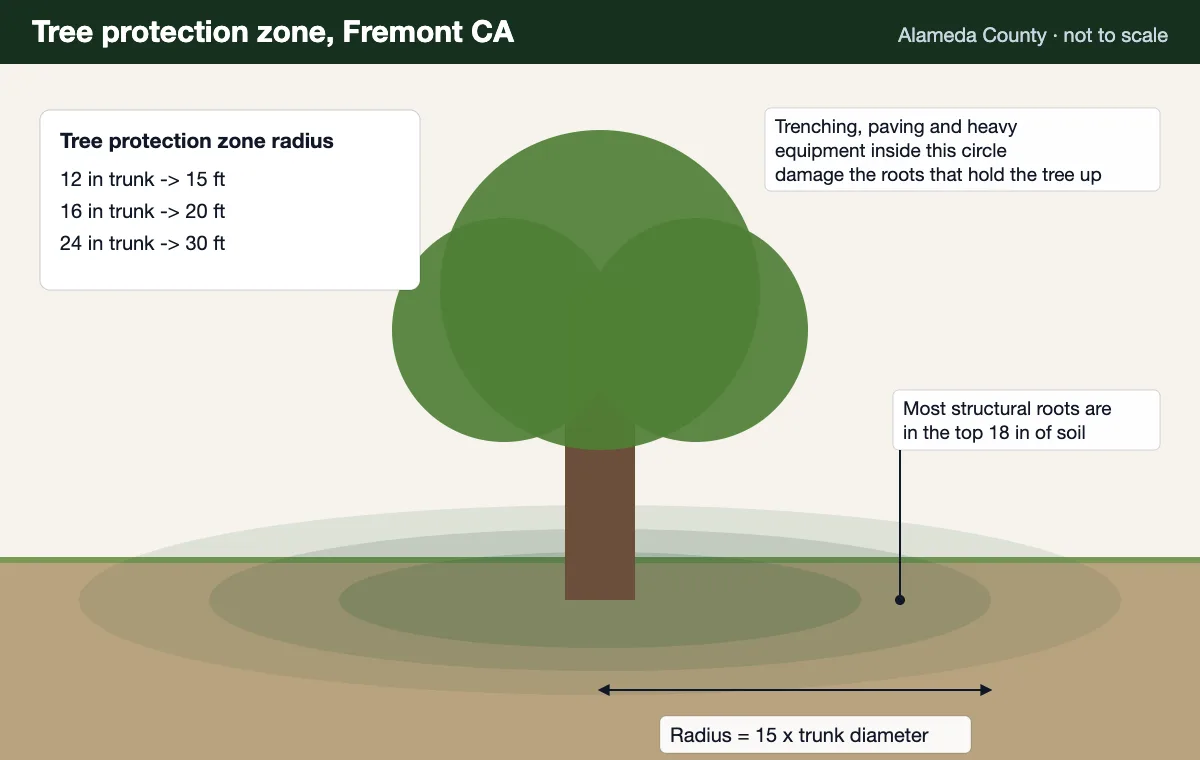
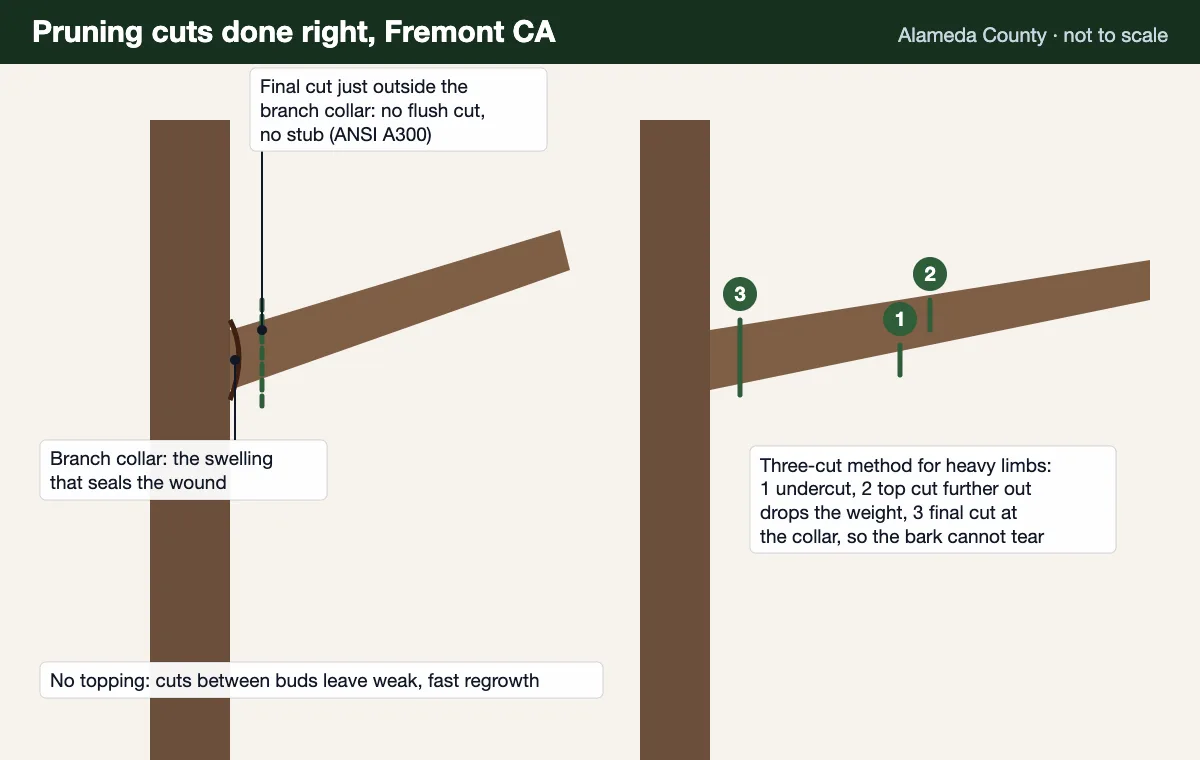
You may generally prune encroaching branches and roots back to the property line at your own expense, but you may not exercise that right unreasonably or negligently in a way that damages or kills your neighbour's tree. California case law has narrowed the old absolute self help rule to exactly that limit, and it is where most people get into trouble.
The practical consequence is that cutting to the line is not automatically safe. Prune a mature coast live oak hard back to a boundary and you can remove enough of its crown to destabilise it or kill it, at which point you have not exercised a right, you have destroyed a tree you do not own. The same is doubly true of roots, because a root plate severed on one side is precisely how a tree ends up on the ground in a February windstorm.
Three things make the self help route defensible:
- A written arborist assessment first, saying how much can be removed without compromising the tree's health or stability.
- Cuts made to ISA standard, at appropriate points, not flush cuts and not stubs.
- Written notice to the neighbour before the work, with the assessment attached.
Our tree trimming page covers the ISA pruning standard in detail. It is the same standard Fremont writes into its street tree ordinance at FMC 12.30.060(b).
Why damaging a tree you do not own is expensive
California Civil Code 3346 sets damages for wrongful injury to trees at three times the sum that would compensate for the actual detriment, and Code of Civil Procedure 733 independently makes a person who cuts down or injures a tree on another's land liable for treble damages. These are not theoretical provisions. They are the reason tree disputes in California settle for numbers that startle people.
Civil Code 3346 reduces the multiplier to double where the trespass was casual or involuntary, or where the defendant had probable cause to believe the land was their own. Actual damages only, with no multiplier, apply in two narrow situations: wood taken by highway officers for public road or bridge repair, and reliance on an inaccurate boundary survey by a licensed surveyor. Note what is not on that list: "I thought I was allowed to cut to the fence."
The base figure is what would compensate for the actual detriment, which for a mature tree is an appraised value rather than the cost of the removal. Treble a professional appraisal of a large specimen oak and the result is an order of magnitude above what the pruning job would have cost. Civil Code 3346 also gives a five year window to bring the action.
Code of Civil Procedure 733 is worth reading closely for one more reason. It applies expressly to trees "on the street or highway in front of any person's house, village, or city lot," which means unauthorised cutting of a Fremont street tree carries this statutory exposure on top of the municipal code violation.
How Fremont's ordinance layers on top of state law
State law tells you who owns the tree. Fremont Municipal Code tells you whether you are allowed to cut it. Both have to be satisfied, and satisfying one does not excuse the other.
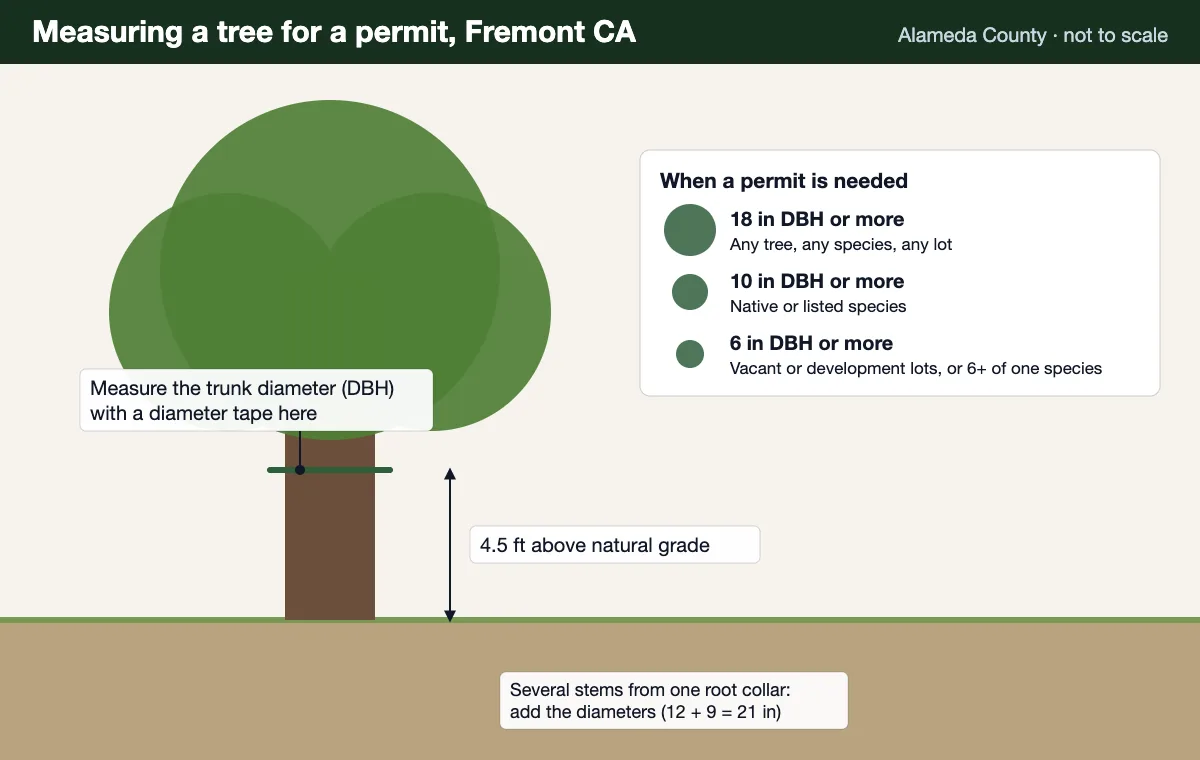
This catches people in a specific and predictable way. A homeowner establishes, correctly, that the tree is theirs under Civil Code 833. They conclude, incorrectly, that they may therefore remove it. Fremont Municipal Code 18.215.050 regulates any tree at 18 inches diameter at breast height, and any native or exceptionally adaptable species at 10 inches, regardless of who owns it. Ownership is necessary but not sufficient.
It cuts the other way too. If a neighbour's protected oak is overhanging your roof, the fact that Fremont protects it does not make the overhang your problem to accept forever, but it does mean the pruning has to be done to a standard that keeps the tree healthy, because damage under FMC 18.215.030 expressly includes topping and cutting expressly includes pruning and trimming.
Read protected trees in Fremont for the thresholds and the drip line rule, and the permit walkthrough for what the City requires.
What actually resolves these disputes
A written arborist assessment, delivered to the neighbour before anyone cuts anything, resolves most Fremont boundary tree disputes at a fraction of the cost of the alternative. It converts an argument about whose tree is being unreasonable into a document about what the tree can tolerate.
The order that works on Fremont properties:
- Establish where the trunk sits relative to the recorded line. If it is close, get a survey rather than a tape measure.
- Check whether the tree is protected under FMC 18.215, or is a City street tree under FMC 12.30.
- Get an arborist assessment of what pruning the tree can take without harm, in writing.
- Send the assessment to the neighbour with a proposed scope, before scheduling anything.
- If the tree is protected or owned in common, get the permit and the agreement in place first.
A good arborist will say plainly when a proposed cut is going to hurt the tree. That is worth more to you in a dispute than a contractor who will cut whatever you point at.
This page is general orientation for Fremont property owners and is not legal advice. For a live dispute, consult a California attorney.
Neighbor tree questions
Who is responsible for trees on property lines in California?
California Civil Code 834 says trees whose trunks stand partly on the land of two or more coterminous owners belong to them in common, which makes a true boundary tree jointly owned. Joint ownership means neither owner can remove or substantially destroy the tree without the other's agreement, and both generally share responsibility for it. If the trunk stands wholly on one side, Civil Code 833 makes it that owner's tree alone.
Who pays for tree removal between neighbors in California?
The owner of the tree pays, and ownership is decided by where the trunk stands under Civil Code 833 and 834. If the trunk is wholly on your neighbour's land, the tree is theirs and the removal is theirs to pay for, even if the canopy is mostly over your garden. If the trunk straddles the line it is owned in common and the cost is ordinarily shared, which in practice means it has to be agreed.
Can I cut branches that hang over my property in California?
You generally may prune encroaching branches and roots back to the property line at your own expense, but that right is not unlimited. California courts have held that the right cannot be exercised unreasonably or negligently in a way that damages or kills the neighbour's tree, so cutting back to the line in a manner that destabilises or kills the tree exposes you to liability for the whole tree.
Can I keep the fruit from branches hanging over my fence?
The fruit belongs to the owner of the tree, which is determined by trunk location under Civil Code 833. Overhang gives you a right to abate the encroachment, not a right to the tree's produce, so picking fruit from a neighbour's overhanging branch is not something the overhang rule authorises.
What happens if I damage my neighbor's tree?
California Civil Code 3346 sets the measure of damages for wrongful injury to trees at three times the sum that would compensate for the actual detriment, reduced to double where the trespass was casual or involuntary or where the defendant had probable cause to believe the land was their own. Code of Civil Procedure 733 separately makes a person who cuts down or injures a tree on another's land liable for treble damages. Because tree value is appraised rather than measured by removal cost, a trebled figure on a mature specimen is substantial.
How long does my neighbor have to sue over a damaged tree?
Civil Code 3346 provides a five year limitations period for timber trespass actions, running from the date of the trespass. That is considerably longer than people assume, and it means a pruning dispute does not quietly go away after a season or two.
My neighbor's tree roots are lifting my driveway. What can I do?
Start with the same self help principle: you may cut encroaching roots at the boundary line, but not in a way that is unreasonable or negligent toward the tree. Root cutting is far more likely than branch pruning to destabilise or kill a tree, so get an arborist to assess how much root plate can be severed safely before anyone touches a saw, and put the assessment in writing.
Does Fremont's tree ordinance override neighbor tree law?
It sits on top of it rather than overriding it. Civil Code 833 and 834 tell you who owns the tree, and Fremont Municipal Code 18.215 tells you whether the City regulates cutting it. A tree can be unambiguously your neighbour's under state law and still be a protected tree that neither of you may remove without a City permit.
What if the tree in dispute is in the strip by the road?
Then it is probably neither of yours. Under FMC 12.30.010 a tree whose base sits wholly or partly in the public right of way is a City street tree, and the right of way includes the park strip, the sidewalk and any dedicated planting easement. Code of Civil Procedure 733 specifically extends treble damages to trees on the street or highway in front of a house, so unauthorised cutting there carries both civil and municipal exposure.
Can my neighbor make me remove a tree they think is dangerous?
Not directly, but a documented warning changes your position. Once you have been put on notice that a tree of yours presents a hazard, a subsequent failure that damages their property is much harder to defend as unforeseeable. The practical response to a hazard complaint is a written arborist assessment, not an argument.
Do I need my neighbor's permission to prune a boundary tree?
For a tree owned in common under Civil Code 834, yes in substance. Neither co owner may remove or substantially destroy a commonly owned tree unilaterally, so significant pruning of a true boundary tree should be agreed in writing before work starts. Ordinary maintenance pruning is a grey area best resolved by agreement rather than by testing it.
Is this legal advice?
No. This page is orientation for Fremont property owners about the statutes that govern tree disputes in California, and it is not legal advice. For a live dispute, particularly one involving a mature or protected tree, talk to a California attorney before anything is cut.
Related Pages
Get the assessment before the argument
Send the address and a description of the tree and the boundary for a free estimate. Get in writing what the tree can safely take and whether the City regulates it.
- Free written estimate, no obligation
- Check whether your tree is protected before work starts
- Ask any crew for its CSLB license and certificate of insurance
- Mark storm damage as urgent in your request