Crane tree removal in Fremont, CA
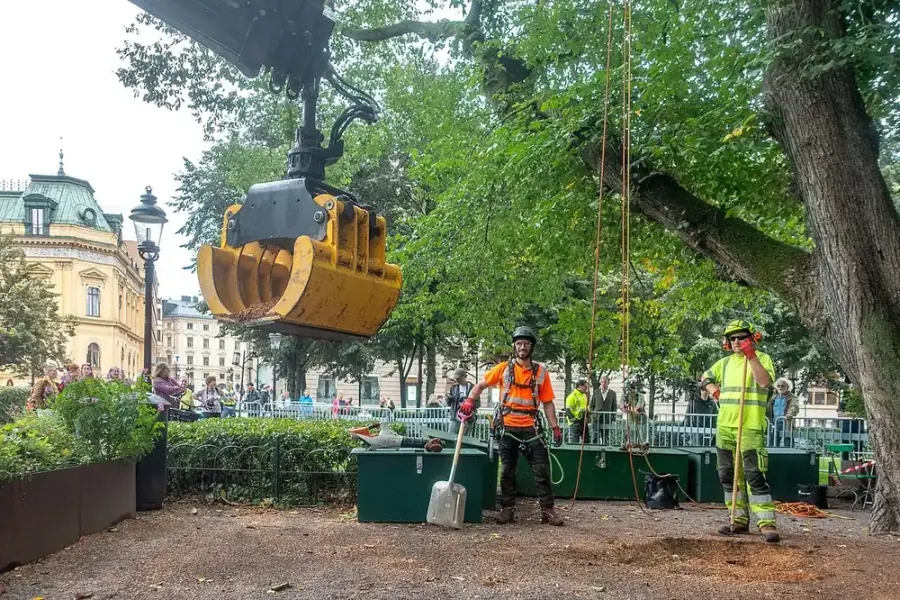
When a crane is the right method
A crane earns its place in four situations: the tree is over a structure with no drop zone, the tree is too decayed to climb, there is no safe way to lower sections through the tree, or it is a tall palm with nothing to rig from. Outside those cases, climbing and rigging is usually the better answer, and a good crew will say so.
Over a structure, no drop zone
Every section has to travel somewhere other than straight down. Lowering heavy wood through the tree over a roof loads both the tree and the rigging points repeatedly. A crane lifts it out vertically instead.
Decayed or dead
A climber dismantling a decayed tree is working from a structure whose soundness is exactly the thing in question. If the tree cannot be trusted to hold a climber, it should not be holding a climber.
Storm damaged and loaded
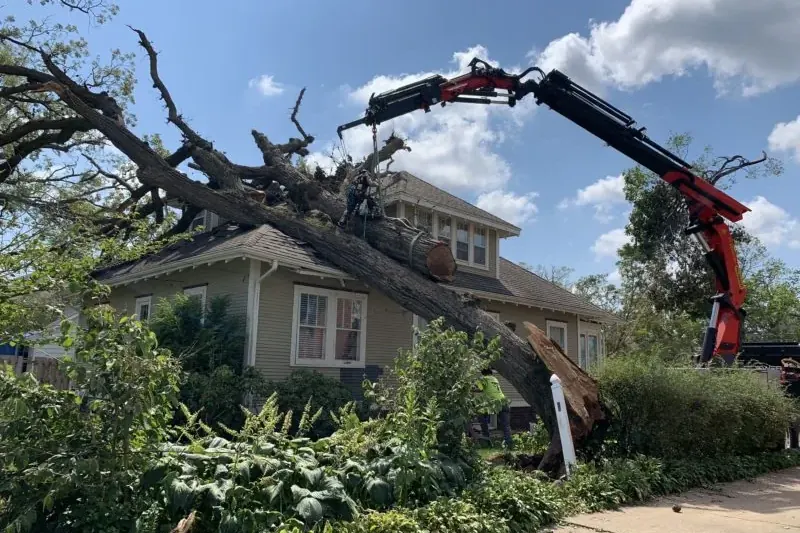
A tree resting on a house is already carrying stored energy in unpredictable places. Taking the weight before cutting is the whole point, and it is the clearest crane case there is.
Tall palms
No lateral branches means no anchor points and no rigging. Above roof height over a structure there is no good felling line either, so the sections come out by crane.
In Fremont the two most common triggers are winter storm failures onto roofs, which are covered on emergency tree service, and tall Mexican fan palms that have outgrown the lots they were planted on.
Radius, not size: what actually governs the job
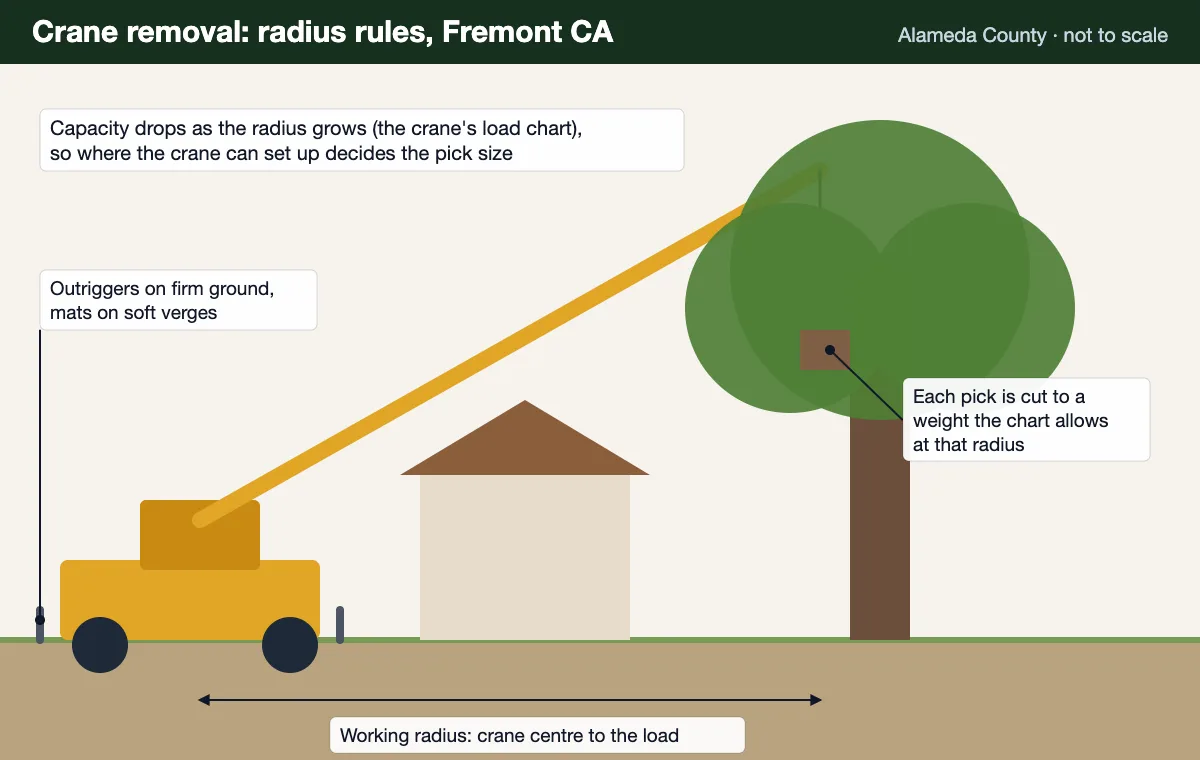
A crane's lifting capacity falls sharply as the boom extends, so the distance from the machine to the tree, and then out to the landing zone, sets the picks and therefore sets the machine. This is why two apparently identical trees on the same street can price very differently.
The tree by the kerb is at a short radius from a crane parked in front of the house. The identical tree in the back garden, behind a wide house, is at a much longer one, and at that reach the same machine can only lift a fraction of what it manages close in. The options become smaller picks, which means more of them and more time, or a bigger crane, which means a different day rate and often a larger set up footprint.
That also explains why a crane can reach a back garden tree at all on a lot where no other machine can get past the house. The crane goes over the building rather than through the side gate. It is the single most useful property of the method on tight Fremont lots, and it is bounded entirely by reach.
Roughly how far the tree is from the street, what is between the street and the tree, the approximate height and trunk diameter, the species if you know it, and where there is space to set wood down. A photo from the street showing the house and the tree in the same frame answers most of that at once.
Set up, ground bearing and the street
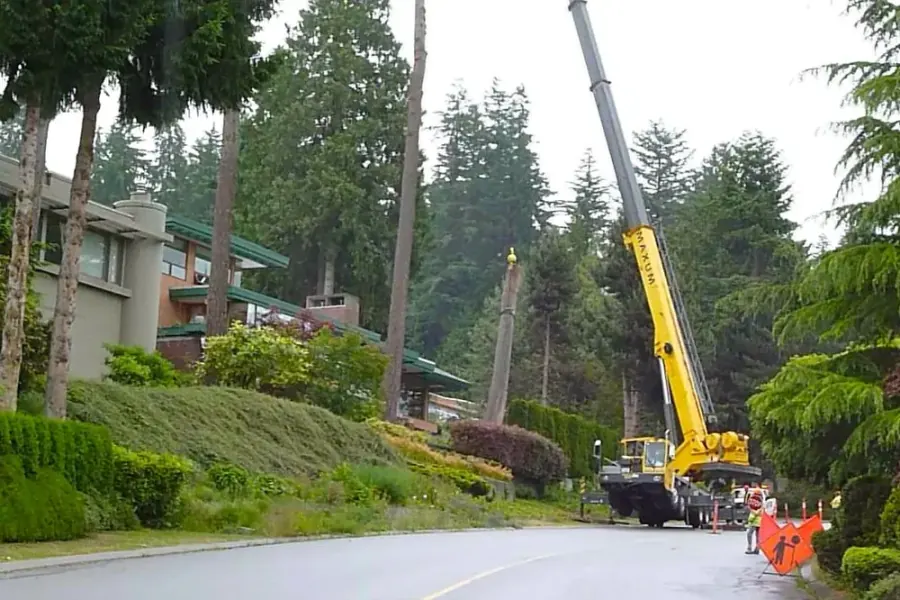
Outriggers concentrate very large point loads into small footprints, so what is underneath the set up position is a real engineering question rather than a formality. On most Fremont residential lots the machine sets up in the roadway, because driveways are rarely wide or strong enough and back gardens are almost never accessible.
Reasons a set up position gets rejected, all of them common on a Fremont street:
- Septic systems and leach fields. Point loading over a septic component is an expensive mistake.
- Drainage, sewer laterals and utility vaults. Shallow, and not always where the plans say.
- Unreinforced driveway slabs. They crack under outrigger loads and the crack is permanent.
- Soft verge or recently disturbed ground. Especially after Fremont winters, when the soil has taken 82 percent of its annual water.
- Overhead conductors. Anything near an energized line changes the job completely and the utility is involved before anyone else is.
Matting spreads outrigger loads where ground bearing is marginal. Where no position works, the honest answer is that a crane is not the right method for that property and the job goes back to climbing and rigging at a different price.
Setting a crane up in the public right of way is an encroachment, and Fremont regulates encroachments under FMC Chapter 12.05. Authorisation, traffic control and clearing parked cars out of the set up zone all get arranged before the day. A crane arriving to find two cars in the way is an expensive delay that nobody wants to pay for. This is separate from, and additional to, any tree removal permit the tree itself needs.
How a pick actually works
The section is slung and the crane takes its weight before the cut is made, not after. That single ordering is what makes the method safe. Nothing falls, nothing swings, and nothing travels through the tree it came out of.
The sequence, repeated for every section from the top down:
- Attach. The climber or bucket operator sets the sling at the balance point of the section to be taken.
- Take the weight. The crane lifts until the section is supported and the operator confirms the load.
- Cut. The section is severed while fully supported. It does not move.
- Lift clear. Vertically, above the roofline, above the fence, clear of everything.
- Swing and set down. Over to the landing zone, where the ground crew processes it while the crane returns for the next pick.
The landing zone is planned at the same time as the set up position, because a crane that can reach the tree but has nowhere to put the wood is only half a solution. On a street set up the landing zone is usually part of the closed section of roadway, which is another reason the traffic control arrangement matters.
What crane removal costs, and why it is often the cheaper option
Fixr puts crane assisted removal on trees of 80 feet and above at $1,500 to $2,500 nationally, with Bay Area pricing above that, and on the right job it comes in below what the same tree would cost to dismantle by climbing. The comparison people make is machine hire against no machine hire, and that is the wrong comparison.
The right comparison is a single day with a crane against two or three days of technical rigging with a full crew, plus the risk that goes with repeatedly loading a compromised tree. Crew days are the dominant cost in tree work, and compressing three into one usually more than covers the machine.
What sits on top of the crane line on a Fremont job:
- Species and size. Fixr puts eucalyptus removal at $700 to $2,200 and oak at $900 to $2,000 before the crane element, and both are dense heavy woods common here.
- Radius. Longer reach can mean a larger machine, which is a different rate.
- Street arrangements. Encroachment authorisation and traffic control under FMC Chapter 12.05.
- Debris. A large tree produces a great deal of wood, and haul away versus leaving rounds is a real line item.
- The stump. Priced separately, by diameter. See stump grinding.
- Emergency timing. Fixr puts emergency removal at $450 to $5,000 depending on the job, and after hours work carries a premium.
Full planned removal pricing, including the species and size tables, is on the tree removal cost page.
How a Fremont crane removal runs
Six steps, and the first three all happen before the crane leaves the yard. Crane jobs are won or lost on preparation, not on the day.
- 1
Assess the tree, the target and the radius
The controlling question is not how big the tree is, it is how far the crane has to reach. A crane's lifting capacity falls sharply as the boom extends, so a modest section at a long radius can be a heavier problem than a large one close in. The plan works out where the machine can legally and safely stand, measure from there to the tree, and size the picks against that.
- 2
Plan the set up position and the ground under it
Outriggers concentrate enormous point loads into a small footprint, so what is under them matters. Septic systems, drainage, utility vaults, irrigation, unreinforced driveway slabs and soft verge are all reasons to move the machine. Matting spreads the load where the ground is marginal, and where no position works, a crane is simply not the right method.
- 3
Sort the street access before the day
On most Fremont residential streets a crane sets up in the roadway, which is an encroachment on the public right of way and Fremont regulates encroachments under FMC Chapter 12.05. That means arranging authorisation, traffic control and parking clearance in advance. A crane arriving to find two cars in the set up zone is an expensive delay.
- 4
Rig each pick before it is cut
The climber or the bucket operator attaches the sling to the section first, the crane takes the weight, and only then is the cut made. That sequence is the whole point of the method. The section never falls, never swings into the house, and never has to be lowered through the tree it came out of.
- 5
Lift out, swing clear, set down on the landing zone
Each section is lifted vertically clear of the structure, swung over to the landing zone and set down for the ground crew to process. The landing zone is planned alongside the set up position, because a crane that can reach the tree but has nowhere to put the wood is only half a solution.
- 6
Process, clear and finish the stump
Sections are cut down, brush is chipped, rounds are hauled or left as agreed, and the site is cleared. The stump is a separate decision and gets priced separately, because whether it is ground or excavated depends entirely on what you want the ground to do afterwards.
Crane removal questions
How much does crane tree removal cost in Fremont?
Fixr puts crane assisted removal on trees of 80 feet and above at $1,500 to $2,500 nationally, and Bay Area pricing runs above national figures. The crane itself is only part of it, because the job also carries the ground crew, the traffic control and street authorisation where the machine sets up in the roadway, and the debris handling, which on a large oak or eucalyptus is substantial in its own right.
Is a crane more expensive than climbing the tree down?
Often it is cheaper, which surprises people. A crane turns a two or three day technical rigging job into a single day with far less risk, and the crew cost of those extra days plus the risk premium usually exceeds the machine hire. The cases where a crane genuinely costs more are small trees, long reaches that force a much larger machine, and properties where the crane has nowhere to set up.
When is a crane necessary rather than optional?
When the tree is over a structure and cannot be safely dismantled by lowering sections through itself, when the tree is dead or decayed to the point that it is not safe to climb, when there is no drop zone at all, and on tall palms where there are no lateral branches to rig from. A storm damaged tree resting on a roof is the clearest case of all, because the tree is already loaded and taking it apart in place is the dangerous option.
Does the crane have to be in the street?
On most Fremont residential lots, yes, because a driveway is rarely wide enough or strong enough and the back garden is almost never accessible. Setting up in the public right of way is an encroachment, and Fremont regulates encroachments under FMC Chapter 12.05, so authorisation and traffic control are arranged in advance. Part of the preparation is making sure the set up zone is clear of parked cars on the day.
Will the crane damage my driveway or lawn?
The risk is real and it is managed rather than ignored. Outriggers concentrate very large point loads into small footprints, which is why the set up position is chosen with what is underneath it in mind, and why matting is used where ground bearing is marginal. Septic systems, drainage runs, utility vaults and unreinforced slabs are all reasons to move the machine rather than reasons to risk it.
How long does a crane removal take?
Most residential crane removals are a single day on site, with the crane itself often needed for only part of that. The set up and the dismantle each take real time, the picks themselves are quick, and the ground processing of the wood usually outlasts the crane. That concentration is exactly why the method is efficient compared with several days of climbing and rigging.
Can a tree be craned out of a back garden?
Frequently yes, because a crane reaches over the house rather than needing to get past it, which is the entire advantage of the method on a tight lot. What decides it is radius: the distance from where the crane can stand to the tree, and then out to the landing zone. Lifting capacity drops sharply with reach, so a back garden tree can need a substantially larger machine than the same tree in a front yard.
Do I need a permit for a crane removal in Fremont?
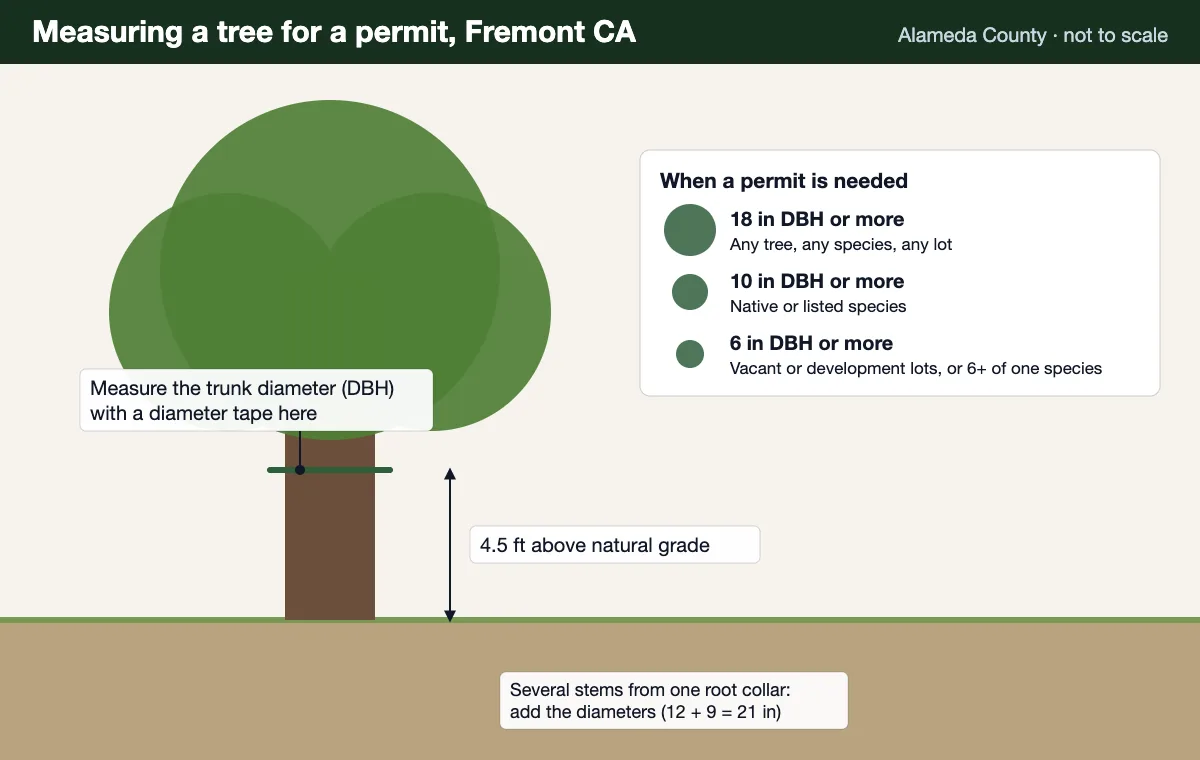
Two separate permissions can apply and they are independent of each other. The tree itself may need a removal permit if it is protected under FMC Chapter 18.215, and that question is about the tree, not the method. The crane set up in the roadway is an encroachment on the public right of way, which Fremont regulates under FMC Chapter 12.05 and which the contractor normally arranges.
Is a crane removal safer than climbing?
For the specific situations it is used in, substantially. A climber dismantling a decayed tree is working from a structure whose soundness is the exact thing in question, and rigging heavy sections down through a tree over a house loads both the tree and the rigging points repeatedly. With a crane the section is supported before it is cut, never falls, and never travels through the tree. That is why crane use has grown in the trade rather than remaining a specialty.
What happens if the tree is on my house right now?
Get everyone clear of the affected part of the house, treat any nearby wire as live and call the utility and 911 if lines are involved, then photograph everything before any cutting starts. Do not go onto the roof. A tree resting on a structure is a loaded object that can shift when disturbed, which is precisely the case a crane exists for, because the weight is taken before anything is cut. See our emergency tree service page for the full sequence.
Why does a crane cost more for a tree further from the street?
Because lifting capacity falls as the boom extends, so reaching further means either lighter picks or a bigger machine, and a bigger machine is a different day rate and sometimes a different set up footprint. This is why two apparently identical trees on the same street can price differently: the one in the back garden behind a wide house is at a much longer radius than the one by the kerb.
Are tall palms a crane job?
Tall palms are one of the clearest crane cases there is, because a palm has no lateral branches, which means there is nothing to rig from and nothing to climb to except the trunk. A Mexican fan palm above roof height over a structure has no good felling line and no rigging points, so the sections come out by crane. See the palm page for how the rest of that job differs from tree work.
Related Pages
One photo from the street shows most of it
Stand far enough back to get the house and the tree in the same frame, then add a shot from beside the tree looking back toward the road. Radius and set up are what matter, and that pair shows both.
- Free written estimate, no obligation
- Check whether your tree is protected before work starts
- Ask any crew for its CSLB license and certificate of insurance
- Mark storm damage as urgent in your request