Tree Service in Newark CA
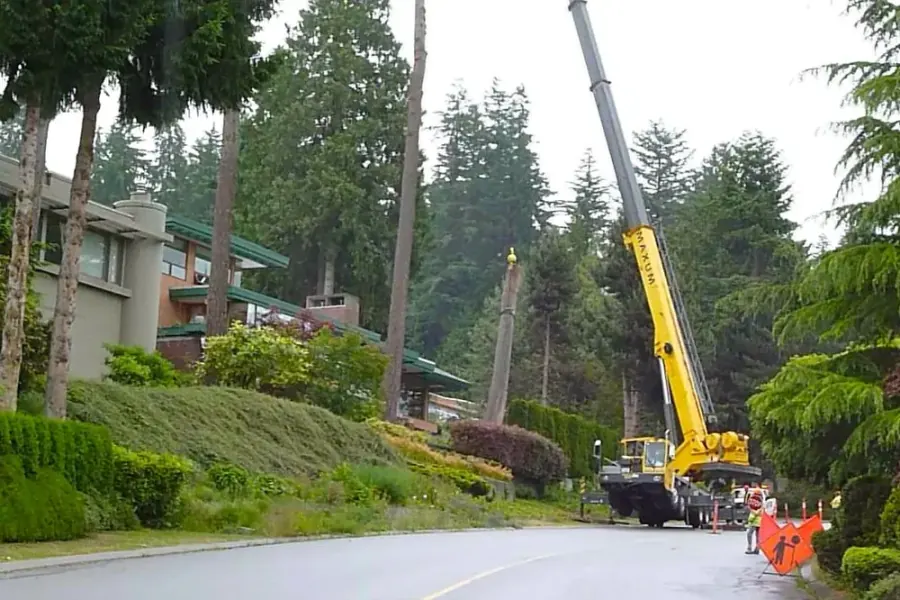
Newark is its own city, with its own rules
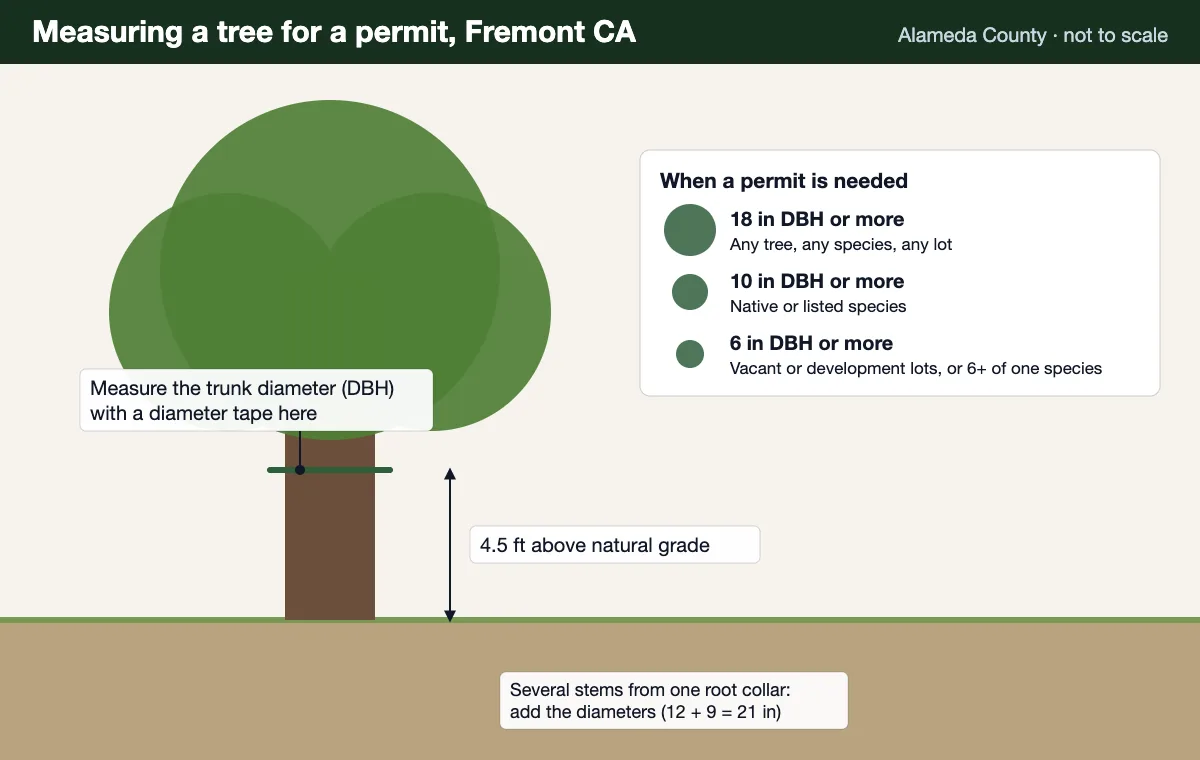
Newark is a separate incorporated city, not a district of Fremont, and that is the single most important thing to know before booking tree work here. Fremont Municipal Code Chapter 18.215 on protected trees and Chapter 12.30 on street trees govern Fremont parcels. They do not govern yours.
Newark was incorporated on September 22, 1955, several months before Fremont unified on January 23, 1956. It covers 13.94 square miles with a 2020 census population of 47,529, and it is an enclave surrounded by the city of Fremont, with Interstate 880 forming the eastern boundary between them. Together with Fremont and Union City it makes up the Tri-City Area.
In practice that means a crew quoting your Newark tree with Fremont’s rules in mind is working from the wrong rulebook. Confirm anything permit related with the City of Newark directly rather than relying on a third party summary, including ours.
Wind off the bay, with nothing in the way
Wind is the defining tree stress in Newark, because there is no terrain between the trees and the bay. The city’s western edge borders San Francisco Bay and the whole of Newark sits at roughly 20 feet of elevation on flat ground, so prevailing wind arrives unobstructed and loads trees from a consistent direction year after year.
You can read that history in the trees themselves. One sided crowns, reaction wood built up on the leeward side of the trunk, and a permanent lean away from the bay are all normal here rather than signs of a problem. What is a problem is a tree that has developed a heavy, dense crown at height while its root plate sits in ground that saturates every winter.
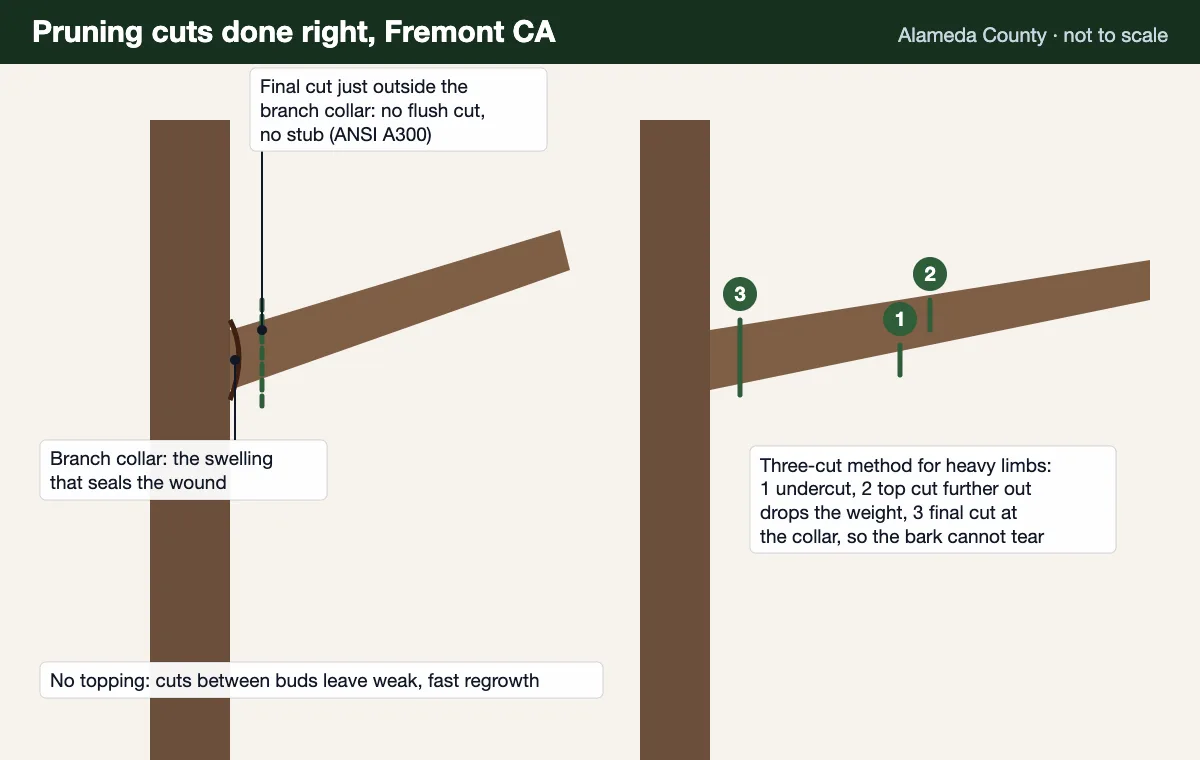
Crown reduction genuinely helps in this situation, provided it is done correctly. Shortening the longest limbs back to appropriate lateral branches reduces the sail and the lever arm together. Stripping the interior foliage and leaving tufts at the branch tips, which the trade calls lion tailing, lengthens the lever arm and makes failure more likely. If a crew cannot explain the difference, get another quote. See tree trimming.
Low flat ground and what it does to roots
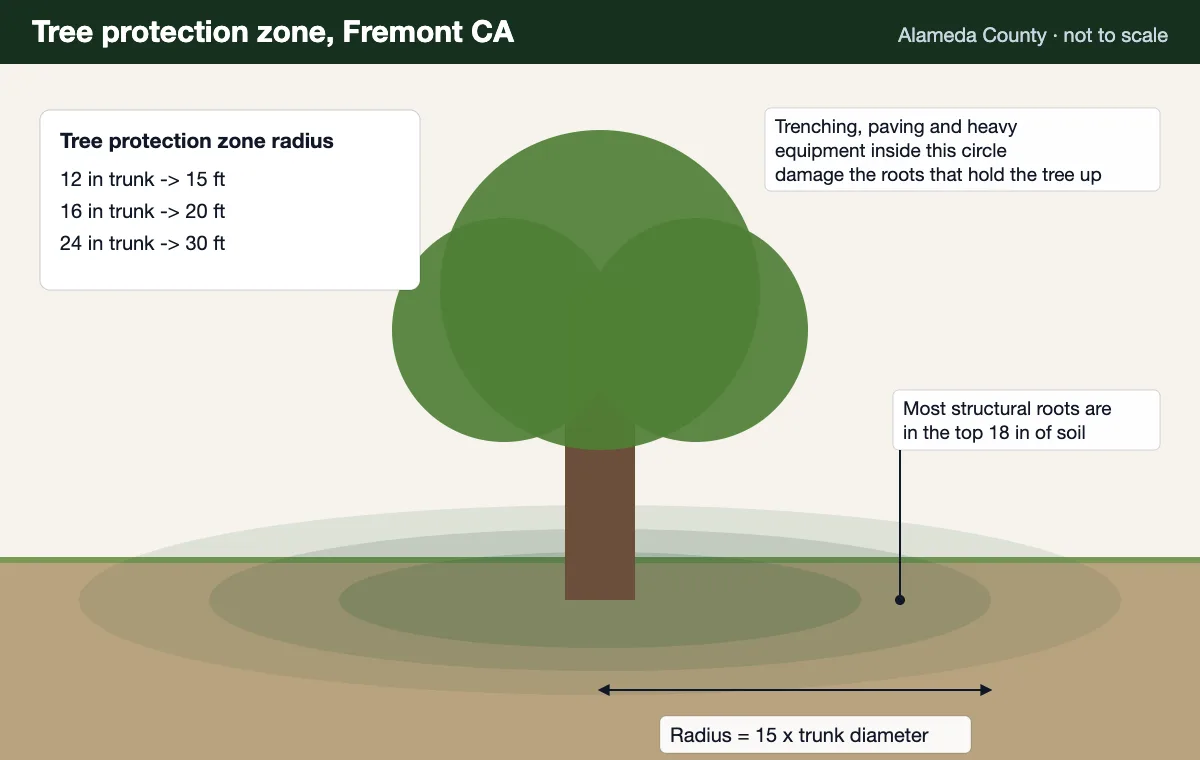
On Newark’s low ground, trees usually fail at the base rather than in the canopy, so the root collar is the first place to look. Flat bay plain drains differently from a Fremont hillside: water does not run off, it sits, and a root collar that stays wet through the winter is a root collar that decays.
Fremont and Newark share the same sharply seasonal rainfall. NOAA 1991 to 2020 climate normals for the nearest station record 16.00 inches annually with 13.08 inches of it, about 82 percent, falling November through March, against just 0.33 inches across the whole of June through September. On a slope that water moves. On flat ground at 20 feet elevation, it lingers.
The bay margin itself adds to this. Newark has a long industrial salt history and Cargill Salt remains one of its larger employers, with 202 people as of June 2025, and the city shares a portion of the Don Edwards San Francisco Bay National Wildlife Refuge with Fremont. On the lowest ground closest to the bay, soil and water table conditions are simply harder on trees than the blocks up against I-880. When a tree there is thinning out, look at the root zone before you assume a canopy disease. See tree disease treatment.
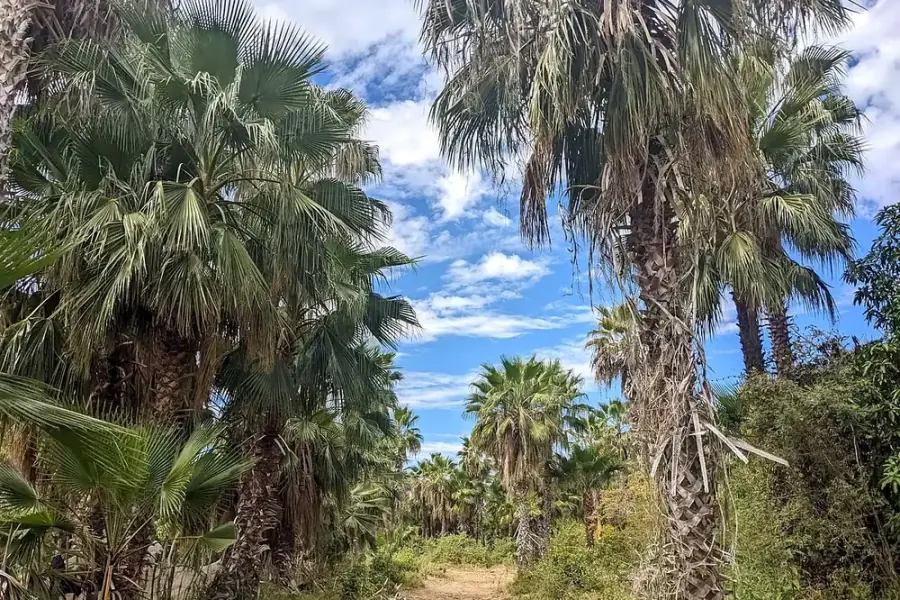
Palms, and why they need their own logic
A palm is not a tree in the way an oak is a tree, and treating it like one is how people kill them. A palm is a monocot with no cambium and no secondary growth, so it cannot compartmentalise a wound or grow new wood over damage. Cut into the trunk and that injury is permanent.
More importantly, a palm has a single apical meristem. The growing point sits at the top and there is only one. Cut the crown off and the palm is dead, no matter how healthy the trunk looks afterwards. Palms also have no branch collar, which means the pruning rules that govern where to cut a shade tree simply do not transfer.
On price, palms are the widest band on both published trimming tables: $100 to $1,500 at Fixr and $100 to $1,330 at LawnStarter. That spread is honest rather than vague. A short palm you can reach from a ladder genuinely is a hundred dollar job. A mature specimen at sixty feet with a heavy skirt is a climb with a rigging plan. See palm tree removal and trimming.
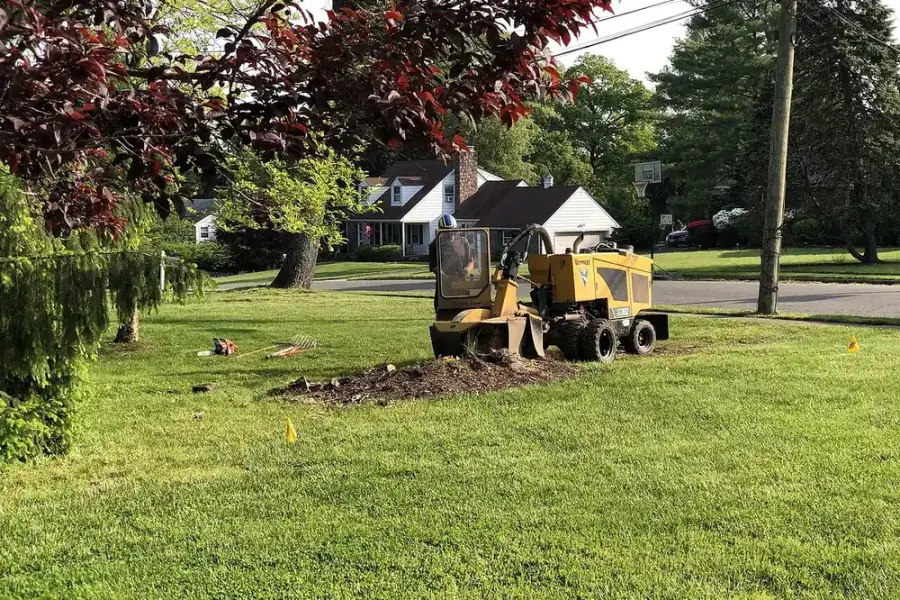
What tree work costs in Newark
Published national ranges put tree removal at $385 to $1,070 with a $630 average (LawnStarter) and $400 to $1,100 with a $435 average (Fixr), and trimming at $175 to $750 with a $450 average (Fixr). Bay Area pricing sits above all of those, and the clearest marker we can source is LawnStarter’s San Diego trimming range of $478 to $710 against its $430 to $640 national band, roughly eleven percent above national. The Bay Area labour market runs above San Diego.
Newark has one real advantage on price. Flat lots, wide streets and generally accessible side gates keep most jobs away from the expensive end of the access scale, which is where hillside Fremont work lands. Fixr publishes trimming by difficulty at $75 to $300 for low, $200 to $600 for medium and $600 to $1,800 for high, and most Newark residential work sits in the first two bands rather than the third.
This site will never print a national average as if it were a Newark number. Expect a real quote in the upper half of the published band for your tree’s size and species, and treat a quote well below the published floor as a prompt to ask what the crew is not carrying. See tree removal cost and tree trimming cost.
How a Newark job should run
- 1
Note the street and how close you are to the bay edge
Newark sits at about 20 feet of elevation across a flat bay plain, and the properties closest to the western bay margin see more wind and different drainage from the blocks against I-880. Where you sit on that gradient changes what is failing and why.
- 2
Confirm which jurisdiction your tree is in
Newark is its own incorporated city, not a district of Fremont, so Fremont Municipal Code Chapters 18.215 and 12.30 do not apply to your tree. Check Newark's own requirements with the City before quoting rather than assuming Fremont's rules carry across the boundary.
- 3
Assess wind loading and crown sail
On a flat bay plain with no hill shelter, prevailing wind off the bay hits trees from a consistent direction their whole lives. Look at one sided crowns, reaction wood, and whether correct crown reduction will genuinely lower the load rather than just remove foliage.
- 4
Check the root collar and drainage
Low flat ground holds water differently from a Fremont hillside. Look at the root collar for burial, decay and standing moisture, because on this kind of site a tree usually fails at the base rather than in the canopy.
- 5
You get a written scope, not a verbal number
The quote names the trees, the cuts, the debris outcome, the access method, and the licence and insurance carried. Tree work in California is a C-49 Tree and Palm Contractor classification under the Contractors State License Board, so ask to see the licence and the certificate of insurance.
- 6
Schedule around wind and saturation
No one should climb or rig in high wind, and work on saturated ground should be timed around the winter rains. If your job would be safer in a calmer window, a good crew says so rather than booking it for a day that suits the diary.
Newark CA tree service questions
Do you serve Newark CA?
Yes, Newark is a core part of the service area alongside Fremont and Union City, the three cities that make up the Tri-City Area. Newark is an incorporated city in Alameda County covering 13.94 square miles, with a 2020 census population of 47,529, and it is an enclave surrounded by the city of Fremont with Interstate 880 forming its eastern boundary with Fremont. Send the address through the form for a free estimate.
Do Fremont's tree ordinances apply in Newark?
No. Newark is a separate incorporated city with its own municipal code, so Fremont Municipal Code Chapter 18.215 on protected trees and Chapter 12.30 on street trees do not apply to a Newark property. Newark was incorporated on September 22, 1955, months before Fremont unified on January 23, 1956, and the two have always been distinct jurisdictions. Confirm Newark's own requirements with the City of Newark directly before any work is quoted.
What California law applies to my Newark tree regardless of city?
State law applies across every California jurisdiction and it covers ownership, damages and licensing. California Civil Code section 833 makes trunk position the ownership test, section 834 covers trees straddling a boundary, and section 3346 sets damages for wrongful injury to trees at three times the sum that would compensate for the actual detriment. California Code of Civil Procedure section 733 provides treble damages for unauthorised cutting, including on the street in front of a house. Tree work is a C-49 Tree and Palm Contractor classification under California Code of Regulations title 16 section 832.49.
Is Newark in a very high fire hazard severity zone?
No. Newark is flat bay plain at about 20 feet of elevation with its western edge on San Francisco Bay, and the very high fire hazard severity zone in this part of Alameda County is concentrated along Fremont's eastern hills, from Mission Peak south toward the Sunol border. That is a meaningful difference: the defensible space obligations that drive a lot of tree work in the Fremont hills are generally not the reason a Newark tree needs attention. Wind and drainage are.
Why do Newark trees get so much wind damage?
Because there is no terrain between them and the bay. Newark's western edge borders San Francisco Bay and the city sits at roughly 20 feet elevation across flat ground, so prevailing wind arrives unobstructed and hits trees from the same direction year after year. The result is one sided crowns, reaction wood on the leeward side, and trees that have been loaded in one axis their whole lives. Correct crown reduction genuinely helps here, provided it shortens long limbs back to laterals rather than stripping the interior.
Does the salt flat and bay margin history affect trees in Newark?
Near the western bay margin, yes, mainly through soil and water table rather than anything dramatic. Newark has a long industrial salt history and Cargill Salt remains one of its larger employers with 202 people as of June 2025, and the city shares a portion of the Don Edwards San Francisco Bay National Wildlife Refuge with Fremont. On the lowest ground closest to the bay, drainage and soil conditions are simply harder on trees than the blocks up against I-880. If a tree is struggling there, look at the root zone before you look at the canopy.
How much does tree removal cost in Newark CA?
Published national ranges put tree removal at $385 to $1,070 with a $630 average (LawnStarter) and $400 to $1,100 with a $435 average (Fixr), and Bay Area pricing sits above both. Newark's flat lots and generally good street access tend to keep jobs away from the expensive end of the access scale, which is a real advantage over hillside Fremont work. Expect a real quote in the upper half of the published band rather than at the midpoint. See the tree removal cost page for the full tables.
How should palms be trimmed or removed in Newark?
Palms need their own logic rather than shade tree logic. A palm is a monocot with no cambium and no secondary growth, so it cannot compartmentalise a wound or grow back over damage the way an oak does, and it has a single apical meristem, meaning the growing point at the top is the whole tree. Cutting the top kills it. Published palm trimming ranges run $100 to $1,500 (Fixr) and $100 to $1,330 (LawnStarter), which is wide because a short palm is a ladder job and a tall one is a climb. See the palm tree removal page.
What should I do about emergency tree damage in Newark?
If a tree or limb has come down, stay clear of anything still attached and under load, treat every downed wire as live, and call PG&E and 911 before calling any tree crew if conductors are involved. Do not cut anything that is still holding weight. Newark's flat street grid usually means faster access than a Fremont hillside job, which matters when something is lying across a driveway. See the emergency tree service page.
How do I know a Newark tree crew is legitimate?
Ask for the CSLB licence number and a certificate of insurance, then verify both yourself. Tree work in California is a C-49 Tree and Palm Contractor classification under California Code of Regulations title 16 section 832.49, approved by the Office of Administrative Law on March 30, 2022. Insurance should include workers compensation, because if an uninsured climber is hurt on your property the exposure can land on you. A crew that cannot produce either document on request is telling you something. See the page on how to hire a tree service.
Related Pages
Newark tree, Newark rules
Send the address and a photo for a free estimate, and confirm the right jurisdiction first.
- Free written estimate, no obligation
- Check whether your tree is protected before work starts
- Ask any crew for its CSLB license and certificate of insurance
- Mark storm damage as urgent in your request