Is it my tree or the City's tree?
The right of way is wider than the pavement
Fremont defines a public street as the entire width of the right of way, expressly including the park strip, the sidewalk and any dedicated planting easement between the adjacent property and the street line. That definition, in FMC 12.30.010, is the whole ball game. It means the City's jurisdiction routinely extends past the back edge of the sidewalk and into what looks like private front lawn.
Most Fremont subdivisions were platted with a right of way several feet wider than the paved surface. The strip of grass between kerb and sidewalk is obviously in it. What catches people is the band behind the sidewalk, which in many streets is also dedicated. A tree planted there by a previous owner, watered by you, and shading your front window can still be the City's asset.
A street tree is defined by where the trunk base sits, wholly or partly. If any part of the base is in the right of way, the entire tree is a street tree, even if ninety percent of the crown is over your roof. Conversely a tree rooted entirely on your lot whose branches overhang the road is a private tree governed by Chapter 18.215 instead.
Before you touch anything near the kerb, check the recorded subdivision map or your title documents for the right of way width, or ask the City. Guessing from where the lawn ends is how homeowners end up on the wrong side of this.
What you may and may not do to a Fremont street tree
You may clear low branches under 2 inches in diameter, and you may do incidental pruning on a newly planted tree under 15 feet tall. Everything else requires a street tree permit and a certified arborist. FMC 12.30.050 sets that line, requiring pruning to be performed by a certified arborist or under a certified arborist's supervision, with a permit, and carving out only those two narrow exceptions.
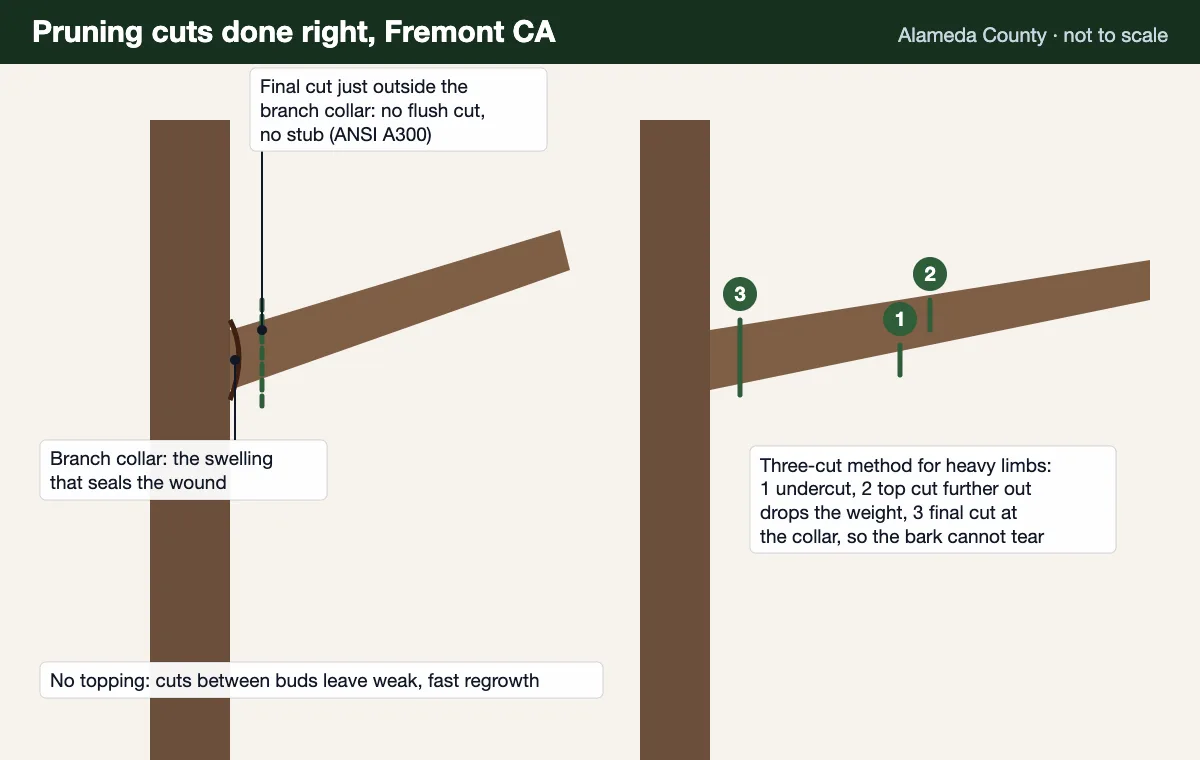
Section 12.30.060(b) goes further and prohibits topping a street tree outright unless the city manager grants written authorisation on clear evidence of extraordinary circumstances. All pruning must follow the current ISA Tree Pruning Guidelines. That is an unusually specific standard to write into a municipal code and it tells you how seriously Fremont takes street tree work.
Three more prohibitions worth knowing:
- 12.30.140 prohibits attaching anything to a street tree without written permission. Lights, cables, signs, brackets.
- 12.30.170 makes damaging a street tree unlawful and expressly includes paving within 4 feet of the trunk.
- Any work in the right of way needs an encroachment permit under Chapter 12.05, separate from the street tree permit itself.
The four foot paving rule is the one that quietly catches residential projects. Widening a driveway, adding a frontage path, or putting decorative gravel right up to a street tree trunk all sit inside it.
Getting a street tree removed
A Fremont street tree may only be removed under a street tree permit, under an approved development plan, or under an emergency authorisation from the city manager. FMC 12.30.070 sets those three routes and no others, and FMC 12.30.080(b) lists seven separate grounds on which the City may grant a nonemergency removal permit.
If the tree is lifting your sidewalk, in decline, structurally compromised, or in conflict with a permitted project, an application is the route. A private contractor cannot authorise the work for you and should not agree to do it without seeing the permit.
Once removal is authorised, 12.30.070 attaches three obligations:
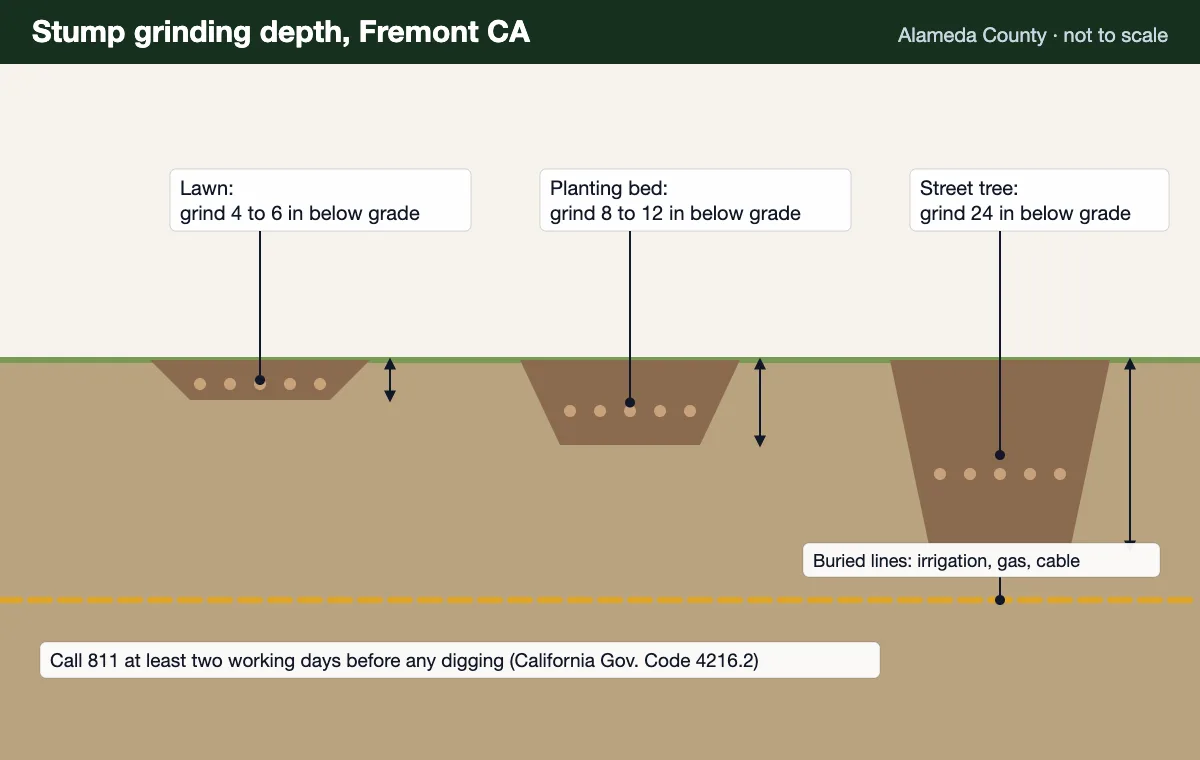
- The stump must be ground to 24 inches below grade or removed entirely. That is roughly double a standard private stump grind depth, so budget accordingly.
- Any damage to the right of way must be repaired.
- The adjoining property owner is responsible for replacing the tree.
That last point surprises people. The City owns the tree, controls the decision, and the frontage owner pays to put a new one in. If you want to understand the depth requirement and what it does to a quote, see our stump grinding page.
Storm emergencies and the two business day rule
Emergency work on a Fremont street tree needs authorisation from City urban forestry staff, and a written description of the work plus the exact location must reach the maintenance department within two business days. That is FMC 12.30.090(d) and (e), and it is the mechanism that lets genuine emergencies be handled at two in the morning without the City losing track of what was cut.
In practical terms, if a street tree limb comes down across your driveway during a December storm, the call goes to the City first. Fremont takes 82 percent of its annual rainfall between November and March, and saturated soil plus wind is precisely what puts street tree limbs on the ground. This is a predictable seasonal event, not a freak one, and the City is set up for it.
For private trees on your own lot, storm response works differently and faster. See emergency tree service in Fremont for what happens when the failed tree is yours.
Why this matters more than it sounds like it should
Unauthorised work on a street tree is a municipal code violation with the tree valued as a public asset, which is a very different financial exposure from a dispute about a private tree. Bay Area cities have issued substantial penalties for unauthorised pruning of public trees, and the enforcement route does not depend on a neighbour complaining.
It also protects you from a bad contractor. A crew that offers to take out the tree by your kerb next Tuesday, cash, no paperwork, is offering you a liability rather than a service. A legitimate Fremont tree company asks where the right of way line is before it quotes, because the answer changes which chapter of the code governs the job, who has to apply, how deep the stump goes, and who pays for the replacement.
Chapter 12.30 was adopted by Ordinance 11-2010 section 5 on 25 May 2010. Confirm the current codified text with the City before relying on any summary, this one included.
How to handle a street tree in Fremont, step by step
The first three steps establish whose tree it is. The last three are what the code requires once you know it is the City's.
- 1
Find where the trunk base actually sits
FMC 12.30.010 defines a street tree as a tree whose base is wholly or partly within a public street or right of way. Position of the canopy is irrelevant. If any part of the base is in the right of way, the whole tree is a street tree.
- 2
Work out how wide the right of way is
The code defines public street as the full right of way width, expressly including the park strip, the sidewalk, and any dedicated planting easement between the adjacent property and the street line. In many Fremont subdivisions that boundary sits several feet inside the sidewalk, which is why trees that look like they are on the lawn are often the City's.
- 3
Confirm the line before you assume
Check your title documents or the recorded subdivision map for the right of way width, or contact the City. Do not rely on where the lawn appears to end. A survey line and a landscaping line are not the same thing.
- 4
For pruning, get an arborist and a permit
FMC 12.30.050 requires street tree pruning to be performed by a certified arborist or under their supervision, and requires a street tree permit. The only exceptions are incidental pruning of a tree under 15 feet tall after planting, and removal of low branches under 2 inches in diameter for clearance.
- 5
For removal, apply for a street tree permit
Under FMC 12.30.070 a street tree may be removed only under a street tree permit, an approved development plan, or an emergency authorisation from the city manager. Section 12.30.080(b) sets out seven grounds on which a nonemergency removal permit may be granted.
- 6
Grind the stump and repair the right of way
FMC 12.30.070 requires the stump to be ground to 24 inches below grade or removed entirely, and requires any damage to the right of way to be repaired. An encroachment permit under FMC Chapter 12.05 has to be in hand before the work starts, and the adjoining owner is responsible for replacing the tree.
Street tree questions
Is my tree a City street tree or my tree?
It is a City street tree if the base of the trunk sits wholly or partly within a public street or right of way, under FMC 12.30.010. The right of way includes the park strip, the sidewalk and any dedicated planting easement between your property line and the street line, so the boundary usually sits further into your frontage than the edge of the pavement suggests.
Can I prune the street tree in front of my Fremont house?
Only under a street tree permit and only with a certified arborist doing or supervising the work, under FMC 12.30.050. Two narrow exceptions exist: incidental pruning of a tree less than 15 feet tall after planting, and cutting low branches under 2 inches in diameter for clearance. Anything beyond that needs the permit.
How do I request street tree trimming in Fremont?
Contact the City of Fremont urban forestry staff through the Public Works maintenance department to request work on a City street tree. Because the tree is the City's asset, City crews or City authorised contractors handle scheduled maintenance, and a private homeowner hiring their own crew without a permit is the exact scenario the ordinance is written to prevent.
Can I remove a street tree if it is damaging my sidewalk or sewer?
Not on your own authority, but sidewalk and infrastructure conflict is among the grounds the City can consider. FMC 12.30.080(b) sets out seven grounds on which a nonemergency street tree removal permit may be granted, so the route is an application to the City rather than a private contractor visit.
Is topping a street tree allowed in Fremont?
No. FMC 12.30.060(b) prohibits topping a street tree unless the city manager gives written authorisation based on clear evidence of extraordinary circumstances, and requires all pruning to follow the current ISA Tree Pruning Guidelines. Topping is the single fastest way to turn a routine clearance job into an enforcement matter.
What happens in a storm emergency with a street tree?
Emergency work on a street tree requires authorisation from City urban forestry staff, and FMC 12.30.090(d) and (e) require a written description of the work and the exact location to be delivered to the maintenance department within two business days. That reporting requirement is what allows genuine emergency response to happen quickly without leaving the City blind to what was cut.
Who pays to replace a removed street tree?
FMC 12.30.070 places replacement of the removed street tree on the adjoining property owner. So while the tree itself is the City's asset and the City controls what happens to it, the cost of putting a new one back falls to the person whose frontage it stands in.
Can I hang lights or a sign on a street tree?
No, not without written permission. FMC 12.30.140 prohibits attaching anything to a street tree without written City permission, which covers lights, signage, cables, birdhouses and anything fixed to the trunk or limbs.
Does paving near a street tree count as damaging it?
Yes. FMC 12.30.170 makes damaging a street tree unlawful and expressly includes paving within 4 feet of the trunk. That four foot band around a street tree trunk has to stay unpaved, which catches a lot of driveway widening and frontage hardscape projects.
How deep does a street tree stump have to be ground?
Twenty four inches below grade, or the stump must be removed entirely, under FMC 12.30.070. That is materially deeper than the 6 to 12 inches that is standard for a private stump grind, so a street tree stump costs more and takes longer.
Do I need an encroachment permit as well?
Yes. FMC 12.30.070 requires an encroachment permit under Chapter 12.05 before street tree removal work in the right of way begins. That is a separate permit from the street tree permit itself, and both have to be in place.
What is the 50/50 street tree program?
Fremont runs a cost shared street tree planting programme in which the City and the resident split the cost of planting a new street tree. Contact the City's urban forestry staff for current availability, species selection and cost share terms, since programme details change between budget cycles.
Related Pages
Not sure where the right of way line falls?
Send the address for a free estimate. Settle whether the tree in your frontage is yours or the City's before anything is scheduled, and if it is the City's, call the City first.
- Free written estimate, no obligation
- Check whether your tree is protected before work starts
- Ask any crew for its CSLB license and certificate of insurance
- Mark storm damage as urgent in your request