Do I need a tree removal permit in Fremont, CA?
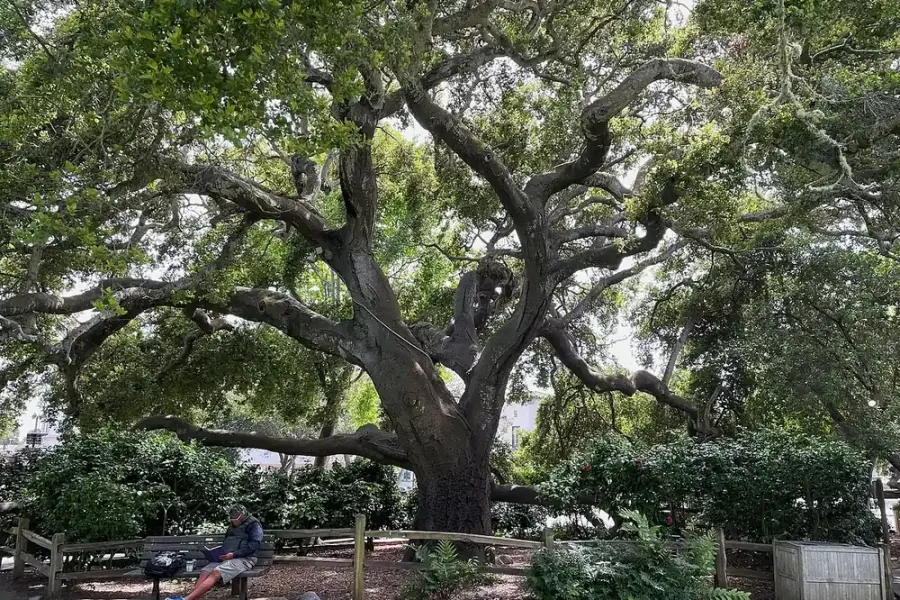
The seven permit triggers in FMC 18.215.050(a)
A Fremont tree needs a removal permit if it meets any one of seven conditions, and the two that catch most homeowners are the flat 18 inch DBH threshold for any species and the 10 inch threshold for natives. You do not need to satisfy all seven. One is enough. Here they are as the code lists them.
- Any tree 6 inches DBH or larger on a vacant or underdeveloped lot.
- Any tree 6 inches DBH or larger on a developed lot where a development application is pending or contemplated.
- A native tree, or a tree of exceptional adaptability, 10 inches DBH or larger.
- Any tree at all, of any species, 18 inches DBH or larger.
- Any tree the City required as mitigation for a previous removal.
- Any tree planted or retained as a condition of a development approval.
- Any tree that is one of a group of six or more trees of the same species on a single lot, where each is 6 inches DBH or larger.
Trigger seven is the sleeper. A row of seven planted redwoods along a property line is regulated at 6 inches each, even though no single one of them would be regulated standing alone. Fremont writes it that way because a screen planting is a canopy asset, and removing the row removes the asset.
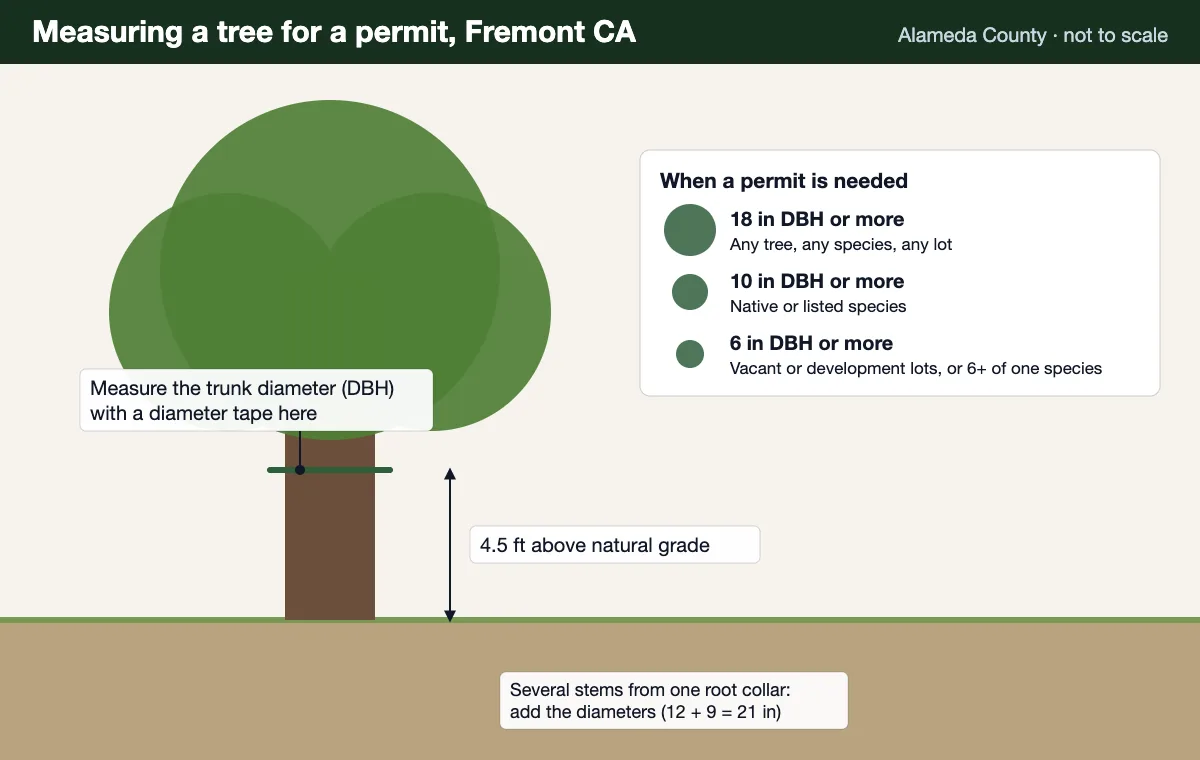
FMC 18.215.030 defines diameter at breast height as the trunk diameter measured 4.5 feet above natural grade. For a multi trunk tree the diameters of all trunks are added together. That addition rule is why coast live oaks, which very often fork low, land inside the ordinance more frequently than homeowners expect.
Which Fremont species drop the threshold to 10 inches
Oak, redwood, buckeye, madrone, sycamore, big leaf maple, red bud and bay are Fremont's native trees, and Fremont cottonwood, California pepper, European olive, black walnut and Deodar cedar are its trees of exceptional adaptability. Any tree on either list needs a permit from 10 inches DBH, eight inches earlier than a non listed species.
In practice this matters most for oaks. Coast live oak is the signature tree of the Fremont hills and the most common mature tree on Mission San Jose lots. A coast live oak reaches 10 inches DBH young, so the vast majority of established oaks in Fremont are regulated trees. If you are looking at an oak and wondering whether to call the City, assume the answer is yes and work backwards from there.
The exceptional adaptability list is Fremont acknowledging that some non native trees earn their keep in this climate. Two of them, black walnut and European olive, are also specifically carved out of the commercial fruit and nut exemption. You cannot call an olive a fruit tree and skip the permit.
If you are unsure what you have, see our Fremont oak care guide for identification, or send a photo through the form at the bottom of this page.
The exemptions that let you skip the permit
The main residential exemption, FMC 18.215.050(c)(1), applies to a developed lot of 10,000 square feet or less, zoned R-1 or a single family detached planned district, where the tree stands behind the forward most face of the front of the principal building. In everyday terms: a standard Fremont subdivision lot, back garden, tree behind the front plane of the house.
The other exemptions in 18.215.050(c) are narrower:
- Trees growing in a container rather than in the ground.
- Commercial fruit and nut species, except black walnut and olive, which stay regulated.
- An emergency, where a City official has determined that an emergency exists. Note the wording: the determination is the City's, not yours and not your contractor's.
- Work performed by a public utility.
No exemption applies to a landmark tree or to a tree that was planted as required mitigation for an earlier removal. If a previous owner took out a protected oak and planted three replacements as a condition of that permit, those three replacements are permanently regulated regardless of lot size or where they sit on the lot.
Read the ordinance text rather than any contractor's summary of it, this page included. The full Fremont Municipal Code, including Chapter 18.215 on protected trees and Chapter 12.30 on street trees, is published on Municode. Permit applications, current fee schedules and Planning Division contact details are on the City of Fremont website. Codes are amended, so a live source beats a snapshot every time.
If the tree is in the strip by the kerb, this page does not apply
A tree whose base sits wholly or partly in the public right of way is a City street tree under FMC Chapter 12.30, not a private tree under Chapter 18.215, and you cannot remove it or even prune it on your own authority. Chapter 12.30.010 defines the public street as the full right of way width, which includes the park strip, the sidewalk and any dedicated planting easement between your property line and the street line.
That definition sweeps in more trees than people expect. The right of way in a lot of Fremont subdivisions extends several feet inside the sidewalk, so a tree that looks like it is on your lawn can still be the City's. Street tree pruning requires a certified arborist and a street tree permit under 12.30.050, and removal requires a street tree permit under 12.30.070.
We wrote a separate page on this because it is the single most common Fremont tree misunderstanding. Read is it my tree or the City's tree before you touch anything near the kerb.
What it costs to get this wrong
Fremont values an illegally removed protected tree with the latest Guide for Plant Appraisal published by the Council of Tree and Landscape Appraisers, calculated by the city landscape architect under FMC 18.215.090(d). That is an appraisal methodology, not a flat fine, and it scales with trunk size, species, condition and location rather than with what the removal cost you.
The practical consequence is that the exposure on a mature specimen tree is an order of magnitude larger than the job. A contractor who tells you not to bother with the permit is quoting you a saving of a few hundred dollars against a liability that attaches to you, the property owner, not to them. This is also why the ordinance requires the permit to be physically posted and visible from the street while the work happens, under 18.215.040(a). The posting is what tells a neighbour or a code officer that the removal is authorised.
Chapter 18.215 was adopted by Ordinance 2481 § 1 on 23 July 2002 and has been amended by Ordinances 11-2010, 16-2015, 01-2017 and 09-2020. Confirm the current text with the City before relying on any summary, including this one.
How to work out whether your Fremont tree needs a permit
Six steps, in order. The first three settle the question for most trees, and the last three are what the City expects once the answer is yes.
- 1
Measure diameter at breast height
Measure the trunk diameter 4.5 feet above natural grade. If the tree has more than one trunk, Fremont Municipal Code 18.215.030 tells you to add the diameters of all trunks together and use the sum. A 12 inch and a 9 inch trunk on one root collar is a 21 inch tree in the eyes of the code, not a pair of small ones.
- 2
Identify the species
The threshold drops from 18 inches to 10 inches for a native tree or a tree of exceptional adaptability. Fremont's native list is oak, redwood, buckeye, madrone, sycamore, big leaf maple, red bud and bay. The exceptional adaptability list is Fremont cottonwood, California pepper, European olive, black walnut and Deodar cedar.
- 3
Check how the lot is classified
On a vacant or underdeveloped lot, or on a developed lot with a pending or contemplated development application, the trigger drops all the way to 6 inches DBH for any species. The same 6 inch trigger applies to any tree that is one of a group of six or more of the same species on a single lot.
- 4
Check whether an exemption applies
FMC 18.215.050(c)(1) exempts a developed lot of 10,000 square feet or less, zoned R-1 or a single family detached planned district, where the tree stands behind the forward most face of the front of the principal building. The exemption never applies to a landmark tree or a tree planted as required mitigation.
- 5
Apply to the Planning Division
Submit the removal application to the City of Fremont Planning Division with the tree location, species, DBH and the reason for removal. The City may require a report from an arborist, defined by 18.215.030 as someone with at least three years of arboricultural practice who is ISA certified and in good standing.
- 6
Post the permit and keep it visible
FMC 18.215.040(a) requires the issued permit to be posted on the lot and prominently visible from the street for the whole time the work is happening. A crew that shows up and starts cutting with nothing posted is the single most common way a legal removal turns into a code enforcement visit.
Fremont tree permit questions
Do I need a permit to remove a tree in Fremont CA?
You need a City of Fremont removal permit if the tree is 18 inches or larger in diameter at breast height for any species, 10 inches or larger if it is a native tree or a tree of exceptional adaptability, or 6 inches or larger on a vacant or underdeveloped lot. Fremont Municipal Code 18.215.050(a) lists seven separate permit triggers, so the safe move is to measure the trunk before you call anyone.
Can I cut down a tree on my own property in California?
Not automatically. California leaves tree removal to city and county ordinance, and Fremont regulates it under Chapter 18.215. Ownership of the land does not exempt you from the permit triggers, and if the tree is in the public right of way it is a City street tree under Chapter 12.30 and is not yours to remove at all.
How much does a tree removal permit cost in Fremont?
The City does not publish a standalone removal permit fee in the municipal code itself, so confirm the current fee directly with the Fremont Planning Division before you budget. Most Fremont tree contractors will prepare and file the application as part of the job rather than leaving the paperwork to the homeowner.
What is a protected tree in Fremont?
A protected tree in Fremont is any tree that falls inside one of the seven triggers in FMC 18.215.050(a), which includes any tree 18 inches DBH or larger, a native or exceptionally adaptable tree 10 inches DBH or larger, a tree required by the City as mitigation, and a tree retained as a condition of a development approval. Protection is about size, species and history, not about a formal per tree designation.
What is DBH and how do I measure it?
DBH means diameter at breast height, measured across the trunk at 4.5 feet above natural grade. Wrap a tape around the trunk at that height to get circumference, then divide by 3.14 to get diameter. For a multi trunk tree, Fremont adds the diameters of all the trunks together.
What is the penalty for removing a protected tree in Fremont?
Fremont values an illegally removed protected tree using the latest Guide for Plant Appraisal from the Council of Tree and Landscape Appraisers, calculated by the city landscape architect under FMC 18.215.090(d). Because appraisal value scales with trunk size, species and condition rather than with removal cost, the exposure on a mature specimen oak runs far above what the removal itself would have cost.
Does topping a tree count as damage under the ordinance?
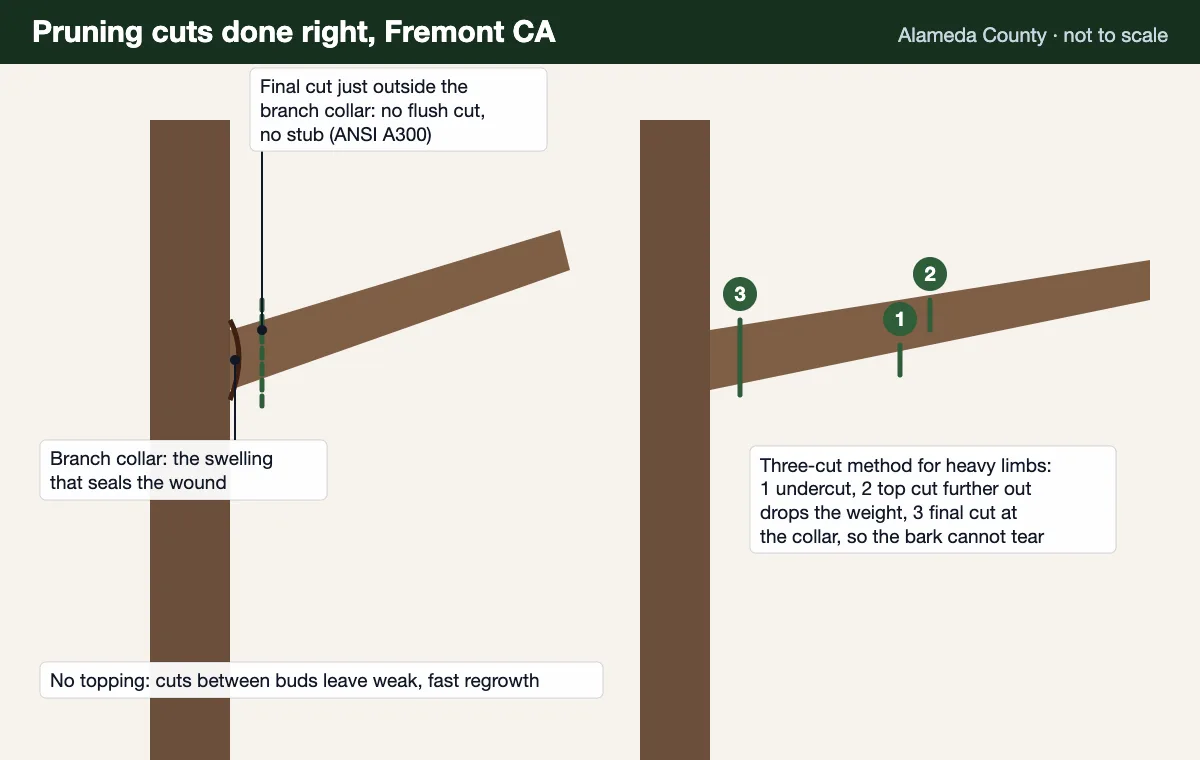
Yes. FMC 18.215.030 defines damage to include topping, which it describes as cutting the main leader, and defines cutting to include pruning and trimming. That means aggressive pruning of a protected tree can put you inside the ordinance even if the tree is still standing when the crew leaves.
Are fruit trees exempt from the Fremont tree ordinance?
Commercial fruit and nut species are exempt, with two named exceptions: black walnut and olive are not exempt. Container trees are also exempt, as is work a public utility performs and an emergency situation where a City official has determined that an emergency exists.
Does my whole back garden fall under the small lot exemption?
Only if the lot is 10,000 square feet or less, zoned R-1 or a single family detached planned district, and the tree stands behind the forward most face of the front of the principal building. A tree in the front garden of an exempt lot is still regulated, and the exemption never covers a landmark tree or a mitigation tree.
What is a drip line and why does the City care about it?
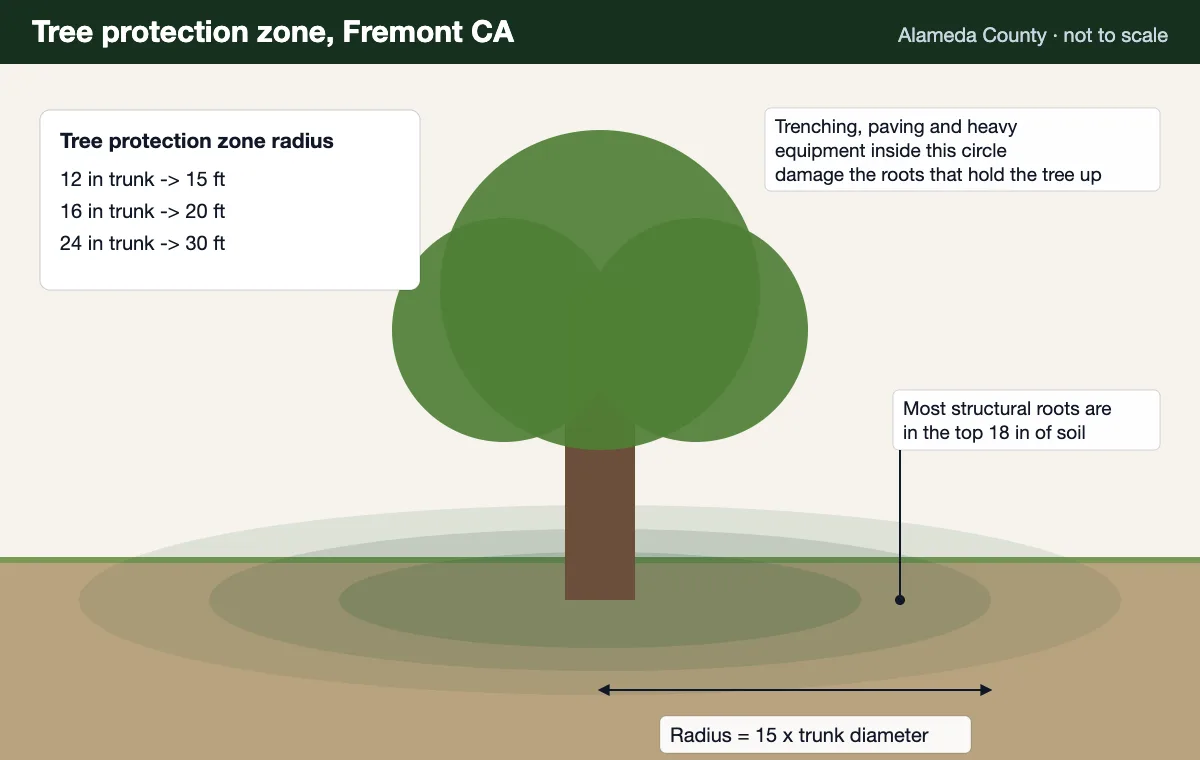
Fremont defines the minimum drip line as a circle with a radius 15 times the trunk diameter at breast height, which means a 20 inch oak carries a 25 foot protection radius. Grading, trenching, paving or stockpiling inside that circle is what kills most protected trees on Fremont construction sites, and it is why the ordinance regulates activity around a tree and not only the act of cutting it down.
Who can sign the arborist report the City asks for?
FMC 18.215.030 defines an arborist as a person with at least three years of arboricultural practice who is ISA certified and in good standing. A general tree crew without that credential can do the work, but cannot author the report the City relies on to make its findings.
How long does a Fremont tree removal permit take?
Timelines depend on whether the City requires an arborist report and whether the tree is tied to a development approval, so ask Planning for a current turnaround when you file. Build permit time into your schedule for any tree that is dying or hazardous rather than assuming an emergency exemption will cover you, because the emergency exemption requires a City official to determine that an emergency exists.
Related Pages
Not sure whether your tree is protected?
Send the address and a photo of the trunk for a free estimate. Find out in writing whether FMC 18.215 applies before a single hour of work is quoted.
- Free written estimate, no obligation
- Check whether your tree is protected before work starts
- Ask any crew for its CSLB license and certificate of insurance
- Mark storm damage as urgent in your request