Tree trimming and pruning in Fremont, CA
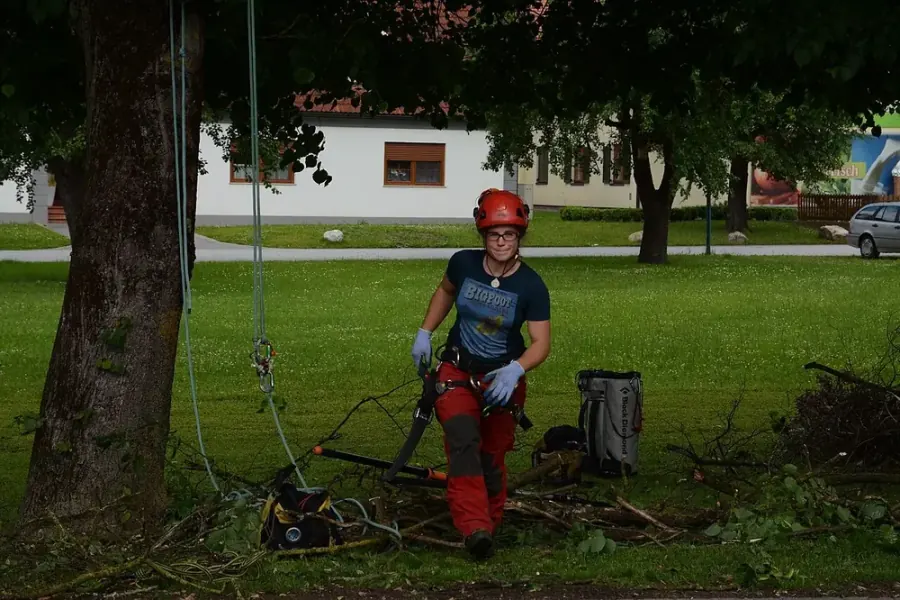
The four kinds of pruning, and which one you actually need
Almost every residential pruning job in Fremont is one of four things: crown cleaning, crown thinning, crown raising, or crown reduction. Naming which one you want is the difference between a good job and an argument. Contractors who quote "trim the tree" without specifying are leaving themselves room, and you have no way to judge the result.
Crown cleaning
Removing dead, dying, diseased and broken branches. The safest prune there is, because nothing living comes off. This is the default maintenance prune and often the only one a healthy tree needs.
Crown thinning
Selectively removing interior branches to reduce density and wind loading while keeping the tree's size and shape. Done badly it becomes lion tailing, stripping interior growth and leaving weight at the ends of limbs.
Crown raising
Removing lower limbs to create clearance beneath. Over a driveway, a path, a roofline, or to break ladder fuel continuity on a fire exposed lot. The most common pruning request in Fremont.
Crown reduction
Shortening height or spread by cutting back to suitable lateral branches. The most technically demanding of the four, because a reduction cut made to the wrong point is topping under another name.
If you are not sure which one applies, describe the problem rather than the solution. "The limb over the garage worries me in storms" says more than "thin it out," and it usually turns out to be a weight reduction on one limb rather than work on the whole tree.
Why no one should top your tree, and why Fremont agrees
Topping makes a tree more dangerous, not less, and Fremont writes that into its municipal code in two separate chapters. FMC 18.215.030 defines damage to a protected tree to include topping, described as cutting the main leader. FMC 12.30.060(b) prohibits topping a street tree entirely absent written city manager authorisation on clear evidence of extraordinary circumstances.
The mechanism is straightforward. Cutting the leader leaves a large wound the tree cannot compartmentalise properly, so decay enters. The tree responds by pushing vigorous shoots from latent buds just below the cut, and those shoots are attached only to the outer layers of wood rather than anchored into the stem. Within a few years you have a tree with a decaying central wound and a crown full of fast grown, badly attached limbs.
Fremont takes 82 percent of its annual rainfall between November and March. Saturated soil plus winter wind is exactly the loading case that breaks poorly attached limbs. A topped tree does not fail in the calm of the summer it was topped. It fails in the third or fourth February afterwards, over whatever is underneath it.
If a tree genuinely is too large for its position, the honest options are a properly executed crown reduction, staged over more than one visit if it is substantial, or removal and replanting with a species that suits the space. Topping is not a third option, it is a deferral with interest.
Pruning on this site follows ISA Tree Pruning Guidelines, which is also the standard Fremont Municipal Code 12.30.060(b) requires on street trees. The International Society of Arboriculture publishes the guidelines and the certification register at isa-arbor.com, where you can also verify that a crew claiming ISA certification actually holds it. For species-level guidance on timing and pest pressure in this region, the UC Statewide IPM Program Pest Notes are the authority California arborists actually work from.
When to prune in Fremont's climate
For most Fremont trees the best pruning window is late spring through the dry summer, because wounds close fastest during active growth and the June through September period delivers effectively no rain to move pathogens. Fremont's June to September rainfall totals about a third of an inch across all four months, with a July normal of zero.
The species specific picture on a Fremont property:
- Coast live oak and other oaks. Prune in dry conditions. Avoid wounding during wet weather. Combine any pruning visit with a look at the lower trunk for the bleeding cankers associated with Sudden Oak Death.
- Eucalyptus. Fast growing, heavy, and prone to limb failure. Wants regular weight management rather than occasional heavy intervention.
- Deciduous ornamentals. Structural pruning is easiest to judge in winter dormancy when the architecture is visible, though Fremont winters are the wet season so timing is a trade off.
- Fruit trees. Their own calendar depending on species and whether you are pruning for structure or for crop.
- Palms. Different discipline entirely. See palm work.
One more timing rule that overrides all of the above: a broken limb hanging over something you care about gets dealt with now, not in the right season. See emergency tree service.
What ISA standard pruning actually means in practice
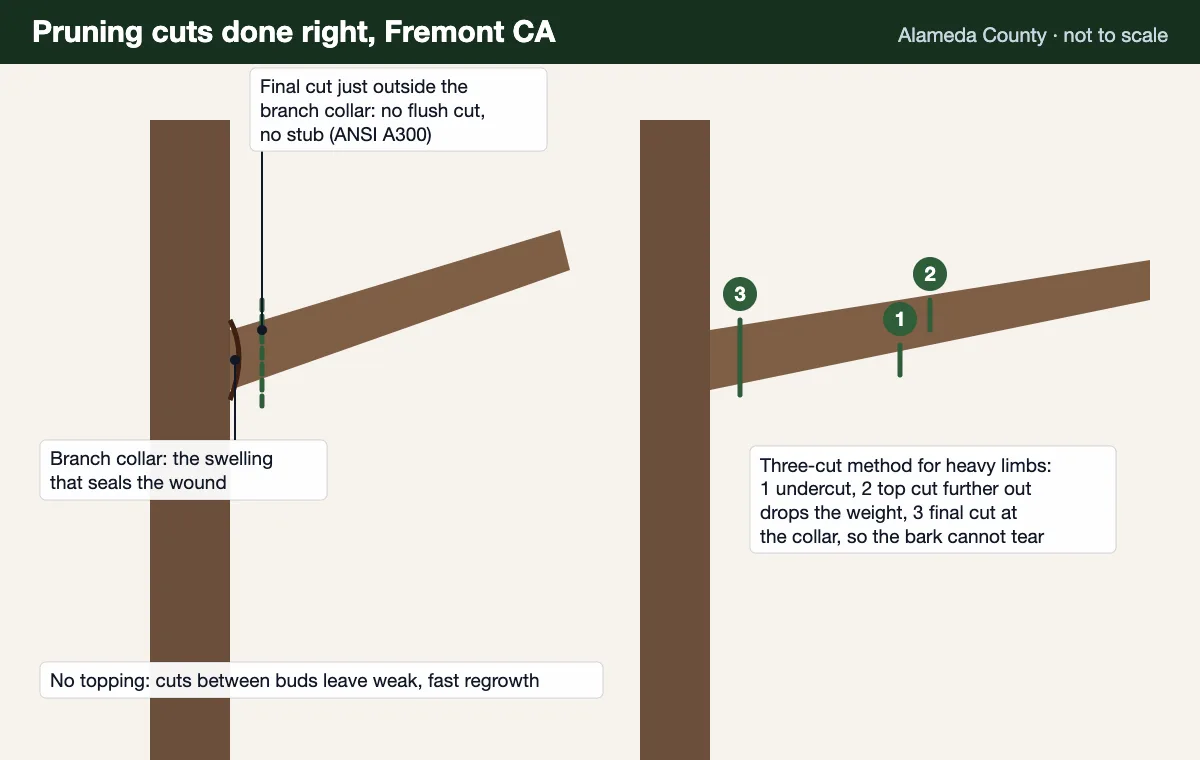
It means cuts are made just outside the branch collar so the tree can seal the wound, large limbs are taken with a three cut technique so the bark does not tear, and no more than a modest proportion of live crown is removed in a season. Fremont references the ISA Tree Pruning Guidelines directly in FMC 12.30.060(b) for street trees, which is unusually specific for a municipal code and tells you the standard is not a marketing claim.
The failures you can spot yourself after a bad job:
- Flush cuts. Cut hard against the trunk, removing the branch collar. The tree cannot compartmentalise, and decay walks straight into the stem.
- Stub cuts. Cut too far out, leaving a dead length that never seals and becomes a decay column.
- Torn bark below a large removal, from cutting in one pass without undercutting first.
- Lion tailing. Interior growth stripped out, leaving tufts of foliage at the branch tips. It looks tidy and it moves all the weight to the end of the lever arm.
- Topping cuts through the leader or through large diameter wood with no lateral to take over.
Skip wound dressing on cuts. Research has not supported it for decades, and sealing a wound can trap moisture against decaying wood. A correctly placed cut on a healthy tree seals itself.
What tree trimming costs in Fremont
Budget roughly $300 to $900 for a typical established residential tree in Fremont, with small ornamentals under 30 feet well below that and mature specimens over 60 feet running past $1,000. Height, access, species, how long since the last prune, and what happens to the debris are what move the number.
For the published baselines: Fixr puts the national tree trimming average at $450 with a range of $175 to $750, broken down as $75 to $300 for small trees at 10 to 20 feet, $150 to $450 at 20 to 30 feet, $150 to $800 at 30 to 50 feet, and $300 to $1,800 at 50 to 100 feet. LawnStarter puts the national average at $430 to $640 per tree, with under 30 feet at $85 to $415, 30 to 60 feet at $215 to $790, and over 60 feet at $475 to $1,835.
LawnStarter's own California city figure puts San Diego trimming at $478 to $710 against a national $430 to $640, roughly eleven percent higher. Bay Area labour and insurance costs run above San Diego, so treat national averages as a floor rather than an estimate. Fixr also puts a certified arborist's hourly rate at $87 to $116, against $50 to $80 for a general tree trimmer.
Full breakdown with the drivers on the Fremont tree trimming cost page.
How a Fremont pruning job runs
Six steps. The first three happen before anyone climbs, and they are what determines whether the result is what you wanted.
- 1
Define the objective before defining the cuts
Good pruning starts with why, not where. Clearance from a roof, deadwood removal for safety, weight reduction on an over extended limb, and light into a garden are four different objectives producing four different prune types. Agree the objective in writing first because it is the only way to judge afterwards whether the job was done.
- 2
Assess species, condition and timing
Species drives timing. Coast live oak has a preferred pruning window and a real risk from wounding during wet conditions, while a fast growing eucalyptus or a fruitless mulberry has very different tolerances. Check the tree's vigour and any existing decay before deciding how much can come off in one visit.
- 3
Check the tree against Fremont's ordinances
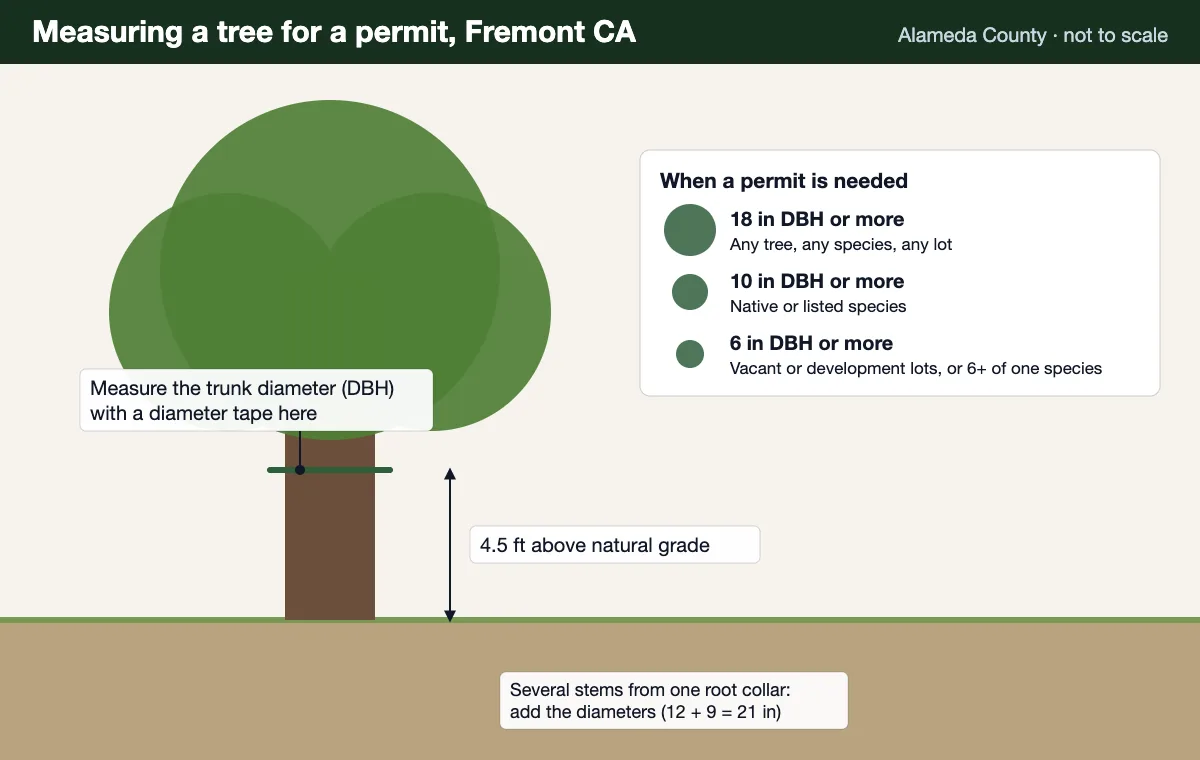
FMC 18.215.030 defines damage to include topping and defines cutting to include pruning and trimming, so a protected tree can be unlawfully damaged while still standing. If the tree is in the public right of way it falls under FMC 12.30 instead, which requires a certified arborist and a street tree permit even for pruning.
- 4
Set up and protect the ground
The crew tarps or boards anything below the work zone, sets a drop area, and confirms rigging points. On a typical Fremont lot with a fence line a few feet from the trunk and a neighbour's glasshouse on the other side, this is a real part of the job rather than a formality.
- 5
Make the cuts to ISA standard
Cuts are made just outside the branch collar, not flush to the trunk and not leaving stubs, so the tree can compartmentalise the wound. Large limbs are removed with a three cut technique to prevent bark tearing. No more than a modest proportion of live crown comes off in a single season on an established tree.
- 6
Clear, chip and walk the site
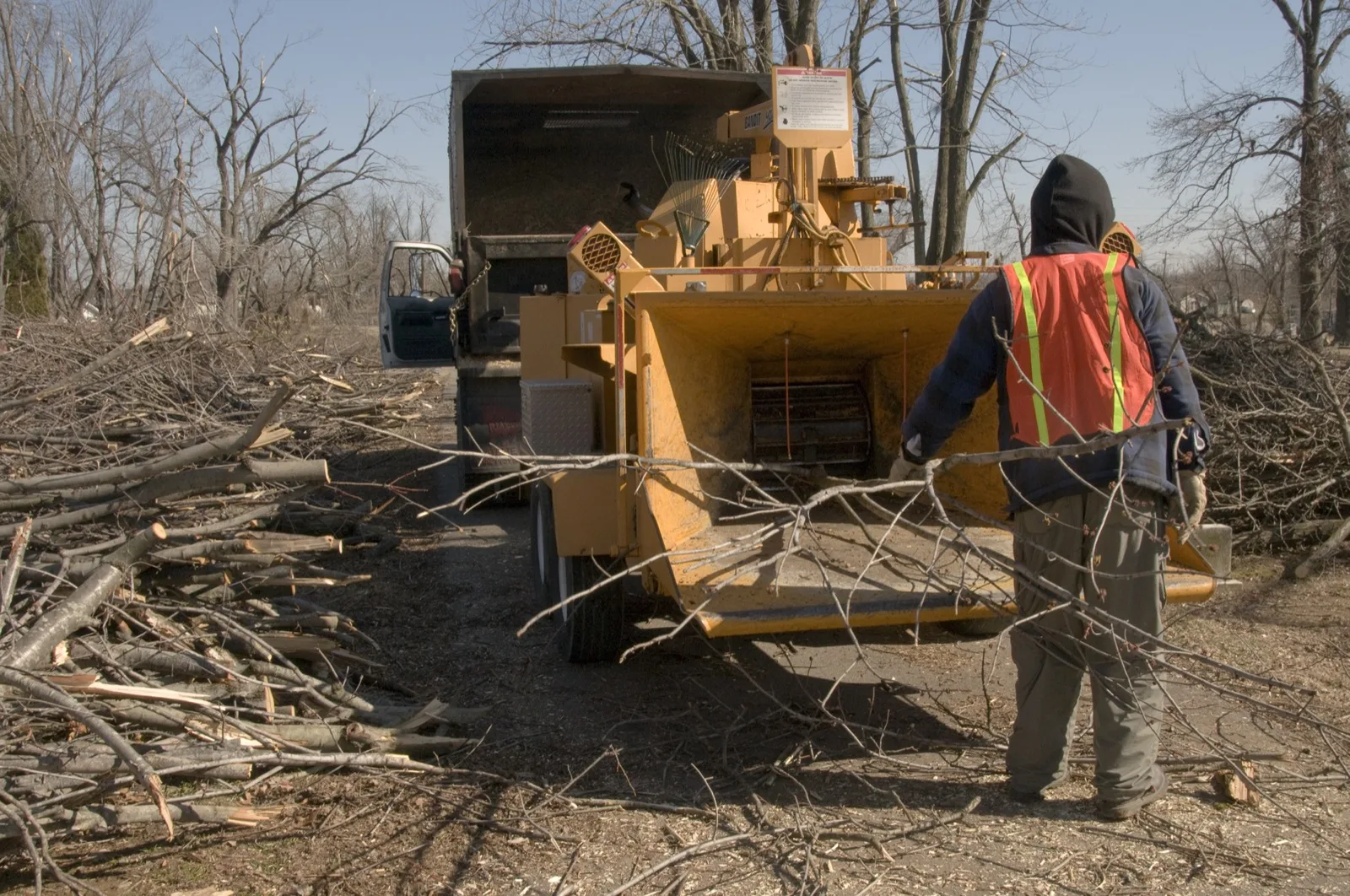
Brush is chipped and removed, rounds are hauled or stacked as agreed, and the work area is raked and blown. Then walk the site against the written objective so there is no ambiguity about what was done and why.
Tree trimming questions
What is the best time of year to trim trees in California?
Late spring through summer is the general window for most Fremont trees, because pruning wounds close fastest during active growth and the four effectively rainless months from June to September keep pathogen pressure low. The important exception is that heavy structural pruning of stressed trees is better avoided in the hottest part of summer, and oaks in particular should not be pruned during wet conditions when pathogen movement is easiest.
How much does tree trimming cost in Fremont CA?
Expect roughly $300 to $900 for a typical established residential tree in the Fremont area, with small trees under 30 feet toward the lower end and large mature specimens over 60 feet running well past $1,000. Fixr puts the national average at $450 with a $175 to $750 range, and LawnStarter puts it at $430 to $640 per tree, but published California city figures run above national and Bay Area labour runs above the rest of the state.
Do I need a permit to trim a tree in Fremont?
For a private tree on your own lot, routine pruning does not require a permit, but FMC 18.215.030 defines damage to include topping and defines cutting to include pruning and trimming, so aggressive work on a protected tree can bring you inside the ordinance. For a tree in the public right of way, FMC 12.30.050 requires both a street tree permit and a certified arborist for anything beyond clearing low branches under 2 inches in diameter.
Why should I never let anyone top my tree?
Topping cuts the main leader, leaving large wounds the tree cannot compartmentalise and forcing weak, fast growing regrowth from latent buds. Those new shoots are poorly attached and fail in exactly the winter wind events Fremont gets every year, so a topped tree is a more hazardous tree within a few seasons, not a safer one. Fremont writes this into the code: FMC 18.215.030 defines damage to include topping, and FMC 12.30.060(b) prohibits topping street trees outright.
What is the difference between crown thinning, raising and reduction?
Crown thinning selectively removes interior branches to reduce density while keeping the tree's shape and size. Crown raising removes lower limbs to create clearance beneath, over a driveway, a path or a roof. Crown reduction shortens the overall height or spread by cutting back to suitable lateral branches, and it is the most demanding of the three because done badly it becomes topping.
How much of a tree can safely be removed in one pruning?
Keep live crown removal modest on an established tree, generally well under a quarter of the living canopy in a single season, and less than that on a mature or stressed specimen. Leaves are how a tree feeds itself, so removing too much at once forces it to draw on stored reserves at the exact moment it needs them, which is how well intentioned pruning starts a decline.
When should coast live oak be pruned in Fremont?
Prune coast live oak during dry conditions and avoid wounding it when the weather is wet, because moisture is how the pathogens that affect oaks move. Fremont's dry window from roughly June through September, when rainfall is effectively zero, is the low risk period. Combine pruning with an inspection of the lower trunk for the bleeding cankers associated with Sudden Oak Death.
Will trimming fix a leaning tree?
Usually not, and a lean that has changed recently is a structural question rather than a pruning one. Weight reduction on the leaning side can reduce loading on a compromised root plate, but if the soil is heaving on the opposite side of the trunk the tree is failing and needs assessment for removal. Fremont's saturated winter soils are what convert a long standing lean into a failure.
Does pruning help with fire clearance?
Yes, crown raising and structure clearance pruning are the core tree actions for defensible space on a Fremont hillside lot. The highest value work is getting limbs off the roof and away from walls, and breaking the vertical ladder fuel continuity from shrubs into the canopy. See the defensible space clearing page for how that work is scoped.
How often should trees be trimmed in Fremont?
Most established residential trees benefit from attention every three to five years rather than annually, with young trees benefiting from lighter structural pruning more often to set good architecture early. Fruit trees and fast growing species like eucalyptus are the exceptions and need shorter intervals. Annual hard pruning of a mature shade tree is usually a sign that the wrong species was planted in the wrong place.
Can branches hanging over my neighbor's fence be trimmed?
If the trunk is on your land the tree is yours under California Civil Code 833 and you may prune it, but if the trunk straddles the line it is owned in common under Civil Code 834 and significant work should be agreed first. If it is your neighbour's tree overhanging your property, you may generally cut back to the line but not in a way that damages or kills the tree. See the California neighbour tree law page before anyone cuts.
Should cleanup be included?
Yes. Brush is chipped and removed, rounds are hauled away or stacked on site as agreed in the written scope, and the work area is raked and blown before the crew leaves. What happens to the debris is written into the estimate rather than left to be sorted out on the day, because that is where most disputes about tree work actually start.
Related Pages
Get a written pruning scope, not a vague quote
Describe what is bothering you about the tree and send a photo from two angles for a free estimate. Get the prune type, the objective and the cost in writing before anyone climbs.
- Free written estimate, no obligation
- Check whether your tree is protected before work starts
- Ask any crew for its CSLB license and certificate of insurance
- Mark storm damage as urgent in your request