Protected trees in Fremont, CA
How Fremont decides that a tree is protected
Fremont protects trees by measurement and species, not by designation, so a tree becomes protected the day it crosses a size threshold without anyone notifying the owner. That is the most important structural fact about Chapter 18.215 and it is why so many Fremont homeowners are surprised by it. There is no register to check and no letter in the post. The oak that was fine to prune at 8 inches is a regulated tree at 10.
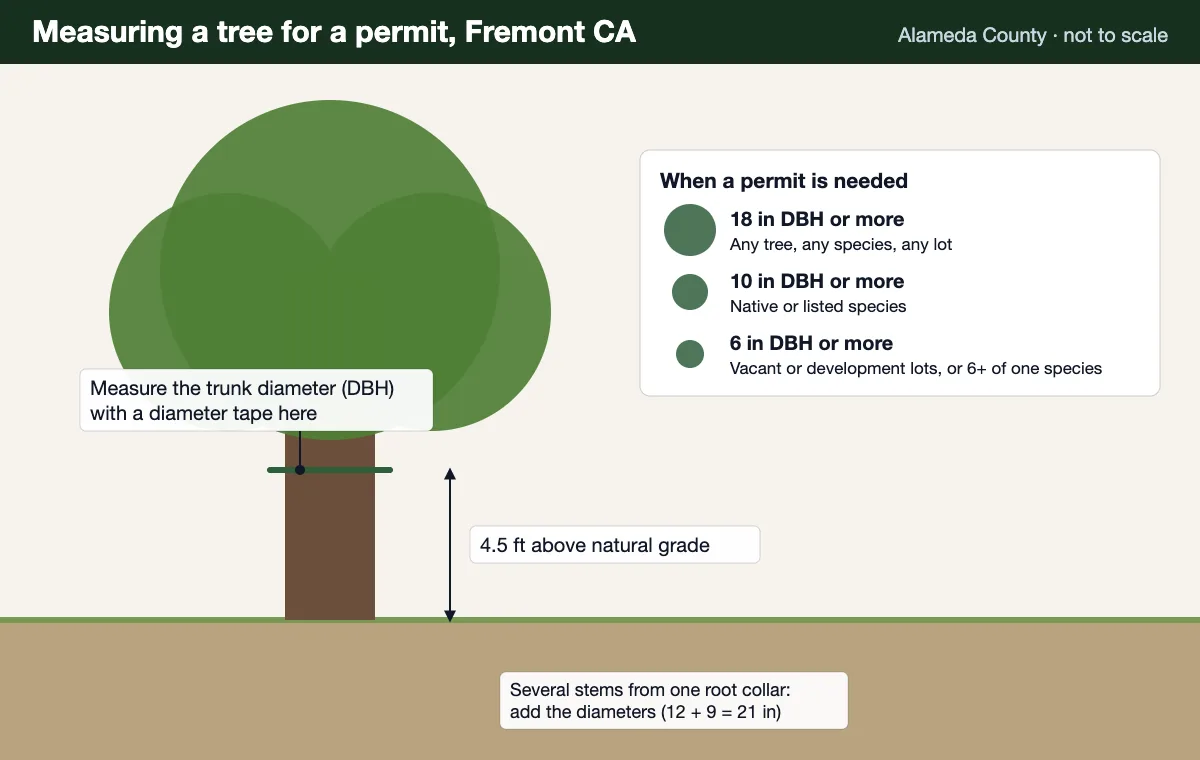
The seven triggers in FMC 18.215.050(a), condensed:
- 18 inches DBH or more, any species, any lot.
- 10 inches DBH or more for a native tree or a tree of exceptional adaptability.
- 6 inches DBH or more on a vacant or underdeveloped lot.
- 6 inches DBH or more on a developed lot with a pending or contemplated development application.
- 6 inches DBH or more where the tree is one of six or more of the same species on a single lot.
- Any tree required by the City as mitigation for an earlier removal.
- Any tree planted or retained as a condition of a development approval.
Notice that three of the seven use a 6 inch threshold. Fremont tightens the rule sharply the moment development enters the picture, because that is when the canopy is actually at risk. A 6 inch tree is roughly wrist to forearm thickness. On a lot with a live planning application, effectively every tree on the parcel is regulated.
The two species lists that lower the threshold
Eight natives and five trees of exceptional adaptability are protected from 10 inches DBH instead of 18, and between them they cover most of the mature trees on an established Fremont lot.
Native trees (18.215.030)
- Oak
- Redwood
- Buckeye
- Madrone
- Sycamore
- Big leaf maple
- Red bud
- Bay
Exceptional adaptability
- Fremont cottonwood
- California pepper
- European olive
- Black walnut
- Deodar cedar
Two of these lists interact with the fruit and nut exemption in a way worth knowing. Commercial fruit and nut species are exempt from the ordinance, but black walnut and olive are specifically excluded from that exemption. An olive that produces fruit is still a protected tree at 10 inches.
Bay is also on the native list, which creates a genuine tension in Fremont. California bay laurel is the main reservoir host for the pathogen behind Sudden Oak Death, so removing bays near a valued oak is a legitimate disease management action. The bay is protected too, which means that management decision goes through the permit process rather than around it.
The drip line rule is where most violations actually happen
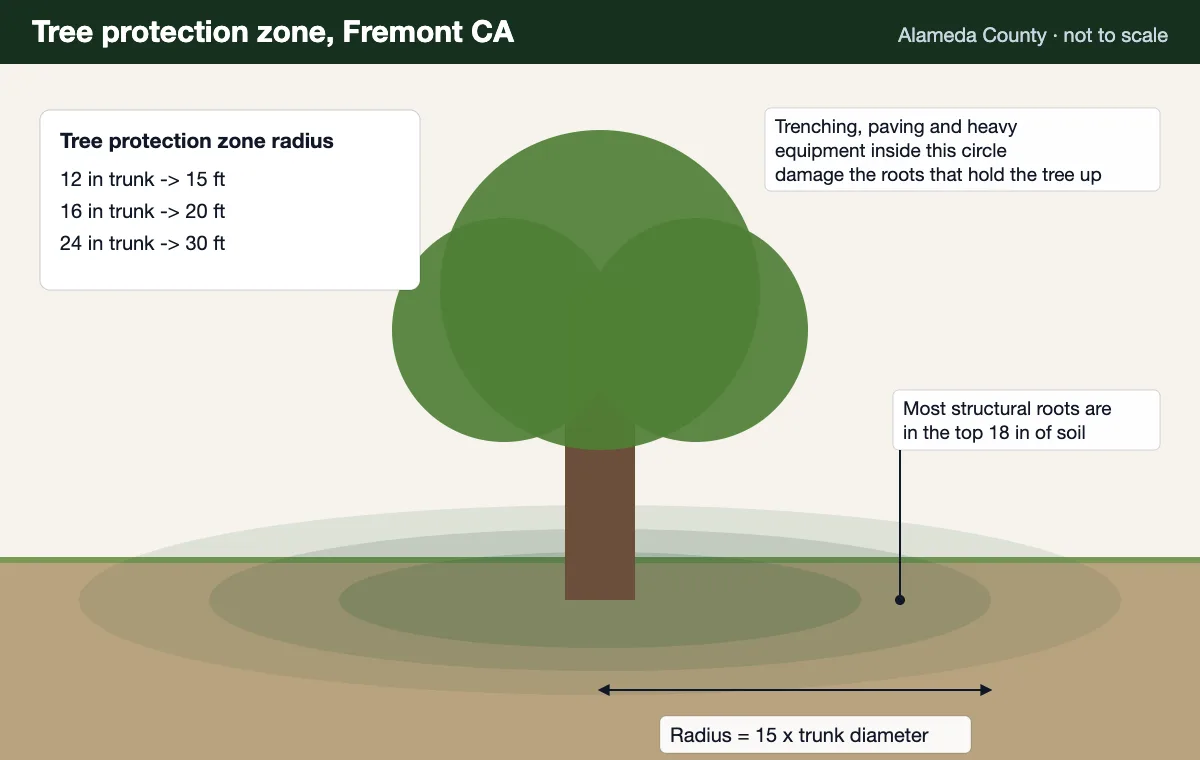
Fremont sets a minimum drip line at a circle with a radius of 15 times the trunk's diameter at breast height, which puts a 20 inch oak inside a 25 foot protected radius. The ordinance regulates activity in that zone, not just the act of cutting the tree down, because that is where a protected tree is realistically killed.
Radius in inches equals DBH in inches multiplied by 15. Divide by 12 for feet. A 12 inch trunk gives a 15 foot radius, a 16 inch trunk gives 20 feet, a 24 inch trunk gives 30 feet. Multi trunk trees use the summed diameter, so they generate a much larger circle than their appearance suggests.
Inside that circle, the things that kill trees are trenching for utilities, cutting grade for a patio or driveway, compacting soil with repeated equipment passes, and paving. None of them look like tree work. A coast live oak that has had a third of its root plate severed for a foundation trench will often hold on for two or three seasons and then decline all at once, by which point the contractor is long gone and the liability sits with the owner.
If you are planning a hardscape, an addition or a utility run anywhere near a protected tree in Fremont, have the drip line mapped before the design is finalised rather than after. It is cheaper to move a trench three feet on paper than to appraise a dead oak.
Mitigation planting creates permanently protected trees
A tree planted as required mitigation for an earlier removal is protected permanently, at any size, with no exemption available. FMC 18.215.050(a) lists mitigation trees as their own trigger, separate from the size thresholds, and no exemption in 18.215.050(c) reaches them.
This matters when you buy a Fremont property. If a previous owner removed a protected tree and planted replacements as a permit condition, those replacements came with the house. A three inch replacement oak in the side yard looks like a landscape shrub and is legally a protected tree. The same goes for any tree that a development approval required be planted or retained.
When a removal is quoted on a property with young, evenly spaced trees of a native species, the permit history should be checked before pricing. It is a five minute question that occasionally saves a customer from an appraisal claim.
What happens if a protected tree comes down without a permit
Fremont values the lost tree using the current Guide for Plant Appraisal from the Council of Tree and Landscape Appraisers, calculated by the city landscape architect under FMC 18.215.090(d). This is a professional appraisal standard used in litigation and insurance, and it produces numbers based on trunk cross sectional area, species rating, condition and site contribution.
Because value scales with the square of trunk diameter, the appraisal on a large mature specimen is not proportional to the removal cost. This is the mechanism behind headline penalties for illegal pruning across the Bay Area, and it is the reason a legitimate Fremont contractor will insist on resolving the permit question before quoting rather than after.
The ordinance also requires the issued permit to be posted on the lot and prominently visible from the street while the work happens, under FMC 18.215.040(a). If a crew arrives at a neighbouring property and starts cutting a mature tree with nothing posted, that is the signal that something has been skipped.
For the full permit walkthrough including the application steps, see do I need a tree removal permit in Fremont.
Protected tree questions
What is a protected tree in Fremont?
A protected tree in Fremont is any tree that meets one of the seven conditions in Fremont Municipal Code 18.215.050(a). The broadest is size: any tree 18 inches or more in diameter at breast height is protected regardless of species, and any native tree or tree of exceptional adaptability is protected from 10 inches. Fremont does not maintain a per tree registry, so protection is determined by measuring the tree rather than by looking a property up on a list.
Which trees are native under the Fremont ordinance?
FMC 18.215.030 names oak, redwood, buckeye, madrone, sycamore, big leaf maple, red bud and bay as native trees. All eight are protected from 10 inches DBH rather than 18. Coast live oak and California bay laurel are the two you are most likely to have on a Fremont lot, and both are on the list.
What is a tree of exceptional adaptability in Fremont?
Fremont classifies Fremont cottonwood, California pepper, European olive, black walnut and Deodar cedar as trees of exceptional adaptability, and protects them from 10 inches DBH just like natives. These are non native species the City considers well suited to local conditions and worth keeping in the canopy.
Does the ordinance protect the roots as well as the trunk?
Yes, through the drip line. FMC 18.215.030 sets a minimum drip line as a circle with a radius of 15 times the trunk diameter at breast height, so a 20 inch trunk carries a 25 foot protected radius. Trenching, grading, paving or stockpiling material inside that circle is regulated activity, which is why most protected tree violations on Fremont sites are construction damage rather than removal.
Is topping a protected tree illegal in Fremont?
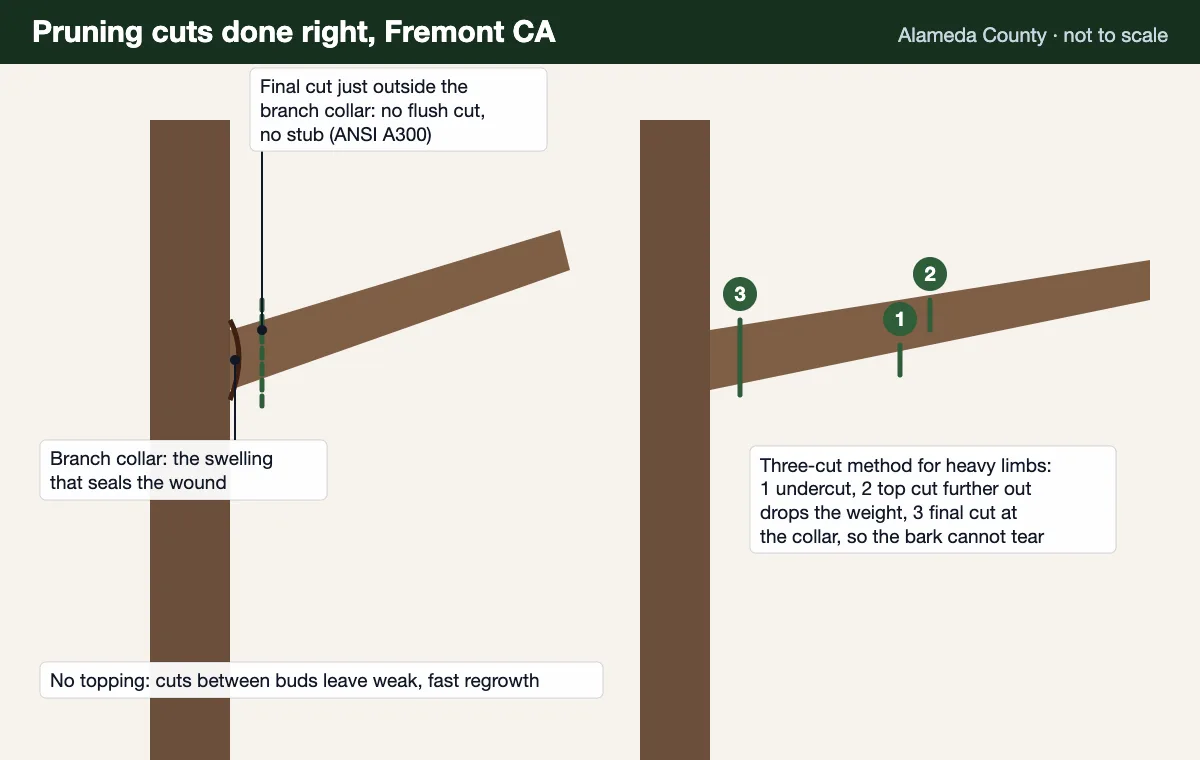
Topping a protected tree without authorisation puts you inside the ordinance. FMC 18.215.030 defines damage to include topping, described in the code as cutting the main leader, and defines cutting to include pruning and trimming. A protected tree can therefore be unlawfully damaged while still standing.
What is the penalty for removing a protected tree in Fremont?
Fremont calculates the value of a protected tree using the latest Guide for Plant Appraisal published by the Council of Tree and Landscape Appraisers, with the calculation performed by the city landscape architect under FMC 18.215.090(d). Appraised value scales with trunk diameter, species and condition, so the figure for a mature specimen oak is far larger than what the removal would have cost.
Do I have to plant a replacement tree?
Where the City approves removal of a protected tree it can require mitigation planting as a condition of the permit, and those replacement trees are then permanently protected themselves. FMC 18.215.050(a) lists a tree required by the City as mitigation as its own standalone permit trigger, with no size threshold and no exemption available.
Can I remove a protected tree that is dead or hazardous?
Not on your own judgement. The emergency exemption in FMC 18.215.050(c) applies where a City official has determined that an emergency exists, which means the determination has to come from the City rather than from you or your contractor. A dead but stable tree is a permit application, not an emergency.
Who is allowed to write the arborist report the City asks for?
FMC 18.215.030 defines an arborist as a person with at least three years of arboricultural practice who is ISA certified and in good standing. A crew can be perfectly competent to do the physical work without meeting that definition, so ask specifically whether the person signing your report holds a current ISA credential.
Does the small lot exemption cover a protected oak?
It can, provided the lot is developed, 10,000 square feet or smaller, zoned R-1 or a single family detached planned district, and the oak stands behind the forward most face of the front of the principal building. The exemption is about lot and position, not about species, but it never applies to a landmark tree or a mitigation tree.
How do I find out if a tree on my Fremont property is protected?
Measure the trunk at 4.5 feet above grade, add the diameters together if it has multiple trunks, and identify the species. If the result is 18 inches or more for anything, or 10 inches or more for a tree on the native or exceptional adaptability lists, treat it as protected and contact the Fremont Planning Division before any work is scheduled.
When was Fremont's tree preservation ordinance adopted?
Chapter 18.215 was adopted by Ordinance 2481 section 1 on 23 July 2002, and has since been amended by Ordinances 11-2010, 16-2015, 01-2017 and 09-2020. Because it has been amended four times, confirm the current codified text with the City rather than relying on an older summary.
Related Pages
Find out whether your tree is protected
Send the address and a photo of the trunk for a free estimate. Find out in writing which side of FMC 18.215 your tree falls on before any work is priced.
- Free written estimate, no obligation
- Check whether your tree is protected before work starts
- Ask any crew for its CSLB license and certificate of insurance
- Mark storm damage as urgent in your request